Google just dropped Nano Banana 2 Lite, a new Gemini image generation tier built for one thing: shipping lots of “good enough” images fast. It’s live in AI Studio and through the Gemini API, and it’s a very clear signal that Google thinks the next creative advantage is not a single perfect render. It is iteration density.
Creators already know the pattern: you do not need one masterpiece, you need 50 drafts, then 10 refinements, then 3 winners. Nano Banana 2 Lite is designed to make that loop feel less like a budget meeting and more like a normal workday.
What shipped
Nano Banana 2 Lite sits in Google’s Gemini image lineup as the speed plus cost lane. In the Gemini API, it’s referenced as gemini-3.1-flash-lite-image, a model optimized for high throughput image generation and editing rather than premium, portfolio grade fidelity.
Translation: this isn’t “make the internet prettier.” It’s “make the content pipeline move.”
And the pipeline part matters. Google is not only giving you a web UI playground. It’s shipping the model with API access from day one, which is what turns a fun generator into something you can operationalize: batch jobs, automated creative testing, dynamic personalization, and internal tools that crank out variants on demand.
Speed and pricing
Two numbers are doing most of the talking:
- Latency: early hands on posts commonly describe “a few seconds” per image, with around about 4 seconds often cited for a standard 1K generation under typical conditions.
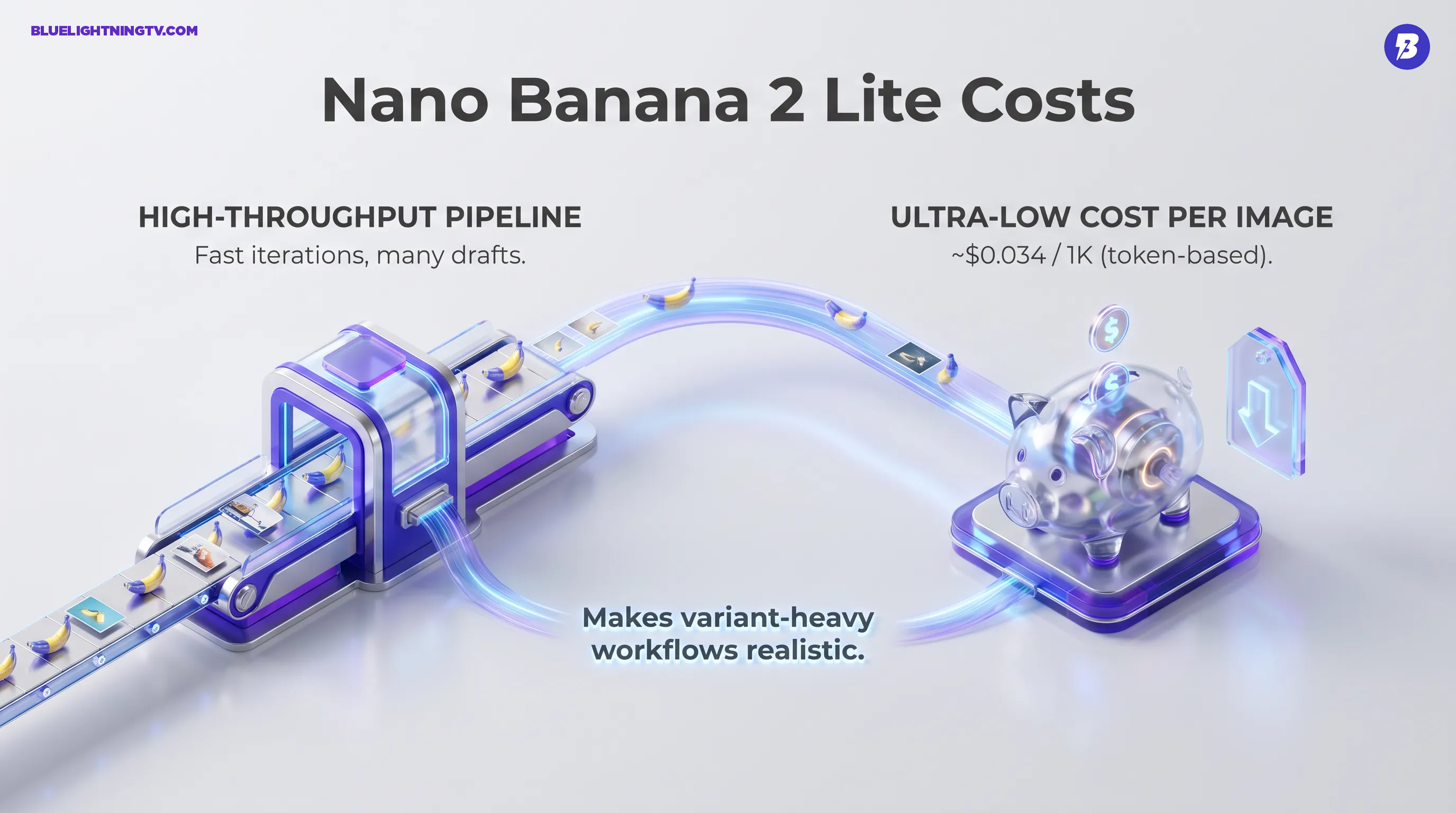
- Cost: Google’s published pricing is the reference point. The clean source is the official Gemini API pricing page. As of 2026-07-02, Google’s pricing math for image output tokens works out to roughly $0.0336 per 1K output image, which you will often see rounded to $0.034 per image.
This is where the internet gets sloppy. People repeat “$0.034” without explaining the unit. In Google’s pricing language, the effective number comes from image output tokenization for a 1K output image. The creator level takeaway is simpler: the per image cost is low enough that you stop rationing attempts.
| What matters | Nano Banana 2 Lite aims for | Why creators feel it |
|---|---|---|
| Turnaround time | Fast, batch friendly generations | More tries per hour, less waiting |
| Unit cost | Priced for volume | Variant heavy workflows become realistic |
| Access | AI Studio plus Gemini API | Prototype to deploy without tool switching |
Who this is for
Nano Banana 2 Lite is not targeted at the single hero image crowd. It’s built for people whose job is basically making the internet look fresh at scale.
Performance marketing teams
Ad creative is a volume game now. Hooks change weekly, formats change daily, and creative fatigue is just another way to say you ran out of variants. A fast, cheap model makes it normal to generate:
- dozens of background concepts for the same product
- multiple lifestyle scenes for the same offer
- new visual metaphors for the same message
The win is not “this one output is incredible.” The win is you get to selection faster, and you do it without burning premium model budget on drafts you will never ship.
Ecommerce and catalog ops
SKU heavy brands do not just need images, they need consistent imagery systems. That often means generating a lot of drafts for review, then routing only finalists to higher fidelity models or human retouch.
Nano Banana 2 Lite fits the front half of that funnel: the “make 200 options so merchandising can argue productively” half.
Creators shipping daily
If you’re on the post every day treadmill, you already know the bottleneck is not inspiration. It is packaging. Thumbnails, covers, post backgrounds, story visuals, quick meme formats, and endless “make it in this style but not exactly that style.”
A model that produces usable drafts quickly does not replace taste. It buys time for taste by deleting the waiting.
Teams building automations
The most interesting users may be the ones you never see on the timeline: product teams and automation leads embedding generation into systems.
- personalized on site banners
- dynamic email visuals by segment
- auto generated category art for marketplaces
- mass creative testing pipelines
For these teams, API first is not a feature. It is the entire point.
Quality tradeoffs
Speed and cost come with predictable constraints. Nano Banana 2 Lite is positioned for draft velocity, not pixel peeping glory.
Teams should expect:
- Small text remains risky: if your asset needs crisp typography, expect retries or a different model.
- Fine detail may soften: textures, micro geometry, and edge perfect products are not the priority.
- Good enough is the target: the output is meant to move the workflow forward, not end it.
Best mental model: Nano Banana 2 Lite is a sketchpad that happens to be callable by API.
How teams actually use it
The most realistic deployment pattern is not “switch everything to Lite.” It’s routing.
- Lite for exploration: generate lots of options cheaply.
- Stronger model for finalists: re run top concepts on a higher fidelity tier when details matter.
- Human polish where needed: apply actual design judgment on the handful of assets that will carry the brand.
| Pipeline step | Best fit | Reason |
|---|---|---|
| Idea flooding | Nano Banana 2 Lite | Fast and cheap variants |
| Detail refinement | Higher fidelity model | Better text, detail, consistency |
| Final approval | Human review | Brand risk management |
For developers, Google’s model documentation is the place to confirm what’s callable and what the model IDs actually are: Gemini 3.1 Flash Lite Image.
Why this matters now
This launch is not really about better images. It’s about new creative tempo. When images are fast and cheap, teams stop treating generation like an event and start treating it like a primitive, something you do continuously as part of production.
If you want adjacent context on how Google is thinking about iteration speed in video too, this companion post is useful: Gemini Omni Flash Speeds Up AI Video Iteration.
Bottom line: Nano Banana 2 Lite is Google betting that creators will choose the model that gives them the most shots on goal. Not because it is the prettiest, but because it makes “generate, pick, refine, ship” feel like a normal workflow instead of a luxury.