

OpenAI is previewing Ultrafast mode for GPT‑5.6 Sol inside select API deployments, pushing generation speeds up to about 750 output tokens per second in some deployments. The clearest reference point is OpenAI’s announcement page for the model family and the Sol tier: Previewing GPT‑5.6 Sol.
This is not a new model drop. It is an infrastructure shift: same GPT‑5.6 Sol weights, new service tier. The practical impact is bigger than a benchmark flex. When output speed crosses human conversation pace, it stops feeling like a system you submit requests to and starts feeling like something you can jam with.
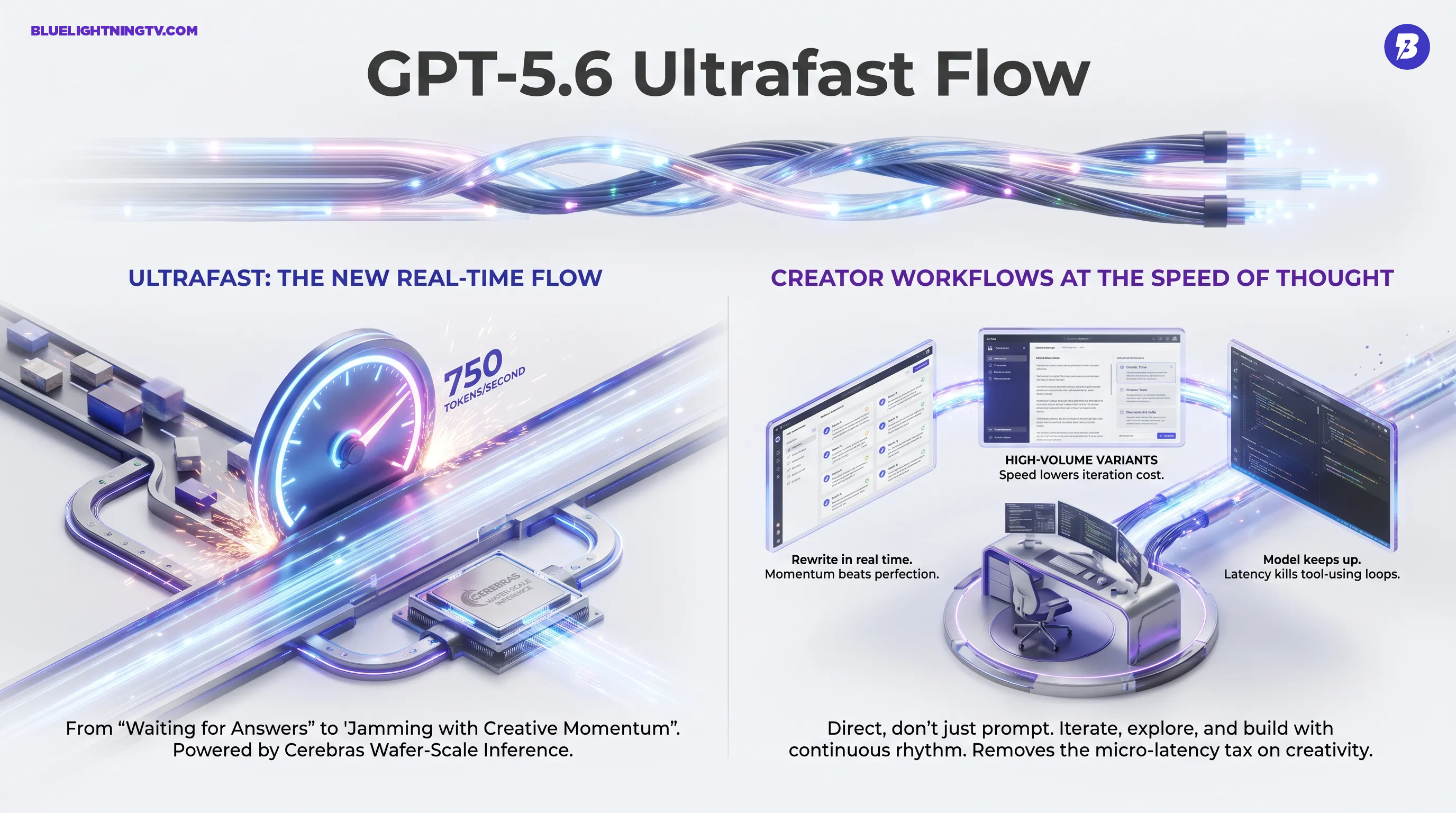
The quiet shift here is not faster answers. It is the removal of micro latency that breaks creative momentum.
Why speed suddenly matters
Quality has been the headline since the first big LLM wave. But in production, especially creator production, latency is the tax you pay on every iteration.
If you are generating:
- hook variants for paid social
- alt lines for a scene
- product copy permutations
- a live brainstorm in a client call
- code edits while you are already in flow
Each extra second is friction. It is losing the thread, re explaining context, and re reading your own prompt like you are debugging your past self.
Ultrafast is OpenAI basically saying: speed is a feature, not a footnote.
What Ultrafast is
OpenAI describes Ultrafast as a high speed generation tier for GPT‑5.6 Sol in the API, currently in preview. Early references put it at up to about 14x the standard tier in some deployments.
The important part: developers do not need to learn a new model. You are not rethinking prompts because the architecture changed. You are deciding whether the request needs the fast lane.
What stays the same
Ultrafast is not positioned as a separate intelligence tier. It is still Sol, the top capability lane in the GPT‑5.6 family.
If you want the broader context on where Sol sits alongside Terra and Luna, OpenAI’s overview is here: GPT‑5.6 overview.
For the COEY take on the lineup and how it maps to real workflows, see: GPT‑5.6 Sol, Terra, Luna: The Think Control.
What changes
Throughput and latency. At up to about 750 output tokens per second in some deployments, a 1,500 token draft can land in roughly two seconds of pure generation time, plus overhead. That is fast enough to feel close to synchronous in a meeting, stream updates without awkward pauses, and support high volume pipelines with less queueing pain.
| What you need | Ultrafast helps when | Why it matters |
|---|---|---|
| Live iteration | You are rewriting in real time | Momentum beats perfection |
| High volume variants | You need 50 to 500 outputs | Speed lowers iteration cost |
| Interactive agents | The model must keep up | Latency kills tool loops |
Cerebras under the hood
OpenAI’s speed leap is closely tied to Cerebras inference infrastructure, built around wafer scale systems designed to reduce bottlenecks that show up in decoder heavy generation.
Cerebras has been pushing instant speed inference publicly, including performance notes for common open models on their infrastructure: Introducing Cerebras Inference.
For COEY readers, the hardware is interesting, but the workflow effect is the headline:
- less stop start prompting
- fewer let’s wait for it to finish moments
- more continuous creative direction, like editing a doc live
When the model is fast enough, your job shifts from prompting to directing.
What gets better for creators
Ultrafast changes the shape of a work session. Not because it makes the model smarter, but because it makes your time feel less chopped up.
Copy and campaign work
The win is not write me an ad. It is multi variant exploration without drag:
- 30 hooks, pick 5
- 10 CTA styles, pick 2
- rewrite into 4 creator voices, keep the one that does not sound like it is trying to win a LinkedIn award
Speed makes it easier to treat the model like a creative slot machine you can steer.
Script and storyboard workflows
If you write scripts, Ultrafast makes it more viable to:
- test different cold opens rapidly
- swap tone on the fly
- generate scene alts while you are already looking at the outline
This is where speed starts to feel like a production multiplier, not a convenience.
Coding and tool building
Agent style workflows are latency sensitive. If you are using GPT‑5.6 Sol for tool calls, structured outputs, or multi step tasks, speed keeps loops tight.
If you are building on OpenAI’s newer API surface, their migration guidance is here: Migrate to the Responses API.
COEY context on why OpenAI is pushing this endpoint for production workflows: GPT‑5.6 Sol Boost: Responses API Advantage.
What to watch (no drama)
Ultrafast sounds like a free lunch. It is not. It is a new set of tradeoffs, and the teams that win will treat it that way.
1) Cost vs speed tradeoffs
OpenAI has historically priced faster lanes at a premium. For this preview, pricing can vary by contract and deployment, so do not assume a single public price card covers every account.
In creator ops terms: Ultrafast probably is not what you use for every batch job. It is what you use when:
- humans are waiting
- you are in a live session
- you are iterating fast enough that latency becomes the bottleneck
2) Capacity and rollout reality
OpenAI is calling this a preview, and preview usually means:
- access is limited
- capacity is managed
- performance can vary by region or routing
If you run a studio pipeline, assume uneven availability at first.
3) The hidden win: creative rhythm
When generation is slow, people over plan prompts and under experiment. When generation is fast, experimentation goes up, and selection skill becomes the differentiator.
Ultrafast does not magically create better ideas. It creates more opportunities for you to find them.
What this signals next
OpenAI pushing Ultrafast on GPT‑5.6 Sol signals that the next competitive frontier is not just intelligence. It is interaction quality:
- speed
- responsiveness
- does this feel collaborative
- does this keep up with your brain
Ultrafast will not replace taste or strategy. But it does remove one of the most annoying barriers to working that way: the pause.