
OpenAI is telling developers to stop treating GPT-5.6 “Sol” like a chat widget and start running it like an agent. The push is centered on the Responses API, which OpenAI positions as the modern endpoint for GPT-5.x workflows and, crucially, the one that can unlock better multi-turn performance through features like retained reasoning and context compaction. The official migration guidance is here: Migrate to the Responses API.
The practical headline: OpenAI is claiming you can get dramatically better automation behavior without changing model weights, just by changing how you call the model. If you are building content pipelines, agents, or tool-using workflows, this is less new model drop and more you have been leaving performance on the table.
What actually changed
OpenAI did not announce a new set of weights for this story. Instead, it is nudging teams to adopt a newer execution path with better default plumbing for long-running tasks.
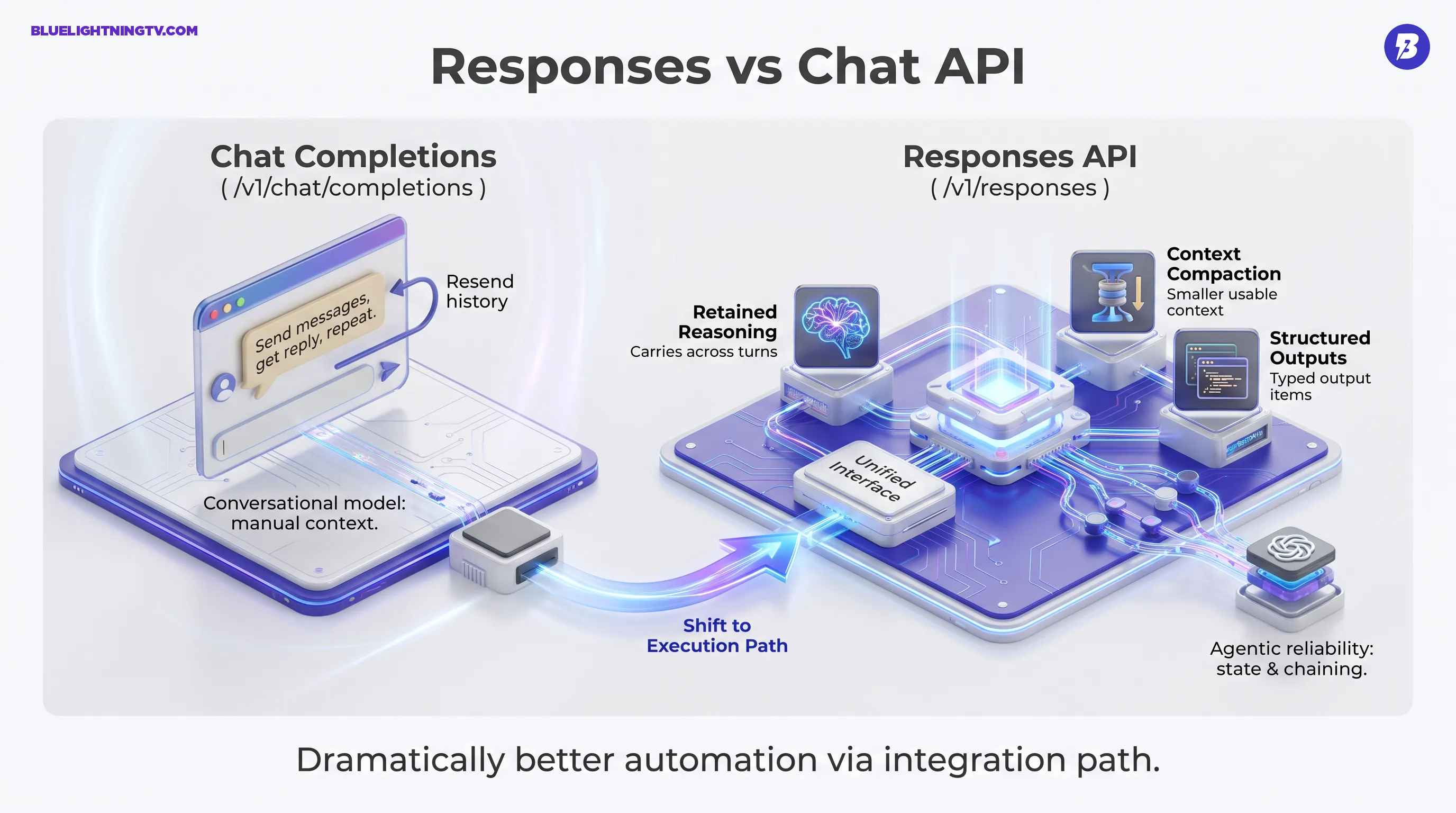
At the center is the shift from Chat Completions (/v1/chat/completions) to Responses (/v1/responses), plus enabling features that make multi-step automation less brittle.
OpenAI’s own docs frame the Responses API as a unified interface for generation plus tool use plus multimodal inputs (where supported), with optional statefulness and a more structured output format. OpenAI Responses migration guide
Chat Completions vs Responses
A lot of creator teams, and plenty of production systems, still use Chat Completions because it is familiar and battle-tested. But it was built around a conversational mental model: send messages, get a reply, repeat. That is fine until you ask the model to behave like an operator that needs to remember what it already tried.
Responses changes three operational realities:
- Input is more flexible (not just a messages array)
- Output is typed (not just assistant said this)
- State can be carried forward without resending your entire history (depending on how you configure storage and chaining)
Here is the fast comparison.
| Topic | Chat Completions | Responses API |
|---|---|---|
| Primary endpoint | /v1/chat/completions |
/v1/responses |
| Conversation state | You resend history | Can chain via previous_response_id |
| Output structure | choices[].message.content |
output_text convenience field plus typed output items |
The two hidden levers
The real reason this matters is not aesthetic API design. It is two mechanics that change how well Sol holds onto a plan mid-flight.
Retained reasoning
OpenAI’s newer agent stack can retain reasoning state across turns, which changes how consistently a model can pursue a multi-step plan instead of re-deriving or drifting. In practice, this shows up as:
- fewer dropped constraints
- less repetition
- more reliable tool loops
Context compaction
Context windows are huge now, but huge context is not the same as usable context. Compaction is the idea that when a thread gets long, the system can compress older context into a smaller representation that preserves what matters and trims the rest.
OpenAI documents compaction as a first-class capability, including guidance for how to compact and keep going in long-running threads. OpenAI compaction guide
This matters in production because just keep adding tokens eventually becomes:
- expensive
- slow
- and weirdly less accurate (because irrelevant details pile up)
If your agent feels smart for five turns and then starts freelancing, that is not AI being moody. That is usually context management failing.
The ARC-AGI-3 spike
OpenAI’s guidance got attention because of a reported benchmark jump on ARC-AGI-3 (an interactive, agent-style eval). The ARC Prize results page for OpenAI GPT-5.6 lists an official baseline on the public set of 13.33%.
Separately, public discussion points to an internal harness change using retained reasoning and context compaction that boosts the same model’s public-set score to roughly 38.3%, without changing model weights. One example of that discussion is here: X thread referencing the 38.3% harness result.
Two important caveats for builders:
- Benchmarks measure setups, not just models. If your harness changes, the same model can behave like a different one.
- This does not automatically mean your app triples in quality. ARC-AGI-3 is a specific kind of multi-step environment. Your mileage depends on how similar your workflow is.
Still, it is a real signal: OpenAI is optimizing Sol’s story around agentic reliability, not just raw response quality.
What this means for creators
If you are a creator, you might read Responses API and think cool, developer stuff. But this lands directly in creator reality because most serious creator workflows are already multi-step systems:
- a script becomes a shot list
- a shot list becomes prompts
- prompts become clips
- clips become selects
- selects become edits
- edits become captions, thumbnails, metadata, cutdowns
- cutdowns become why are we still doing this manually
The failure mode in these pipelines is rarely the model cannot write. It is the model cannot stay on-task across steps.
So if OpenAI’s new default path reduces context loss and token waste, that can translate into:
- fewer re-explain the project moments
- fewer continuity errors across serialized content
- fewer expensive reruns on long threads
- more dependable tool use
If you want the broader COEY context on how OpenAI has been shifting toward automation that actually finishes, see: GPT-5.5 Targets Real Automation for Creators.
What to watch operationally
This is where the hype gets replaced with the boring stuff that actually matters.
Cost and latency patterns
Retained reasoning and compaction can change token dynamics in two directions:
- Lower waste (less repeated restating of context)
- Higher overhead if you crank deep reasoning on everything
Output parsing changes
Responses output is structured differently than Chat Completions. If you have downstream code that assumes a specific shape (choices[0].message.content), migration is not hard, but it is not a copy and paste swap either. OpenAI calls this out directly in the migration guide. Migration guide: output handling changes
Statefulness vs privacy
Responses supports storage and chaining patterns (like previous_response_id), but teams still need to be intentional about what is persisted versus kept stateless, especially in client work.
Bottom line
OpenAI’s message with GPT-5.6 Sol is not look, a smarter model. It is: your integration path is now part of performance. The Responses API is positioned as the endpoint where OpenAI is packing in the agent-friendly features: retained reasoning, compaction, structured outputs, and stateful workflows.
For teams building automation-heavy content systems, the implication is simple: if Sol feels inconsistent in long, multi-step work, it may not be the model. It may be your harness.