
The next phase of AI video trust is not is this fake It is whose fake is this A new system called SAGA Source Attribution of Generative AI Videos pushes provenance detection past binary deepfake spotting into something creators platforms and brands can actually use identifying the likely generator family and model identity behind an AI made clip The project is detailed on the official site including the paper and demos SAGA: Source Attribution of Generative AI Videos.
If that sounds like nerdy forensics it is But it is also a practical upgrade for anyone shipping video at scale especially as AI video stops looking like AI video and starts looking like a normal Tuesday on the internet.
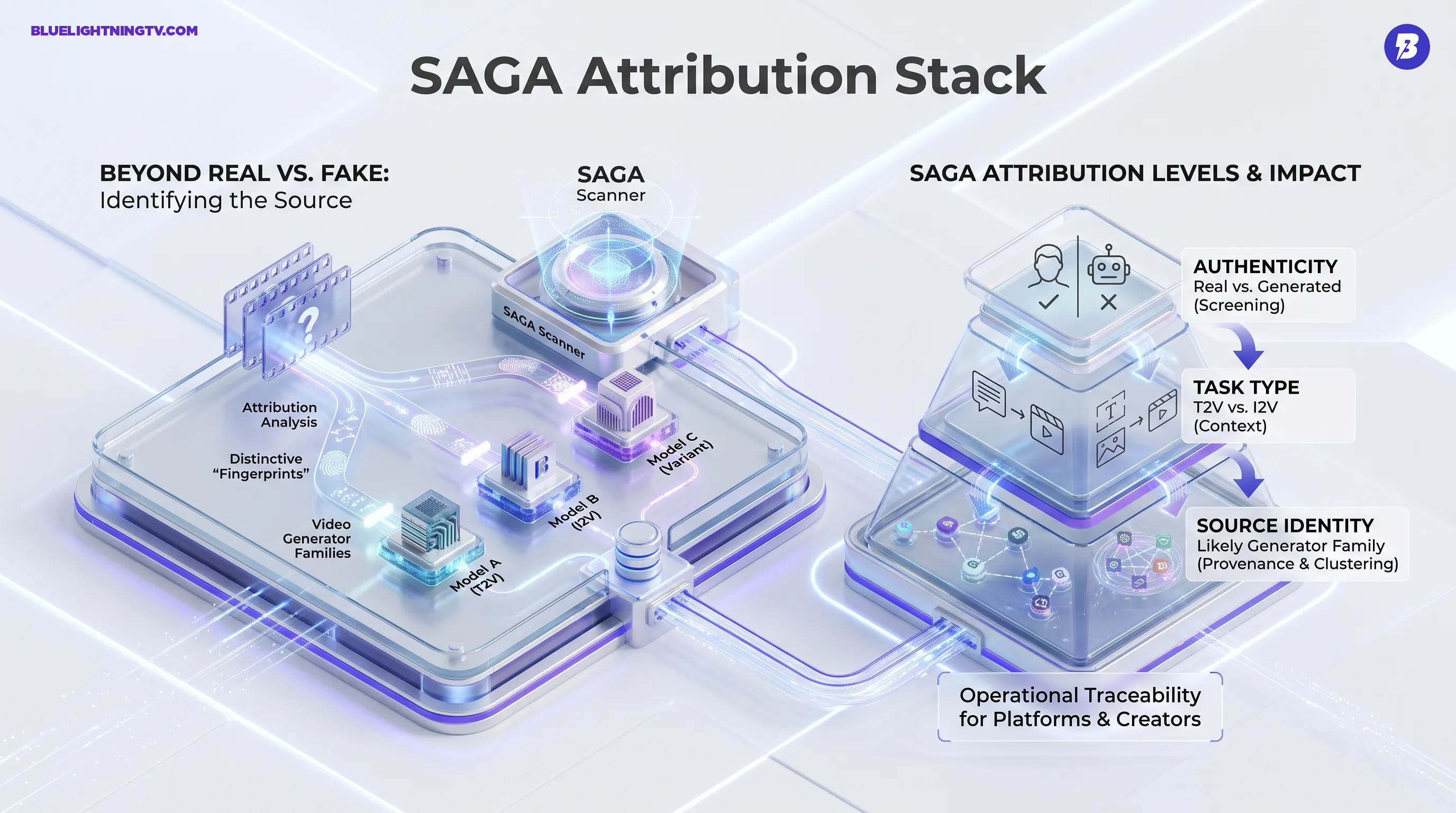
Big shift: Detection is moving from authenticity (real vs generated) to provenance (which model likely produced this), which changes how disputes, takedowns, and brand safety investigations can work.
What SAGA is
SAGA comes out of a research collaboration led by University of California, Riverside researchers, with collaborators from YouTube and Google DeepMind. Instead of treating synthetic video as one big category, SAGA tries to attribute a clip to its likely source generator by learning the subtle, persistent fingerprints different video models leave behind.
This is a key nuance: SAGA is not a watermarking system. It is not embedding anything into the media. It is analyzing the video output itself and asking: do the spatiotemporal artifacts here match what we usually see from generator X?
For creators, the headline is not more moderation. It is that provenance tooling is evolving into something that can support real workflows: verifying vendors, auditing ad deliveries, and resolving we did not make that situations faster.
Beyond real vs fake
Most public-facing AI video detection has lived in the same neighborhood for years: classifiers trained to label content as synthetic based on visual inconsistencies, facial artifacts, motion weirdness, or compression oddities.
SAGA’s claim is that this framing is now insufficient. Because even if a detector is correct that a video is synthetic, it still does not answer the next set of questions that actually matter:
- Which generator likely made it?
- Was it text to video or image to video?
- Is it from a known provider or a fine-tuned variant?
- Can we cluster this clip with other incidents?
SAGA frames attribution as multi-level, not one label. Platforms might need high-level grouping. A brand team might need enough specificity to trace patterns.
How attribution works
SAGA’s core idea is that generative video models do not just create content. They create content in distinctive ways. Those differences show up as patterns across frames, motion, textures, and temporal consistency.
Under the hood, SAGA uses a transformer-based video classifier trained to recognize source-specific cues. The paper also describes interpretability tooling that highlights which parts of a clip the model is using when it makes an attribution call.
SAGA attribution levels
| Level | What it predicts | Why it’s useful |
|---|---|---|
| Authenticity | Real vs generated | Basic screening and triage |
| Task type | T2V vs I2V (and real) | Context on how it was made |
| Source identity | Likely generator or model family (as trained) | Provenance tracing and clustering |
The operational point: attribution is a comparison problem. SAGA learns profiles from known generators, then matches new samples to that learned landscape. As new models ship, attribution systems have to keep updating or they drift into best guess territory.
Why YouTube is involved
YouTube’s involvement is the part creators should not ignore. Not because SAGA is automatically shipping into YouTube tomorrow, but because it signals what platforms care about next: traceable origin rather than just label it.
This lines up with YouTube’s move toward disclosure and transparency around altered or synthetic media. YouTube has a creator-facing disclosure flow for altered or synthetic content, which can show viewers a label and a How this content was made explanation: Understanding How this content was made disclosures.
If you have been watching platform policy evolve, this is the kind of technical substrate that can make those policies more enforceable without relying entirely on self-reporting.
What creators can expect
SAGA is not a creator tool you toggle on in an editor. It is an attribution framework that could show up as infrastructure inside:
- upload pipelines (platform-side checks)
- brand safety tooling (agency-side monitoring)
- verification workflows (publisher or marketplace audits)
Creators will still feel it, just indirectly, because attribution changes what proof looks like when something goes sideways.
If you want more context on how provenance signals are becoming operational, see our coverage of verification tooling in: Google SynthID Detector Now Checks Audio Watermarks.
Limits and evasion
Attribution is not magic, and SAGA is not claiming a perfect naming-and-shaming machine. There are practical constraints that matter for anyone treating this as production-grade signal.
Compression and edits
Video gets mangled in the wild: reposted, re-encoded, screen-recorded, filtered, subtitled, memed. Those transformations can blur or erase the very artifacts attribution systems depend on.
Model churn
Generative video models update constantly. Even within one vendor, versions can change output characteristics enough to require new attribution tuning. The faster the market moves, the more attribution becomes a continuous maintenance job.
Adversarial behavior
If attribution becomes meaningfully useful, assume some actors will try to evade it. That can look like post-processing to wash artifacts, deliberate degradation, or blending multiple sources.
SAGA-style attribution can become a strong signal, but it will not eliminate human review or platform judgment calls.
How it fits provenance trends
SAGA is arriving in a moment when provenance is becoming a product layer, not just a research topic. Google DeepMind has also been pushing watermarking as one complementary route via SynthID, which embeds an imperceptible mark at generation time: SynthID (Google DeepMind).
SAGA and watermarking are different strategies:
- Watermarks help when the content is generated inside an ecosystem that reliably embeds them.
- Attribution helps when you do not control the ecosystem and need to infer origin from the media itself.
For creators, that means the future is likely plural: multiple overlapping provenance signals, none of them perfect, but together more actionable than today’s AI-generated label.
What to watch next
SAGA is currently positioned as research, but it is easy to see the path to real deployment: platform moderation stacks, partner APIs, and brand safety tooling that can attach provenance signals to assets.
The main questions that will determine whether this becomes practical:
- How well attribution holds up under real-world platform compression
- How quickly the attribution library can update as generators evolve
- How platforms present attribution results (confidence and appeal paths matter)
- Whether creators get any visibility when attribution is used operationally
SAGA’s core bet is straightforward: in a world where synthetic video is normal, AI-generated is not enough information. The next operational need is where it came from, and SAGA is a serious attempt to make that traceability possible.