

Google is rolling out Gemini 3.7 Flash in the Gemini API lineup, pitching it as the new workhorse model for people who actually ship: creators, marketing teams, and developers building automations that run all day without burning budget. This is not a flagship flex. It is a throughput play: faster responses, stronger coding, better tool use, and token pricing that is clearly meant to make agent workflows feel less like a science project and more like a default.
If you have been watching Google’s recent cadence, like Computer Use landing inside Flash and Gemini Notebook getting more operational, 3.7 Flash lands in the middle of the strategy: make the fast tier smart enough that it is the model you route most tasks to.
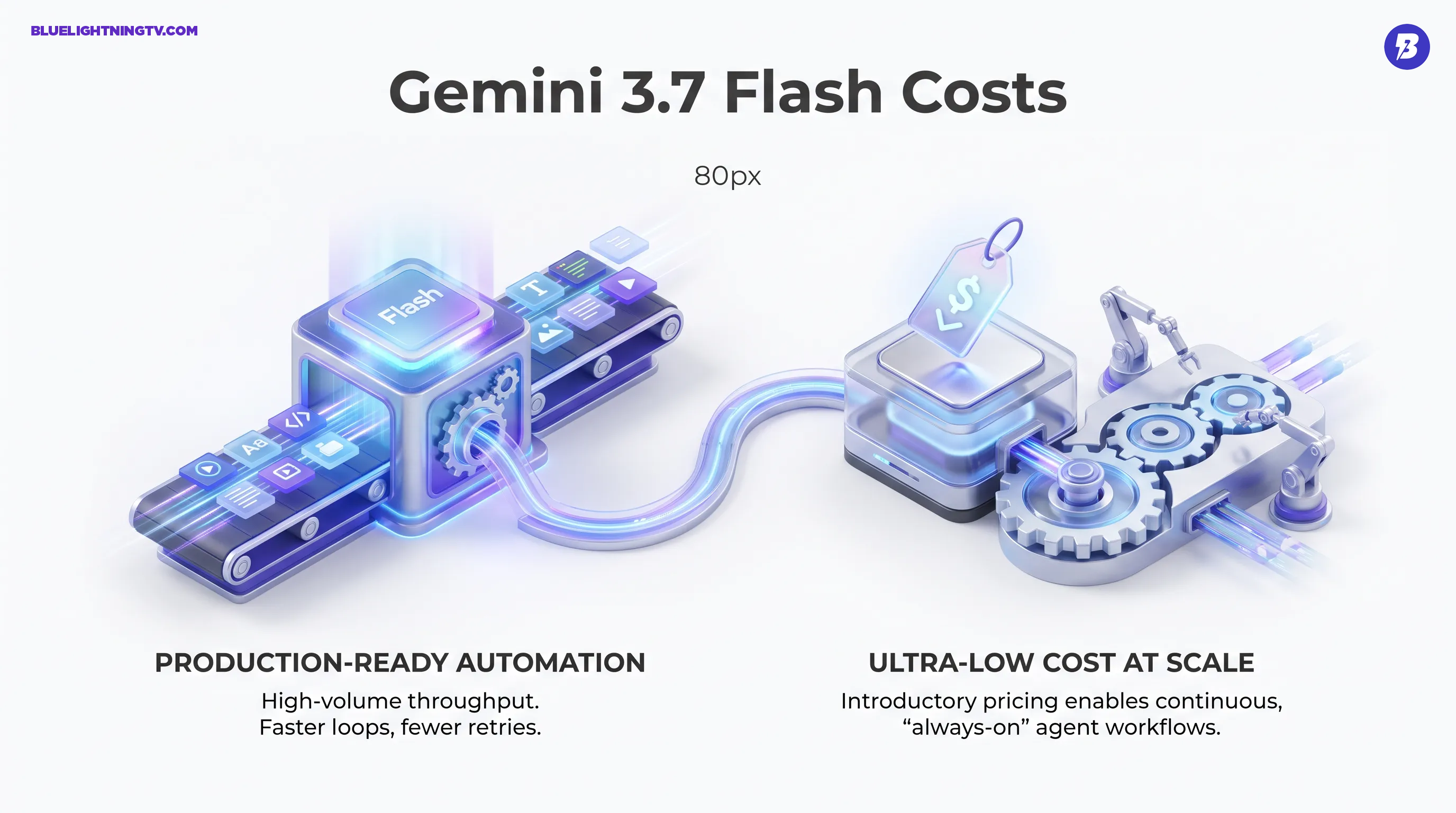
The signal here is not “Google has another model.” It is that the cheap and fast lane is becoming capable enough to run real production systems, not just chat demos.
What actually shipped
Gemini 3.7 Flash is the latest in Google’s Flash line, models optimized for speed, cost, and volume workloads. Google is positioning it for:
- Coding and web dev output that needs less cleanup
- Agent-style instruction following over longer, chained tasks
- Tool use and orchestration (calling functions, parsing outputs, continuing reliably)
- Lower unit economics so teams can run it constantly
It is available through the usual Google surfaces: Gemini API and AI Studio for builders and prototypers, and Vertex AI for enterprise deployment. If your pipeline already routes work through Gemini, 3.7 Flash is designed to be the default do-the-work model while heavier models stay reserved for the few tasks that truly need them.
Why Flash matters now
Creator teams are not struggling because they cannot generate content. They are struggling because content has become an operations problem: variants, localization, templates, deadlines, QA, and can we do this again next week, but faster.
Flash models win when they make iteration cheap enough that you stop rationing attempts. The difference between we can test five variants and we can test fifty is rarely inspiration. It is latency plus cost plus reliability.
Meanwhile, the people running real pipelines are quietly asking a simpler question: which model gives me the most usable output per dollar per hour?
Big workflow upgrades
Better code on first pass
Google’s messaging around 3.7 Flash is heavily coding-forward: fewer broken snippets, stronger UI generation, and better behavior in real ship-a-change scenarios. That matters because a huge chunk of creator automation is code-adjacent:
- templated landing pages
- CMS formatting and structured content transforms
- ad variant generation with strict constraints
- internal tools that wrap prompts in guardrails
The practical win is boring, so it is real: less time debugging the model’s output, fewer retries, and fewer this looked right until we deployed it moments.
Stronger multi-step instruction handling
Most creator workflows are not one prompt. They are a chain: ingest inputs, rewrite, tag, generate variations, map into a schema, and then push into another system. Flash models historically were fast, but could get wobbly when the instruction stack got long or conditional.
3.7 Flash is positioned to handle those longer chains more consistently, which is exactly what you want if you are building:
- campaign repurposing pipelines
- batch localization
- content QA passes (tone, structure, brand rules)
- brief to draft to variants to packaging automations
Cleaner tool use
Google keeps pulling Gemini closer to agent behavior where the model does not just answer. It calls tools, checks results, and continues. For creators, that is where the real leverage is: automations that can fetch data, transform it, and format output for downstream systems.
It is also where things break in production when models get sloppy. Better tool sequencing and state awareness means fewer half-finished runs and less babysitting.
Agents do not fail because they cannot write. They fail because step 7 depends on step 6, and step 6 quietly went off the rails.
Pricing and access
The pricing is one of the loudest parts of this rollout because it is clearly meant to push adoption for high-volume workloads. Google’s official pricing reference for token costs is the Gemini API pricing page, which is where teams should anchor budget math as rates update over time.
Google is offering introductory pricing through December 31, 2026:
| Item | Intro pricing | Why it matters |
|---|---|---|
| Input tokens | $0.75 / 1M | Cheaper ingestion for long prompts and docs |
| Output tokens | $3.75 / 1M | Affordable variant generation at scale |
| Availability | Gemini API, AI Studio, Vertex AI | Prototype fast, then operationalize |
Token pricing is not exciting. But it changes behavior. When output is cheap, creators stop treating generation like a precious event and start treating it like a routine production primitive.
Benchmarks, with caveats
Google’s launch framing leans on coding and agent evaluations, including DeepSWE v1.1, where Gemini 3.7 Flash is reported at 65.3% versus 49.0% for Gemini 3.6 Flash in widely shared launch summaries. The benchmark headline is simple: better first-pass performance on longer-horizon software engineering tasks.
Two pragmatic caveats matter if you are reading benchmark charts like they are gospel:
- Benchmarks do not measure your workflow. They measure a shaped version of a workflow.
- Speed plus reliability beats peak scores when your job is run this 500 times today instead of win a leaderboard.
The useful takeaway is not it won a chart. It is that Google is closing the gap between fast models and serious agent capability, which is the difference between experimenting and deploying.
Who benefits most
Creators shipping at volume
If your output is daily or hourly, you care less about best single response and more about how quickly you can get to three usable options. 3.7 Flash’s value is the tempo: more iterations, more packaging, less waiting.
Marketing and content ops teams
Flash is built for repeatable production: template-based copy, structured content generation, variant testing, and multi-step workflows that tie into campaign systems. Lower cost makes it easier to run these automations continuously instead of only during big launch weeks.
Builders making assistants
If you are building an internal tool, a client-facing helper, or an automation agent that calls APIs and routes outputs, you want predictable latency, stable instruction following, and good enough reasoning without flagship cost.
That is the exact box Flash is trying to own. For related COEY context on how Google is pushing speed and iteration in the Flash tier, see Gemini 3.5 Flash Adds Built-In Computer Use.
What to watch next
The most important question is not whether 3.7 Flash is the best. It is whether it stays stable as teams push it into production: long prompts, strict schemas, tool calls, and real-world mess.
Three practical things to watch as this rolls into more stacks:
- Consistency under load: speed claims only matter at scale
- Tool-call reliability: fewer silent failures, cleaner retries
- Routing patterns: Flash as default, heavier models as escalation
Gemini 3.7 Flash reads like Google doubling down on a simple creator truth: the teams that win are not the ones with the fanciest model. They are the ones with the fastest loop from idea to output, without needing a budget meeting for every iteration.