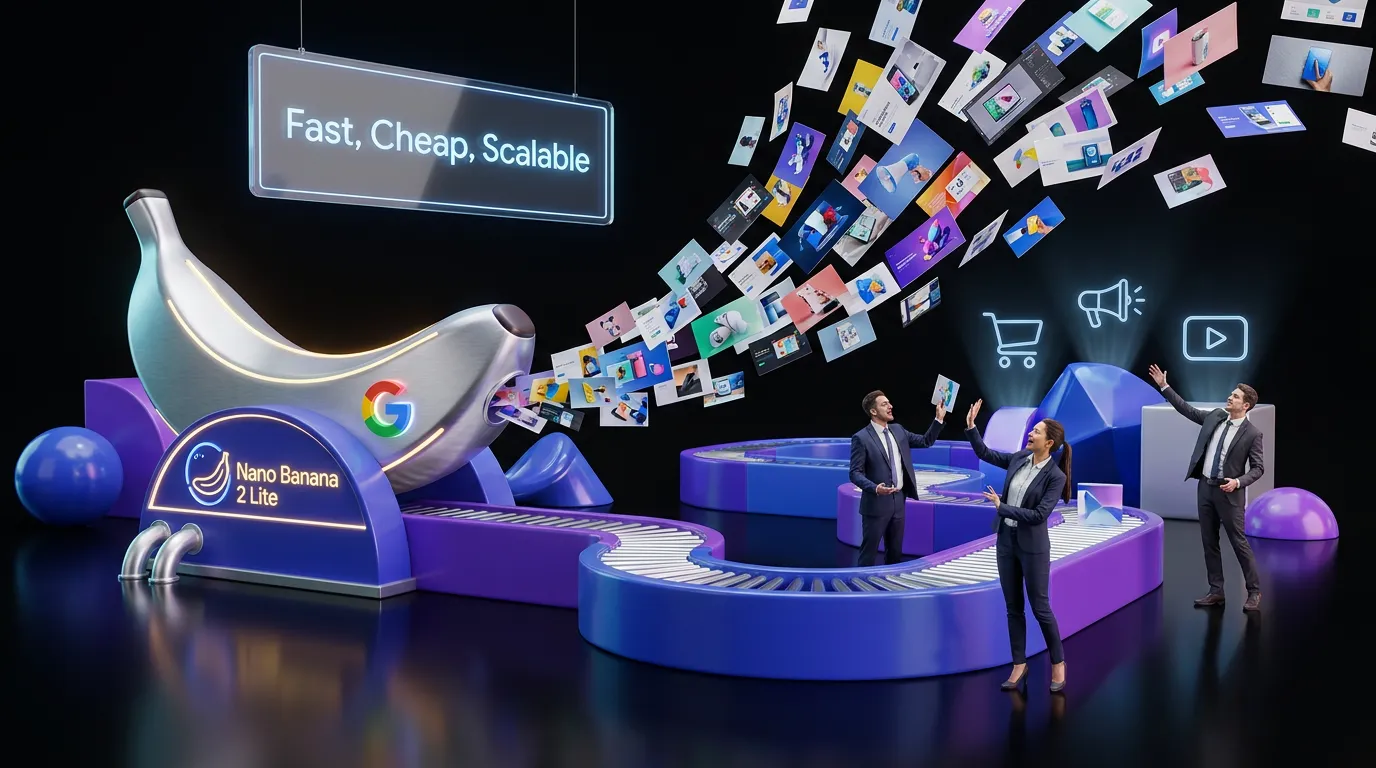
Google just dropped Nano Banana 2 Lite, a new generative image model built for one thing: cranking out a lot of images fast without burning your budget or your patience. It’s live in Google AI Studio and the Gemini API, and it’s the clearest signal yet that Google is treating draft velocity as a first class product feature, not a side effect.
Here’s the important framing: Nano Banana 2 Lite isn’t trying to win the gallery. It’s trying to win the spreadsheet. If your workflow is “generate 200 options, keep 20, ship 5,” this model is designed to make that loop feel normal, maybe even boring.
What shipped
Nano Banana 2 Lite sits in Google’s Gemini image generation lineup as the speed and cost tier. In the Gemini API and documentation, it’s commonly exposed under the model ID gemini-3.1-flash-lite-image, with Nano Banana 2 Lite used as the product name and branding. The story Google is telling is consistent: high throughput image generation for production workflows, not just one off creative play.
Translation: Google is optimizing for more shots on goal, because that’s what content teams actually need when they’re shipping ads, thumbnails, product imagery, and endless variants.
Google positions the model as available across its creator and developer surfaces: AI Studio for quick testing, and the Gemini API for automation and product integration. If you’re building pipelines, that availability is the headline: you can test and deploy without waiting for a separate enterprise only unlock.
Speed and price
The two numbers everyone will repeat are the ones that change behavior:
- Generation time: roughly about 4 seconds per image is a commonly cited launch experience, though real world latency varies with load, region, and prompt complexity.
- Cost: pricing depends on the SKU and output settings you select. The clean way to confirm what you will actually pay is Google’s official pricing documentation: Gemini API pricing.
Even if your exact pricing differs by plan, region, or API tier, the intent is obvious: make image generation cheap enough that teams stop rationing iterations.
| Factor | Nano Banana 2 Lite | What it changes |
|---|---|---|
| Latency | Built for fast turnaround | More iterative loops per hour |
| Unit economics | Priced for volume | More variants per campaign |
| Availability | AI Studio plus Gemini API | Easier to operationalize |
Who it’s for
This release is aimed at the people who make the internet look effortless at scale: performance marketers, e commerce teams, agencies, and anyone building automated creative systems.
Ad variant factories
If you’re generating hundreds of layout adjacent images, backgrounds, product in scene variations, hook specific visuals, Lite is designed to keep up. The real win isn’t a single pretty output. It’s time to selection: how quickly you can get enough options to pick winners.
Thumbnail and social drafts
Creators live in thumbnail roulette. The fastest teams don’t design one. They generate, pick, refine, and ship. A cheap, fast model makes the early draft stage basically unlimited, which is exactly where thumbnails usually stall.
Catalog scale e commerce
SKU heavy brands have a boring problem with expensive consequences: consistent imagery at scale. When generation is quick and cheap, you can produce large batches for internal review, then reserve higher fidelity models, or human retouch, for the final picks.
Personalization systems
When images are inexpensive, personalization becomes less theoretical. You can generate region specific, audience specific, or placement specific visuals without treating every new variant like it needs CFO approval.
Tradeoffs to expect
Speed and cost don’t come free. Google’s own positioning and early hands on chatter both point to a familiar reality: Lite models tend to be best when you’re okay with strong draft rather than pixel perfect hero.
In practical terms, plan for these constraints:
- Small text is still risky: if your image needs tiny, readable typography or dense infographics, assume you’ll need retries or a different model.
- Fine detail can soften: textures, micro elements, and precise product geometry may not hold up the way they do on premium tiers.
- Consistency isn’t guaranteed: for character continuity across a narrative sequence, you’ll still want stronger conditioning workflows or higher end models.
Best mental model: Nano Banana 2 Lite is a sketchpad that happens to be API addressable.
How teams deploy
The deployment story is intentionally straightforward: try it in AI Studio, then wire it into whatever you’ve built through the Gemini API. For builders, the practical advantage is that Google is putting these capabilities in the same ecosystem where teams already run Gemini text, multimodal understanding, and tool based workflows.
For reference, Google’s Gemini API model documentation is the place to sanity check what supports what and to avoid the internet’s favorite hobby: inventing model IDs. Start here: Gemini API models.
Routing becomes the strategy
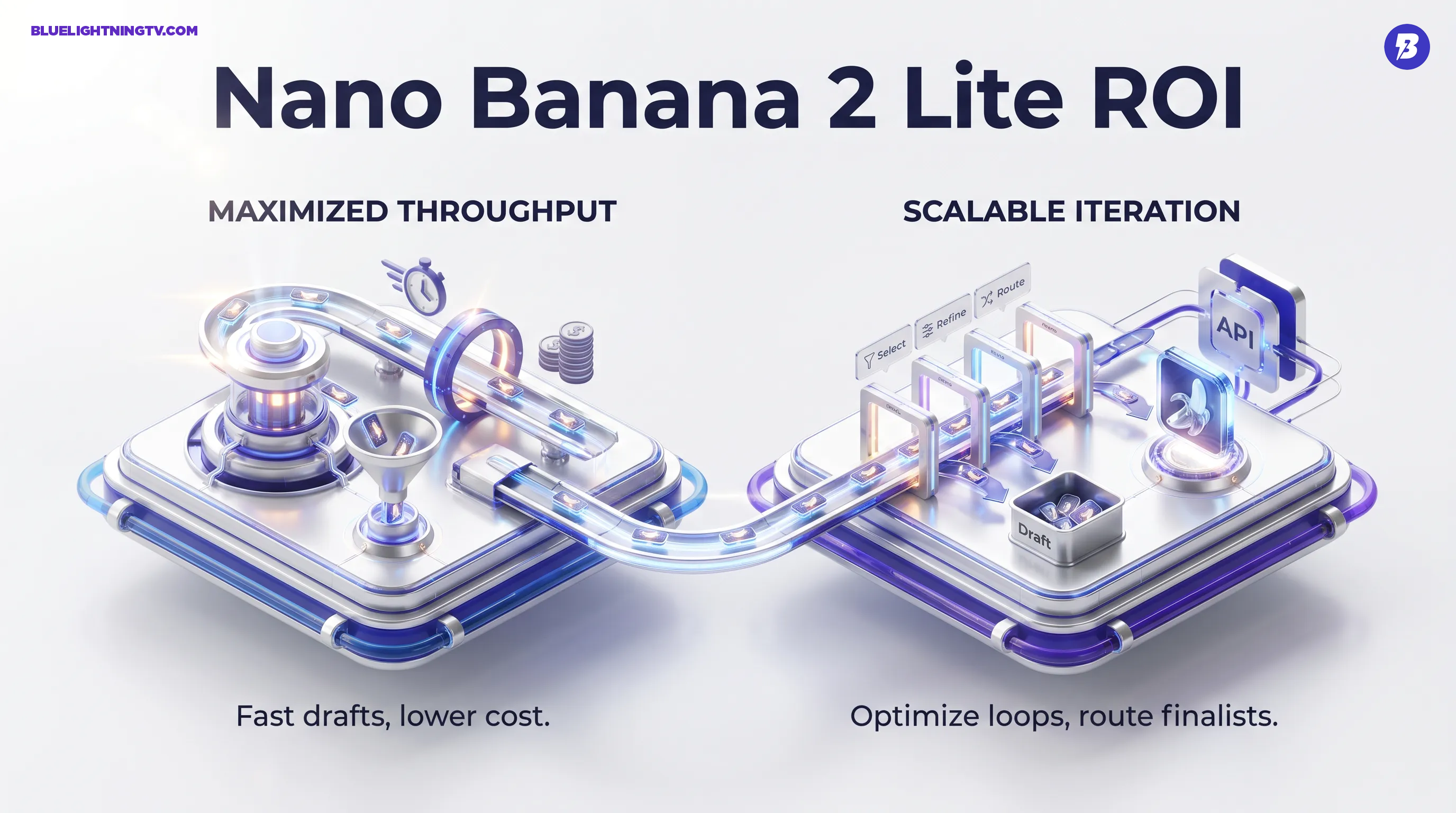
This launch matters most if you think in model routing, not one model to rule them all. Lite is the front line for fast drafts. Then you route the finalists to a higher fidelity image model, or to human design, when the asset is actually going to be paid media, a hero banner, or something your brand will be judged on.
| Workflow step | Best fit | Why |
|---|---|---|
| Ideation plus exploration | Lite tier image gen | Low cost, fast iteration |
| Selection plus refinement | Higher fidelity model or human | Fix details, improve consistency |
| Production publishing | QA plus constraints | Avoid scaled mistakes |
Why this matters now
Nano Banana 2 Lite is less about new art and more about new operating tempo. Google is betting that the near term competitive advantage in generative media is not perfection. It’s iteration density. More tries. Faster loops. Cheaper learning.
That also fits neatly beside Google’s broader momentum around iterative media workflows, including conversational editing patterns in newer video facing models. If you want the COEY context on that direction, this companion post is useful: Gemini Omni Flash Speeds Up AI Video Iteration.
Bottom line: Nano Banana 2 Lite makes image generation feel less like a precious act and more like a scalable production primitive. If you’re building systems that live on variants, ads, e commerce, thumbnails, personalization, this is exactly the kind of release that changes what normal output looks like.