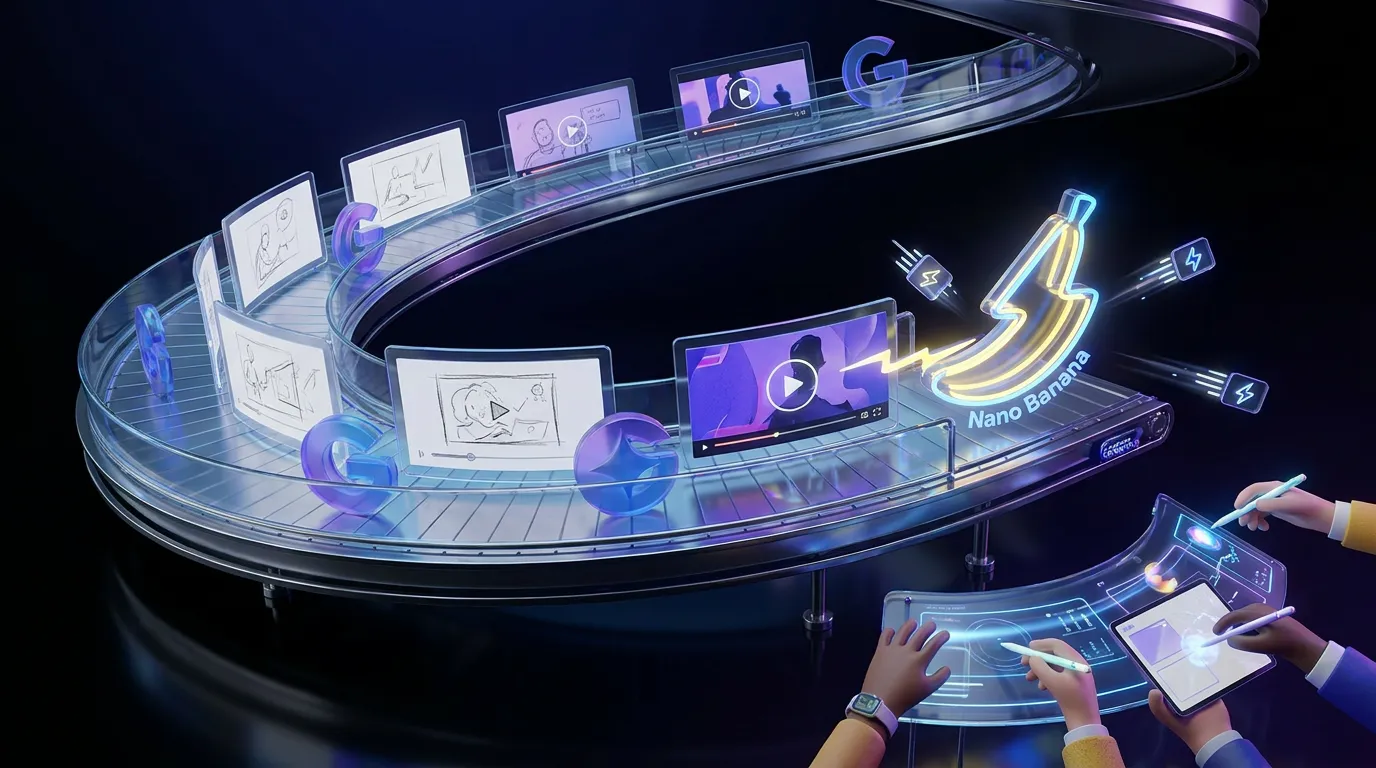
Google’s Gemini Omni announcement is a clear signal that the next round of generative media competition will not be won by the prettiest demo. It will be won by whoever makes iteration feel instant. With Gemini Omni Flash positioned around conversational video creation and editing, and Google’s fast image stack continuing to chase lower latency outputs, Google is aiming straight at a creator pain point everyone recognizes: you do not need one perfect render. You need fast passes you can steer.
There is also an important reality check baked into this moment: a lot of the internet will inevitably compress this into “Google launches two new models” and then immediately invent pricing and model IDs that are not in public docs. So we are sticking to what is verifiable and focusing on what it means for creators who ship content, not just people who collect AI screenshots.
What actually shipped
Two threads matter here:
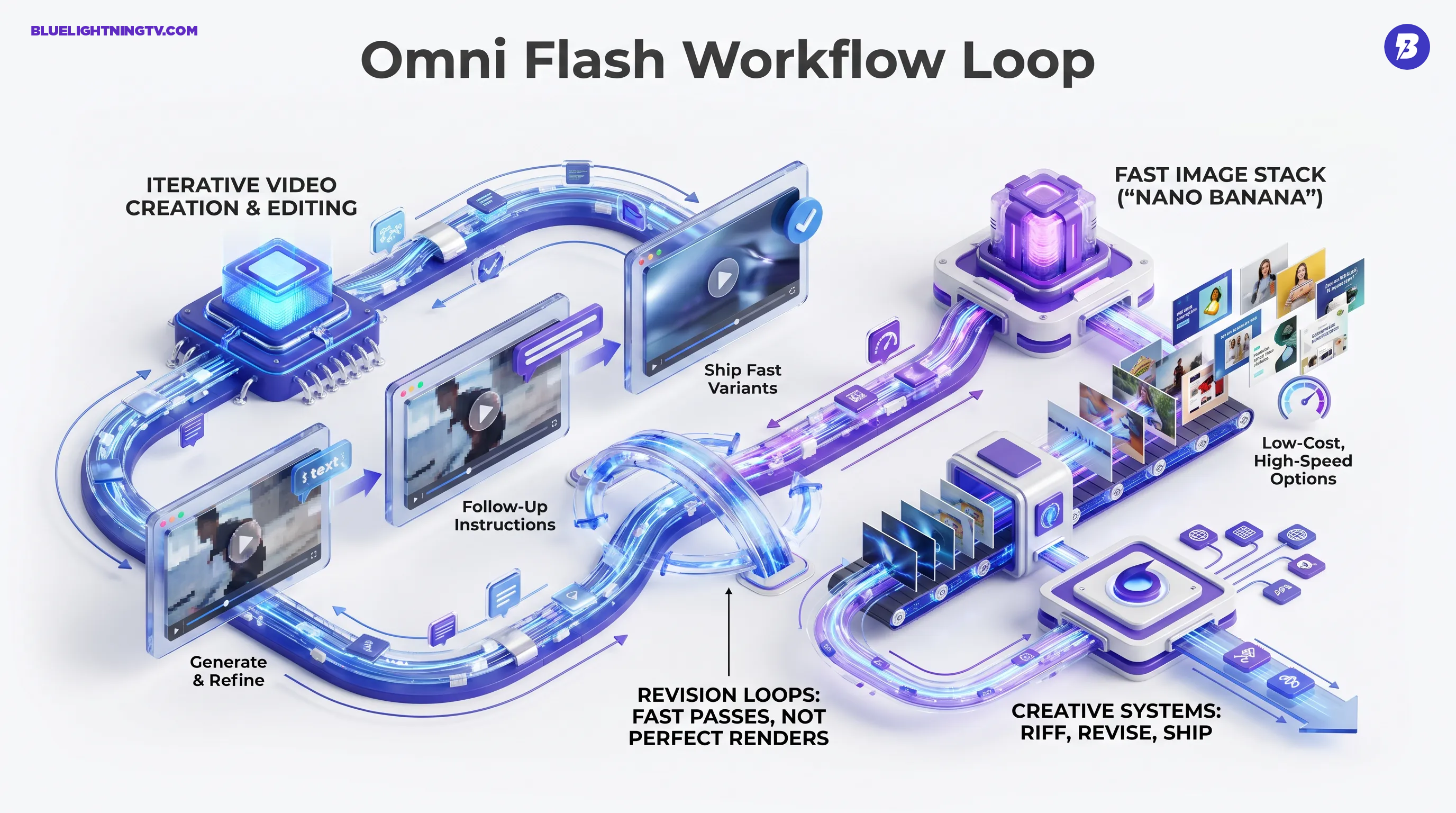
- Gemini Omni Flash: a new model in Google’s Gemini Omni family, aimed at video generation and iterative, chat-style editing where you refine a clip through follow up instructions rather than restarting from scratch.
- “Nano Banana” image generation direction: a creator nickname for Google’s fast image generation and editing direction inside Gemini and creator tooling. Publicly, Google has been surfacing faster image options, but “Nano Banana” itself is not a consistent official product name in documentation.
The real story is not “new models.” It is that Google is designing gen media around revision loops, the part of the workflow where time, money, and sanity usually go to die.
Omni Flash, in practice
Editing without restart
Omni Flash’s headline is the conversational edit loop: generate a short clip, then adjust it via additional instructions, background changes, pacing tweaks, object swaps, style changes, without doing the classic “re roll everything and lose what was working.” Google frames Gemini Omni as natively multimodal, supporting text, image, audio, and video inputs, which is what enables that keep context and keep continuity promise in the first place.
In creator terms: it is trying to feel less like a slot machine and more like a collaborator that remembers what you meant two messages ago.
Where it fits best
This kind of model is most valuable in workflows where:
- speed beats perfection (ads, Shorts, promos, social hooks)
- variants are the product (A/B testing, multi audience packaging)
- editing overhead is the bottleneck (non editors who still need frequent revisions)
It is also a strong fit for teams building internal tools: when conversational edits are part of the interface, you can give non technical teammates a “change this” box instead of a crash course in timelines and keyframes.
The speed stack matters
Why “fast” is strategic
We are in the content ops era of generative AI. The winners are the tools that reduce cycle time across the whole pipeline:
- brief to first draft
- first draft to variants
- variants to selects
- selects to revisions
- revisions to exports
Omni Flash is essentially a bet that iteration is the unit of creative productivity. Not resolution. Not vibes. Not cinematic. Iteration.
This matches the direction we have already seen in Google’s broader gen video push. If you want a grounded, production facing view of how Google is treating video as infrastructure, our earlier coverage on Veo is a useful companion: Veo 3.1: The Real Upgrade Isn’t a Version Jump.
Nano Banana naming reality
What is verifiable vs viral
“Nano Banana” is one of those internet nicknames that became shorthand for Google’s fast image generation layer, useful in conversation, messy in documentation. The verifiable part is that Google has been rolling out image generation options with an emphasis on throughput. The messy part is that the nickname gets mixed with unofficial model IDs and made up price sheets.
One common example is the claim “$0.034 per 1K outputs.” The most reliable public reference point is Google’s published Gemini API pricing for image generation models, which lists $0.034 per image for a specific image generation option in batch mode. If you are budgeting or planning a pipeline, that unit matters: per image is not per thousand. The cleanest source to anchor on is the official pricing page: Gemini API pricing.
So the practical takeaway is less about the nickname and more about the direction: Google wants an image tier that is fast enough and cheap enough to run at scale for thumbnails, ad creatives, ecommerce assets, and template driven design systems.
Workflow implications now
Image to video becomes normal
The combined effect of fast images plus iterable video edits is a pipeline shift: teams can generate a pile of image directions quickly, pick winners, then promote the best ones into motion, without switching to a completely different mental model or toolset.
That matters because a lot of AI video workflows are secretly just AI image workflows with extra suffering. If the tooling encourages a smoother hop from image ideation to video execution, you get more output with less friction.
Variant production gets formalized
When generation is quick and revisions do not require full resets, teams start designing for variants from the start:
| Creative need | What Omni style iteration enables | What still needs humans |
|---|---|---|
| Ad testing at scale | Rapid tweaks across hooks and visuals | Strategy, selection, brand judgment |
| Short form packaging | Fast cutdowns and style swaps | Pacing taste, platform instincts |
| Localization | Quick edits per region and market | Context, nuance, cultural fit |
The creative floor rises (more drafts, faster), but the creative ceiling still depends on humans making calls about what is worth shipping.
Limits worth noticing
Continuity is still hard
Conversational editing sounds like magic until you ask for multiple changes across motion heavy scenes. Even strong video models can drift on identity, textures, small objects, and text rendering. Omni Flash’s approach should reduce restarts, but creators should still expect:
- some character drift across heavier edits
- some nearly right outputs that still need a re roll
- best results with clear constraints (references, consistent descriptions, fewer simultaneous changes)
Tooling beats model names
The bigger competitive edge here is not that the model has a cool label. It is that Google is building toward gen media that behaves like software: you iterate, you refine, you keep what works, you change what does not.
Creators do not need more hype. They need fewer start over moments. Omni Flash is Google optimizing for that exact problem.
What to watch next
APIs and product surfaces
Google’s advantage is distribution: when these capabilities show up inside surfaces creators already touch, the question becomes less “should we adopt a new tool?” and more “it is already here, how do we route work to it?”
For teams building systems, the practical watch items are boring but decisive:
- API stability (versioning, predictable outputs)
- throughput (latency under load, batch behaviors)
- control surfaces (reference conditioning, edit constraints)
- cost clarity (no mystery math)
Bottom line: Gemini Omni Flash pushes Google’s gen video story toward the part creators actually care about: fast iterations with less rebuild. Pair that with Google’s ongoing push for high throughput image generation, and you get a very specific bet: the next era of AI media is not one prompt, one masterpiece. It is creative systems that can riff quickly, revise cleanly, and ship on deadline.