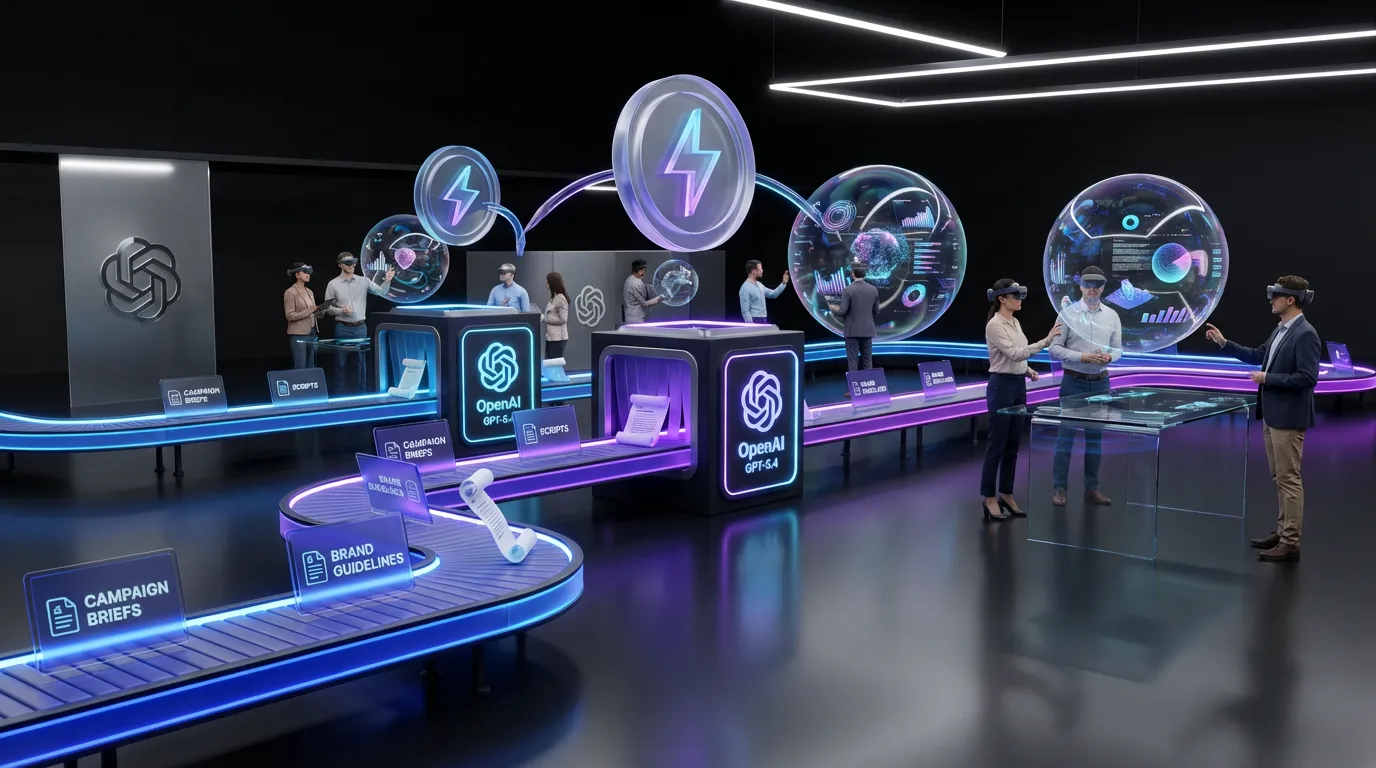
OpenAI’s new model, GPT-5.4, is less about prettier prose and more about production-grade throughput with bigger context, more reliable tool use, and clearer “pick your mode” options for speed vs depth. The official announcement frames it as an upgrade for professional workflows, with agentic computer use, and up to 1M-token context (in select experiences), plus new variants tuned for how real teams actually work. Read OpenAI’s release here: Introducing GPT-5.4.
If you make content for a living, campaigns, scripts, brand systems, client work, product pages, GPT-5.4’s real story is that it reduces the two biggest pain points in AI-assisted creation:
- Context fragmentation (the endless “here’s the doc again” loop)
- Workflow friction (the “cool output… now I still have to do 19 clicks” problem)
This release doesn’t magically eliminate human taste (sorry, the robots still can’t tell if your hook is cringe). But it does tighten the gap between AI that can talk about work and AI that can move work forward.
For the COEY angle on what this means in real ops terms, see our internal breakdown: GPT-5.4: 1M Context and Real Agent Workflows.
What shipped
GPT-5.4 lands as a bundle of upgrades that matter most when you’re past the “try a prompt” phase and into repeatable output at scale.
The headline features
OpenAI’s positioning clusters around a few practical pillars:
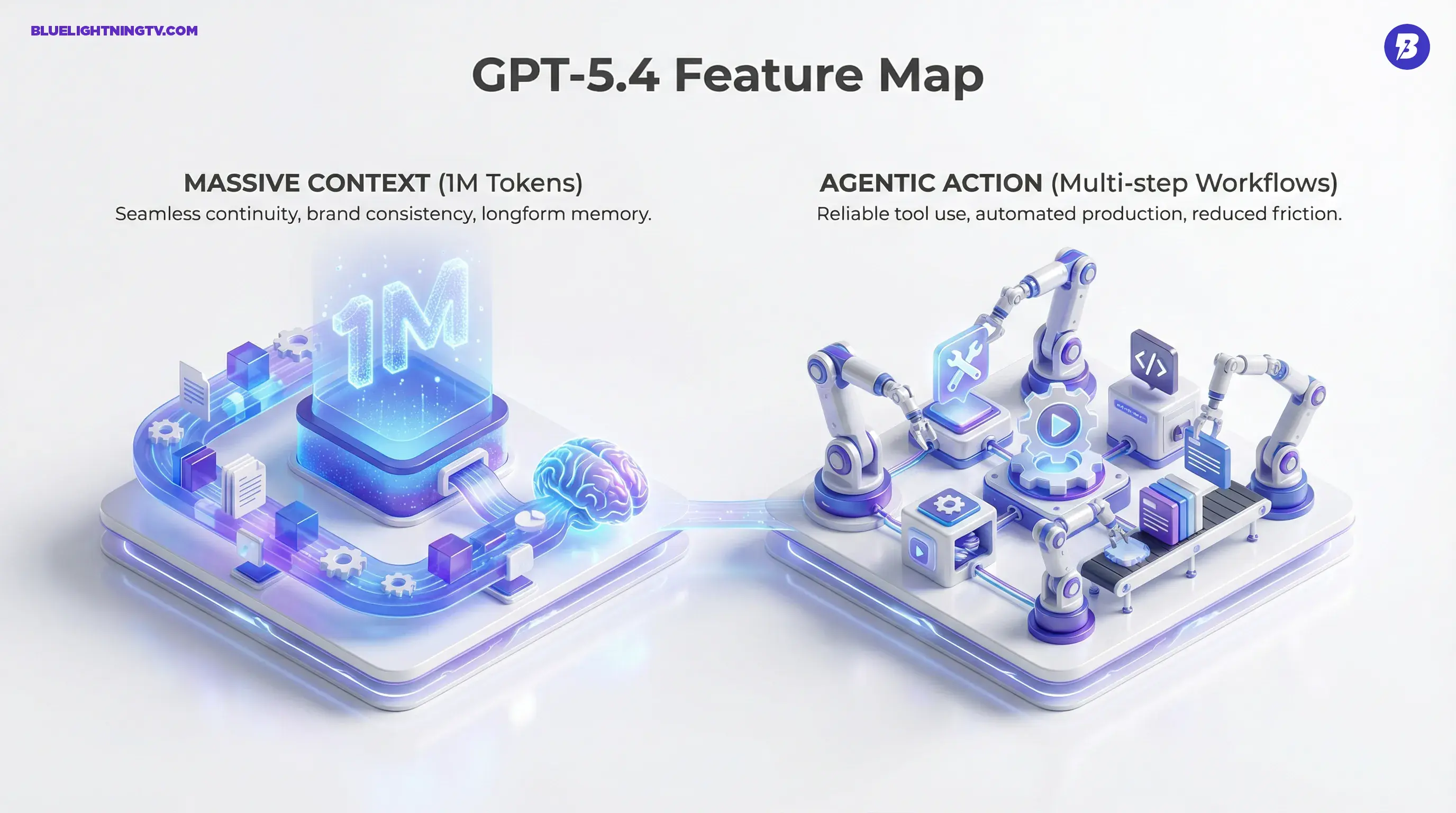
- Long-context support up to 1M tokens in supported surfaces (not universally enabled everywhere)
- Improved long-context understanding, not just raw window size
- Stronger agentic tool use and “computer use” style workflows
- Multiple model variants (not one-size-fits-all)
- Performance improvements that target professional reliability, not vibes
External coverage echoes the same theme: GPT-5.4 is about “knowledge work capability” and operational improvements more than a writing refresh (TechCrunch overview).
The quiet shift: OpenAI is making “context + tools + autonomy” feel like the product and plain text generation the default expectation.
1M context, for real
The most creator-relevant upgrade is the massive context window. Yes, “1M tokens” is a number people will meme. But the boring truth is: it solves boring problems and boring problems are where time goes to die.
What it changes
With larger context, you can keep more of your actual working reality in one place:
- Brand guidelines + voice examples + banned phrases
- A full campaign history + performance notes
- Long scripts + transcripts + revision notes
- Multi-document client briefs + stakeholder feedback threads
- Large codebases and internal tooling docs
The point isn’t that you should jam everything in every time. The point is you no longer have to compress everything into brittle summaries just to make the prompt fit.
Bigger isn’t automatically better
Long context doesn’t make a model magically wise; it makes your workflow less fragile. The risk shifts from “the model forgot” to “you fed it too much noise.” The winners here will be teams that treat context like a curated project folder, not a junk drawer.
Cost gets real fast
There’s also a non-glamorous implication: big context can get expensive when you run it at scale. OpenAI’s current pricing and any caching discounts live on its pricing page (OpenAI API pricing). Practical takeaway: use huge-context runs when they save time overall (ingest a whole project, run a deep audit), not because “more tokens” feels like a flex.
Agents that actually act
GPT-5.4 continues OpenAI’s push into agentic workflows where the model doesn’t just generate text, but uses tools and interfaces to complete multi-step tasks.
From tool calls to workflows
Tool use has existed for a while, but GPT-5.4 is being framed as better at:
- choosing the right tool at the right time
- maintaining intent over multiple steps
- reducing needless back-and-forth
- completing longer sequences with fewer failures
OpenAI also describes “tool search,” a mechanism to avoid stuffing every tool definition into the prompt, helpful when your workflow involves lots of integrations (OpenAI details).
Why creators should care
This is how AI stops being “the writing tab” and becomes the production assistant. The immediate wins are the tasks that are objectively not why anyone got into creating:
- Content QA across a whole asset set
- Repurposing one long source into many deliverables
- Metadata cleanup and asset inventory
- Reporting assembly (pull numbers, summarize, format)
If your workflow currently requires a human to move outputs between apps like a very tired courier, better agent behavior is the difference between “helpful” and “actually saving time.”
The benchmark doesn’t matter as much as the feeling: fewer “it failed on step 3 so I restarted everything” moments.
Model variants matter
GPT-5.4 also lands with different variants, which is a subtle but important signal: OpenAI is acknowledging that creators don’t have one single “best model,” they have modes.
Speed vs depth is a feature
You don’t want the same behavior when you’re:
- generating 40 short variants for ads
- writing a careful narrative arc for a long script
- debugging a finicky automation
- reconciling a messy client doc set
In practice, GPT-5.4’s lineup is positioned around that reality: some options optimized for responsiveness, others for heavier reasoning. OpenAI’s docs also highlight Priority Processing for more predictable latency on supported API usage (Priority Processing).
Quick snapshot
| Area | What’s new | Why it matters |
|---|---|---|
| Context | Up to 1M tokens (supported surfaces) | Fewer re-uploads, stronger continuity |
| Agents | Better multi-step tool use | More end-to-end automation |
| Variants | Different “modes” for work | Match speed vs depth to task |
What changes in content ops
Put the features together and you get the real shift: GPT-5.4 makes it easier to treat AI as a workflow component, not a “generate a draft” button.
Brand consistency scales better
With enough room for brand rules and examples, consistency stops depending on whether someone remembered to paste “Voice Guidelines v7 FINAL (for real)” into the chat.
The implication: teams can build systems where the model is consistently grounded in:
- approved messaging
- product positioning nuance
- past campaign learnings
- formatting and accessibility standards
Longform becomes less Groundhog Day
Longform workflows have been context-limit torture tests. GPT-5.4’s long-context capacity makes it more realistic to keep continuity across:
- multi-episode scripts
- serialized newsletters
- evergreen content libraries that get updated over time
Automation becomes less brittle
Agentic improvements matter most when you’re trying to eliminate the “human glue” between steps. But it’s still not set-and-forget.
Pragmatic rule: automate the steps you can verify cheaply, and keep humans where mistakes are expensive (publishing, claims, paid spend, client deliverables).
Availability and access
OpenAI is rolling GPT-5.4 across ChatGPT, Codex, and the API, with access depending on plan and endpoint. OpenAI’s announcement describes a tiered rollout (with higher tiers getting earlier or broader access, and the largest-context experiences not guaranteed across every surface at launch) (Introducing GPT-5.4). Expect the biggest capabilities, like maximal context and deeper agent behavior, to feel uneven across surfaces at first, because they’re compute-heavy and operationally sensitive.
What to watch next
GPT-5.4 makes the “agents” conversation less theoretical and more operational. The next few weeks will reveal the real story in four places:
- Reliability over long runs (does it stay on track?)
- Cost control patterns (when does 1M context pay for itself?)
- Team usability (can non-technical creators steer safely?)
- Integration maturity (does it fit real stacks cleanly?)
GPT-5.4 isn’t here to replace creative direction. It’s here to remove the busywork that blocks it, so you spend less time doing tab acrobatics and more time making things people actually want to watch, click, and share.