

OpenAI just shipped GPT-5.4, and the headline is not “it writes nicer.” It is that OpenAI is widening the gap between chat that talks about work and systems that actually move work forward. The release bundles three creator-relevant upgrades into one drop: a 1 million token context window, stronger agentic computer use, and new variants tuned for either speed or deeper reasoning.
If you run content ops, build automations, or live in the “make 40 versions by lunch” reality, GPT-5.4’s value comes down to one question: does it reduce tool friction without making you babysit? Early signals say yes, if you treat it like a production system, not a party trick.
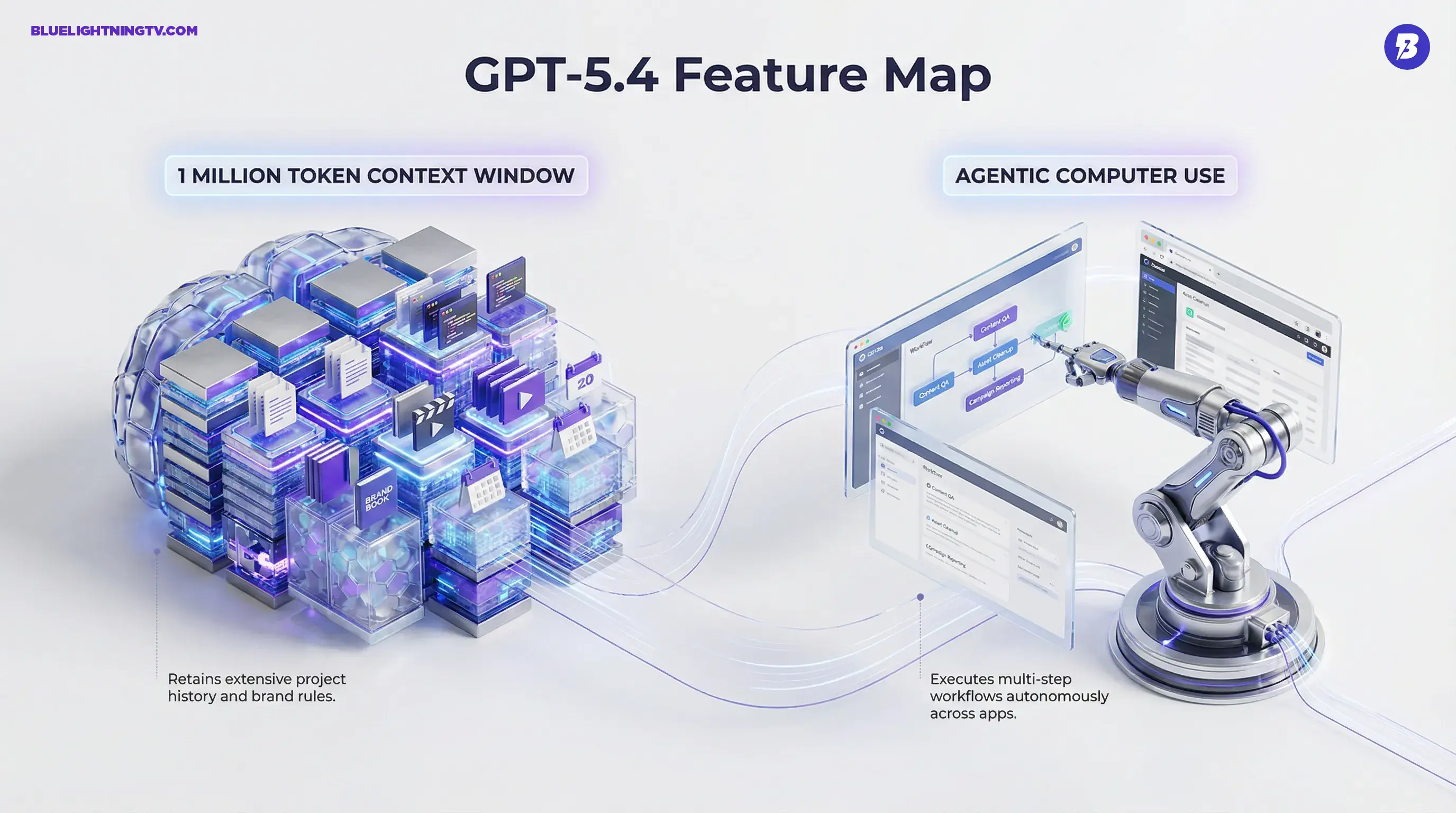
What shipped, quickly
GPT-5.4 arrives with multiple flavors (including Pro and Thinking), and OpenAI’s positioning is blunt: this model is built to do more knowledge work, not just answer prompts. External coverage highlights the same framing: expanded context, improved efficiency, and more serious agent behavior rather than incremental writing polish (TechCrunch, Ars Technica).
The quiet shift: OpenAI is treating “context + tools + autonomy” as the core product, and plain text generation as table stakes.
The context leap
GPT-5.4’s biggest practical upgrade is the 1M token context window. That is not just “upload a longer PDF.” It changes how teams can structure projects.
Why 1M tokens matters
Creators have been working around context limits forever: chunking docs, summarizing, creating mega-prompts, then hoping nothing important gets lost between paste #7 and paste #8. With 1M tokens, you can keep far more of a project’s reality in-session:
- Brand books + past campaigns + voice rules
- Long video scripts + transcripts + notes
- Full content calendars + performance exports
- Large codebases (for teams building internal tools)
This also reduces a common failure mode: the model “agreeing” with your latest instruction while quietly contradicting something you shared earlier but it could not hold onto. More memory does not guarantee correctness, but it reduces the need to compress everything into a brittle summary.
If you are tracking the broader long-context race, COEY covered similar implications recently in Claude Opus 4.6 Brings 1M Context and Agent Teams.
The cost reality
Here is the part that will not trend on X because it is less sexy: huge context windows can get expensive fast. Even when a model is more token-efficient, 1M-token workflows can turn into “we accidentally spent a weekend’s ad budget” if you run them at scale.
OpenAI has published API pricing for GPT-5.4 at $2.50 per million input tokens (with cached input priced separately) and $15 per million output tokens. Pricing details live on OpenAI’s API pricing page.
Agents, but usable
OpenAI is also pushing GPT-5.4 as a more capable computer-using agent: the model can take multi-step actions across a desktop-like environment with less handholding than earlier generations.
What “computer use” means now
The most important distinction: this is not just tool-calling in a sandbox. The direction is toward UI-level execution: navigating, clicking, reading what is on screen, and carrying a task across steps. If you have been watching this space, you know the promise has always been “automation,” and the reality has often been “automation, plus a human driving.”
GPT-5.4 aims to shrink that gap with better reliability on longer sequences. On the benchmarking side, OpenAI is pointing to stronger performance on computer task evaluations. Reporting has noted gains on OSWorld-Verified style desktop navigation tasks, with OpenAI reporting 75.0% on OSWorld-Verified (vs 47.3% for GPT-5.2), a useful proxy for “can it actually operate a computer without immediately faceplanting?” (TechCrunch).
Translation for creators: fewer “it got step 3 wrong so I restarted the entire thing” moments.
Where this hits content teams
The most obvious wins are the workflows you already do, but hate doing:
- Content QA passes (links, claims, formatting consistency)
- Asset inventory + metadata cleanup
- Repurposing at scale (turn one webinar into 30 deliverables)
- Campaign reporting (grab numbers, draft insights, package for stakeholders)
The model is getting better at being the ops assistant that actually pushes tasks forward, not just narrates what you should do next.
Variants that signal intent
GPT-5.4 introducing Pro and Thinking variants matters less as branding and more as product strategy: OpenAI is acknowledging that creators and teams do not have one universal “best model.” You have modes:
- Fast mode: quick iteration, lots of variants, tight loops
- Thinking mode: planning, logic-heavy decisions, higher-stakes synthesis
This mirrors how real production works: brainstorm fast, then slow down where mistakes are expensive.
Snapshot table
| Capability | What changed | Creator impact |
|---|---|---|
| Context | Up to 1M tokens | Keep brand, history, and long projects in one thread |
| Agent behavior | Stronger multi-step “computer use” | More end-to-end automation, less babysitting |
| Model options | “Pro” and “Thinking” variants | Pick speed vs depth based on the task |
What changes in workflows
GPT-5.4’s most meaningful impact is not any single feature. It is how the features combine. Bigger context plus better agents means teams can stop treating AI like a “draft generator” and start treating it like a workflow component.
Brand consistency gets less painful
With enough room to hold actual brand rules and examples, GPT-5.4 can function like a brand-aware collaborator instead of a vibe-based improviser. This is where large context is more than convenience. It is governance. You can keep:
- approved phrases and banned phrases
- tone rules and examples
- product positioning nuances
- past launches and what not to repeat
and still ask for new deliverables without the model “forgetting” the guardrails mid-sprint.
Longform becomes truly iterative
Longform projects (series scripts, podcast planning, serialized newsletters) have always exposed the limits of small contexts. With GPT-5.4, the model can hold more of the narrative arc, more continuity, and more of your internal feedback over time, meaning fewer continuity errors and less time re-explaining the premise like it is Groundhog Day.
Ops teams get a bigger lever
If you are running content operations, the win is throughput without chaos. GPT-5.4 is positioned to handle more of the glue work that kills momentum: reconciling documents, tracking changes, mapping outputs to channels, and packaging deliverables with fewer manual hops.
That said: do not confuse “can” with “should.” The right mental model is trust, but verify, especially anywhere a workflow touches publishing, paid spend, or external-facing claims.
Access and rollout
OpenAI is rolling GPT-5.4 across ChatGPT, Codex, and the API, with availability depending on plan and endpoint. As of launch, GPT-5.4 Thinking is available in ChatGPT to Plus, Team, and Pro subscribers, while GPT-5.4 Pro is available via the API and to Enterprise and Edu customers in ChatGPT. In practice, teams should still expect staggered access to the biggest context sizes and agent features, especially where compute costs and safety constraints are tighter.
If you are already in the OpenAI ecosystem, the main question is not “should we try it?” It is which workflows get upgraded first: the ones where context fragmentation and repetitive clicking are currently stealing hours.
What to watch next
GPT-5.4 does not end the “agents” conversation, it makes it more concrete. The next phase is going to be less about dazzling demos and more about boring-but-critical details:
- Reliability on long-horizon tasks (does it stay on track?)
- Cost control (does 1M context become routine or reserved?)
- Team usability (can non-technical creators steer it safely?)
- Integration patterns (does it plug into real stacks cleanly?)
OpenAI’s direction is clear: models are graduating from “generate output” to “operate systems.” For creators, that is exciting for exactly one reason: it means more time on the parts of the job that are actually creative, and less time doing spreadsheet cosplay and tab acrobatics.