
OpenAI just rolled out GPT-5.3 Instant in ChatGPT, positioning it as the new fast, everyday default for standard replies. Alongside it, GPT-5.3-Codex lands as the code-focused sibling built for agentic, tool-driven tasks, less autocomplete, more go update the repo and do not get lost.
This is not a look, the model is smarter announcement. It is OpenAI doubling down on something creators and teams have been quietly begging for: less waiting, fewer weird refusals, and outputs that sound like a useful collaborator instead of a cautious robot reading policy.
What actually shipped
OpenAI’s release is a two-part workflow move:
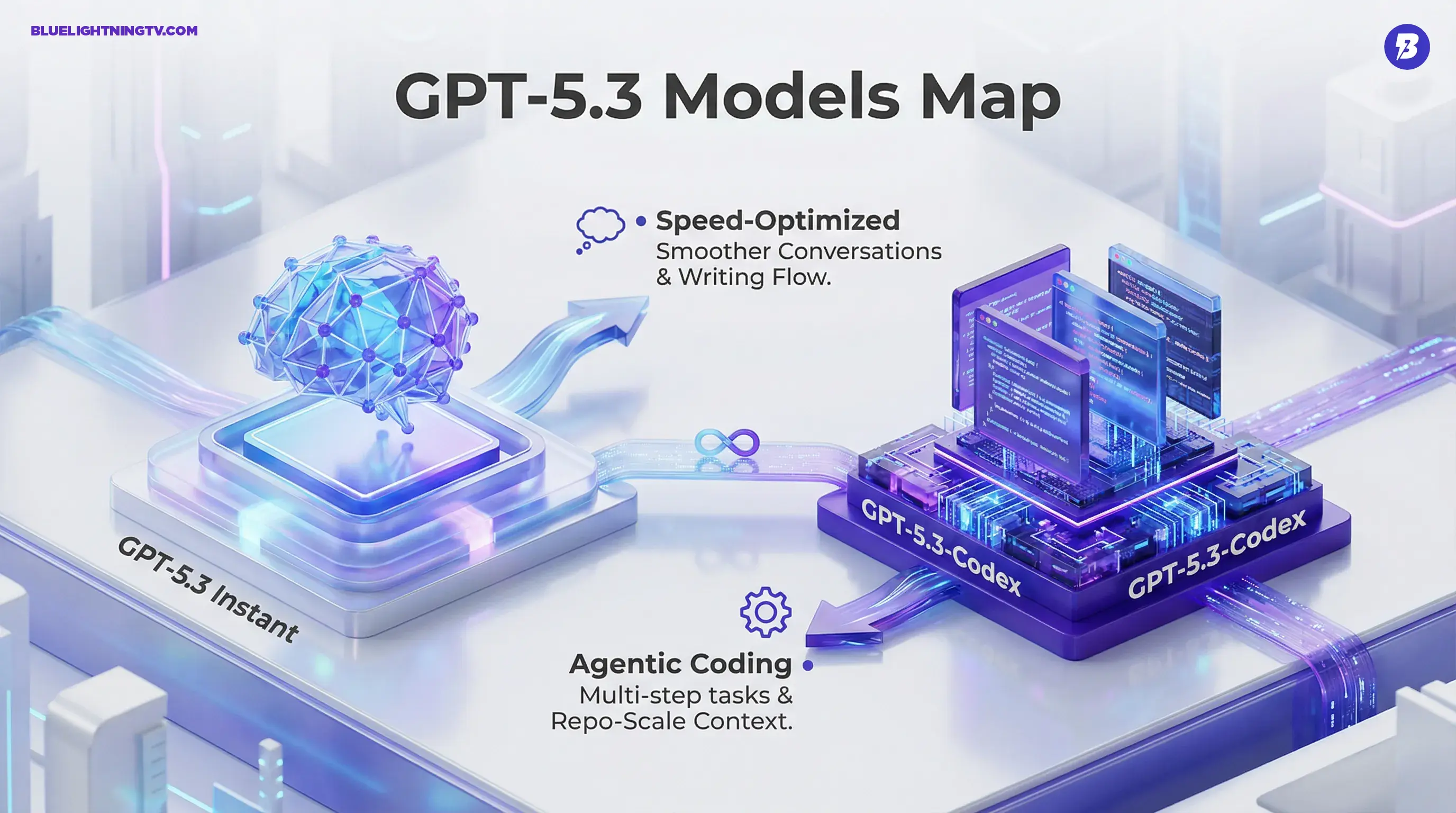
- GPT-5.3 Instant: A speed-optimized ChatGPT model aimed at smoother conversations, better writing flow, and improved reliability when you are iterating quickly.
- GPT-5.3-Codex: A coding model designed for agentic development work like multi-step tasks, tool use, and repo-scale context, available across Codex surfaces and integrated dev workflows.
The subtext: model quality matters, but latency plus usability decides whether AI becomes infrastructure or just another tab you forget is open.
GPT-5.3 Instant, explained
Instant is meant to feel like the model you keep in the foreground. OpenAI’s framing emphasizes smoother, more useful everyday conversations, with improvements that hit three pain points that show up in real creator work:
- Conversation tone that is less stiff and less I can’t help with that when you are doing normal creative tasks.
- Accuracy improvements, which matters most when you are moving fast and do not want to fact-check every other sentence.
- Long-context work that is more practical for briefs, brand docs, and multi-step planning without constantly re-pasting context.
There is also a quality-of-life change that matters in day to day use: less boilerplate. If you have ever asked for ad copy and gotten a paragraph of throat-clearing before the headline, you already know why this matters.
What “Instant” is optimizing
OpenAI is essentially saying: not every session needs the maximum deep-thought model. Most working sessions are:
- tight iterations on copy
- rapid rewrites for different platforms
- brainstorm to shortlist to refine
- turn messy notes into a clean draft
Instant is tuned for that rhythm. And for teams, rhythm is money.
GPT-5.3-Codex, explained
Codex is the do-the-work-in-the-codebase model. OpenAI positions GPT-5.3-Codex for software engineering tasks where the hard part is not writing a function. It is holding context across a multi-step job.
In practice, that shows up when the task becomes:
- read the repo
- make edits across multiple files
- run tests or interpret tool output
- adjust without breaking everything
- summarize changes in a way a human can review
That is also why Codex matters to creators who do not identify as developers. Creator businesses are increasingly code-adjacent by default: landing pages, analytics events, automation glue, CMS tweaks, email templates with logic, and lightweight internal tools. You do not need a full engineering team to benefit from a model that can keep a plan intact across steps.
Where Codex lands first
OpenAI is putting Codex where the work happens: Codex surfaces including the Codex app, CLI, and IDE extensions, plus broader integrations. If you want the COEY context on how GPT-5.3-Codex is already showing up inside mainstream dev tooling, see GPT-5.3-Codex Hits Copilot: Faster Agentic Coding.
And because OpenAI is treating agentic as the point, the model’s value is not just output quality. It is whether it stays coherent after step five.
What changed in practice
The most useful way to think about this launch: OpenAI is tightening the loop for two different kinds of creator speed.
| Need | What OpenAI shipped | What it changes |
|---|---|---|
| Fast creative iteration | GPT-5.3 Instant | More back-and-forth per hour without tone friction |
| Multi-step execution | GPT-5.3-Codex | More tasks completed end-to-end, not just drafted |
| Long briefs plus history | Long-context emphasis | Less please re-send that info behavior mid-project |
It is a shift from AI helps me think to AI helps me keep moving. That is the part teams feel immediately.
Implications for creators
For creators, studios, and marketing teams, the big implication is not that you can generate more words. You could already generate more words. The implication is that more of the output becomes reviewable and usable faster, because the model is:
- snappier with less dead time between prompts
- less awkward with less filler and unnecessary safety boilerplate in normal scenarios
- more stable across multi-step tasks
That changes how you staff work. Not by replacing taste, but by reducing the production drag that eats afternoons: reformatting, rewriting, rebriefing, and re-explaining.
Where you will feel it fastest
- Copy and scripting: tighter loops for hooks, CTAs, and platform variants without the model getting precious.
- Creative ops: long docs stay in play longer, which makes one source of truth less of a fantasy.
- Prototype-to-shipping: Codex makes small web builds and automations less dependent on can we grab an engineer for 20 minutes?
The creator economy does not run on genius. It runs on iteration. These updates are OpenAI optimizing for iteration speed.
Limits to keep in mind
Even in a speed and quality upgrade, the pragmatic reality stays the same:
- You still need review. Faster output can also mean faster mistakes if you ship blindly.
- Less boilerplate is not no guardrails. Expect safety behavior to still show up where it should, just with fewer unnecessary detours.
- Agentic code still needs adults. Codex can do more end-to-end work, but your job is still to validate diffs, run tests, and keep scope tight.
In other words: the upgrade is real, but it is not a permission slip to turn your brain off. It is a permission slip to stop wasting it on the boring parts.
Availability snapshot
GPT-5.3 Instant is live in ChatGPT as the default model for standard replies, and it is also available in the API as gpt-5.3-chat-latest. GPT-5.3-Codex is available across Codex experiences, with OpenAI positioning it for integrated development workflows.
The larger signal is simple: OpenAI is treating speed, tone, and follow-through as first-class features. That is exactly what creator teams need right now, not hype, not demos, just fewer blockers between idea and send.