
Google’s Gemini 3.1 Flash Lite is here and it is not trying to be your creative soulmate. It is trying to be your throughput engine.
Google positioned Gemini 3.1 Flash Lite as its most cost effective Gemini model yet, available in preview via the Gemini API in Google AI Studio and for production teams through Vertex AI. The official announcement is here: Gemini 3.1 Flash Lite.
If your workflow is “generate 200 variants, keep 20, ship 5,” Flash Lite is aimed at making that loop feel less like a luxury habit and more like default behavior. The headline is not “smarter.” It is faster, cheaper, and controllable enough to sit inside real automation: translation, moderation, UI copy, metadata, and bulk rewrites.
What Google shipped
Flash Lite lands as the lightweight speedster in the Gemini 3.1 lineup: throughput first for high volume, latency sensitive work. It is available in the places that matter if you are building, not just chatting: Google AI Studio for prototyping and the Gemini API experience, and Vertex AI for deployment at scale.
Google’s broader Gemini message lately has been consistent: operational wins over demo wins. In our earlier coverage of the reliability push with Gemini 3.1 Pro, that theme was loud and clear: Gemini 3.1 Pro Boosts Reliability for Creator Workflows.
The real pitch: You do not need frontier model spend to run big batches, lots of iterations, and always on automations.
Pricing that changes habits
Token pricing is usually the broccoli of AI news: good for you, not exciting. Flash Lite pricing is exciting because it changes what teams will actually do with it.
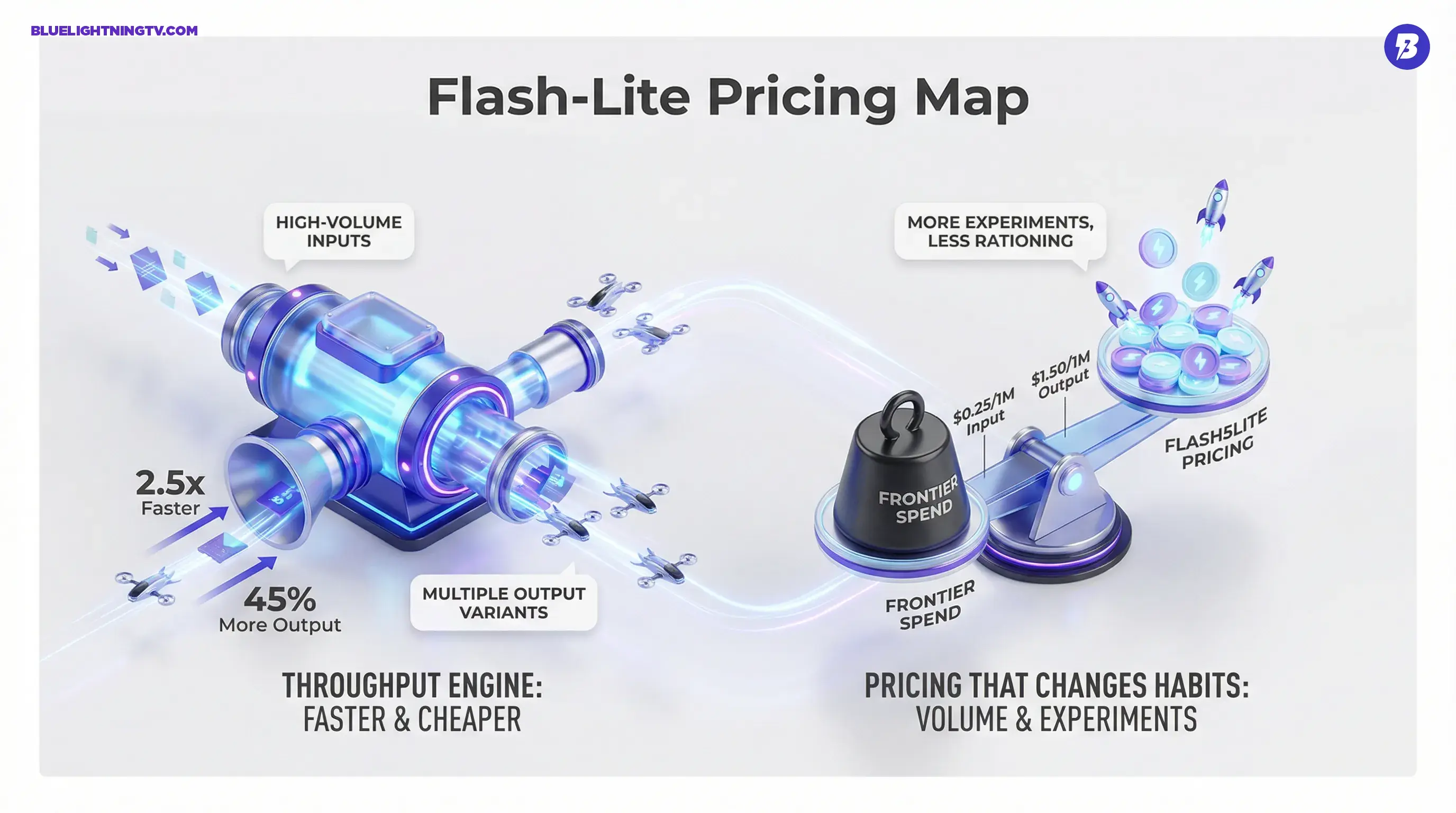
Google lists preview pricing at $0.25 per million input tokens and $1.50 per million output tokens for text, image, and video inputs. Google also lists a separate preview rate for audio input: $0.50 per million input tokens, with $1.50 per million output tokens. For content ops and performance creative teams, this is the difference between “we should limit generations” and “let’s flood the zone and pick winners.”
| Cost lever | Flash Lite preview pricing | What it enables |
|---|---|---|
| Input (text, image, video) | $0.25 / 1M tokens | Cheaper ingestion of briefs, catalogs, brand rules |
| Input (audio) | $0.50 / 1M tokens | Lower cost audio transcription and audio conditioned workflows |
| Output | $1.50 / 1M tokens | More variants per dollar, less prompt rationing |
| Deployment | AI Studio plus Vertex AI | Fast testing, smoother move into production |
The practical implication: teams can run bigger creative experiments without needing budget approval for every extra round of “give me 30 more options but make them punchier.”
Speed upgrades that matter
Google also claims Flash Lite is materially faster: 2.5x faster time to first token and a 45% increase in output speed compared with Gemini 2.5 Flash, as stated in the announcement.
That shows up as real workflow changes when your model is inside tooling instead of a chat tab:
- Snappier internal apps (copy generators, listing builders, bulk editors)
- Shorter iteration cycles when you are refining a message
- Less pipeline drag in batch runs where latency stacks up step by step
If you have ever watched an automation queue crawl because every step waits on an LLM response, “fast” stops being a spec and becomes a product feature.
Where it fits best
Flash Lite sweet spot is high volume, lower to mid complexity text work where consistency and speed beat deep reasoning. Google calls out use cases like translation, moderation, UI generation, and simulations. Creator world translations of that list include: captions, descriptions, hooks, tags, category labels, content cleanups, and “make 60 versions of this headline without breaking the brand voice.”
Variant factories
Performance creative is basically a factory now. Same concept, endless packaging:
- hooks for different audience segments
- CTAs for different placements
- intros for different creators and voices
- tone swaps (friendly, premium, chaotic good)
Flash Lite is built for this kind of work because the economics do not punish you for exploring. It is not “better taste.” It is more at bats.
Content ops glue work
A huge percentage of creator work is formatting, cleaning, and adapting. Flash Lite is aimed at that middle layer:
- converting notes into clean copy blocks
- reformatting content by channel specs
- generating metadata at scale
- rewriting to stay consistent with tone rules
It is the stuff nobody posts about but it is what ships.
Moderation at scale
Google explicitly mentions moderation, which is a signal Flash Lite is meant to live in production systems that scan, classify, and filter large volumes of content. For brands, platforms, and community heavy creators, moderation is not about vibes. It is about maintaining publishing standards without hiring an army.
Thinking level controls
One of the most interesting parts of this release is the emphasis on adjustable thinking levels, letting developers trade off reasoning depth for speed and cost depending on the task. Google highlights this capability in the Flash Lite announcement, framing it as a way to tune performance based on workload complexity.
In practice, this supports a more mature routing strategy:
- low thinking for bulk formatting, tags, simple rewrites
- higher thinking for edge cases, sensitive moderation calls, trickier instruction stacks
The signal: model choice is becoming less “pick one brain” and more “dial the brain to the job.”
This is also consistent with Google’s broader push toward reliability and operational controls: less “watch this demo” and more “this will not break your pipeline.”
Availability and access
Flash Lite is available in preview through:
- Google AI Studio (fast evaluation, prototyping)
- Vertex AI (production deployment, scaling)
For teams already in Google’s ecosystem, this matters because it shortens the path from “tested it in a playground” to “it is powering part of our stack.”
| Surface | Best for | Why it matters |
|---|---|---|
| Google AI Studio | Creators, builders, prototypers | Quick testing and iteration |
| Vertex AI | Teams shipping systems | Production pipelines and scale |
Reality checks
Flash Lite positioning is refreshingly clear. But cheap and fast has two predictable side effects if you are not careful: you generate more, and you can ship more mistakes.
Cheap is not hands free
High volume generation still needs guardrails: templates, validation, brand constraints, sampling QA. The risk is not one bad output. It is a consistent small mistake multiplied across 10,000 items.
Speed amplifies mess
If your workflow does not include checks, even lightweight ones, faster output just means faster cleanup later. Flash Lite works best as a throughput engine inside a system that knows how to constrain it.
Bottom line
Gemini 3.1 Flash Lite is Google leaning into the real 2026 genAI contest: not who writes the prettiest paragraph, but who helps teams run more iterations, more automation, and more content ops without turning budgets into confetti.
Flash Lite value is straightforward: low cost, higher speed, and shippable quality for the high volume text work that actually powers creator businesses. Not hype. Just a practical new engine for scale.