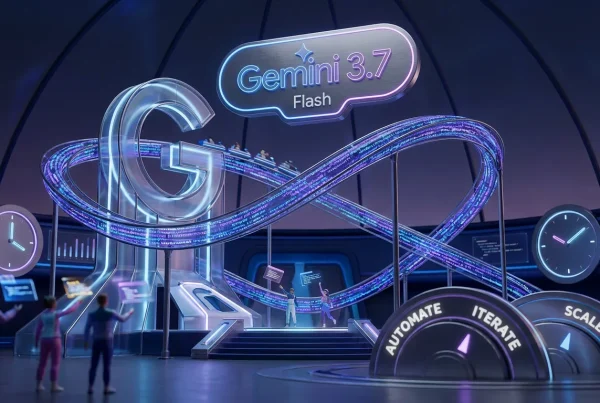

Google’s Gemini 3.1 Flash-Lite just dropped and it is a very specific kind of flex: a model built for teams that need a lot of “good enough to ship” text, fast, without lighting their budget on fire. Google positions it as its most cost effective Gemini model yet, available in preview via Google AI Studio and Vertex AI: Gemini 3.1 Flash-Lite.
Flash-Lite is not trying to win the “most poetic paragraph” Olympics. It is aimed at high-volume, automation-heavy content work: translation, moderation, UI copy, simulations, and the endless grind of variants that powers modern creative ops. The headline numbers matter because they change what’s feasible: $0.25 per million input tokens and $1.50 per million output tokens (as listed for Gemini 3.1 Flash-Lite preview pricing). If your workflow is “generate 500 options, keep 30, ship 5,” the economics are not just nice, they are the difference between experimenting freely and rationing prompts.

What Google shipped
Gemini 3.1 Flash-Lite lands as the lightweight speedster in the Gemini 3.1 lineup, positioned for throughput first workloads. Google is making it available in the same places creators and teams actually use: AI Studio for testing and the Gemini API experience, and Vertex AI for production deployment.
A lot of model launches try to sell you on “capability.” This one sells you on capacity.
The real pitch: you can run bigger batches, more iterations, and more automations without needing a “frontier model” budget.
For more context on Google’s recent reliability focused Gemini push, see our internal coverage: Gemini 3.1 Pro Boosts Reliability for Creator Workflows.
Pricing that changes behavior
Token pricing is usually boring until it is not. Flash-Lite’s pricing is explicitly designed to encourage high-frequency usage, the stuff people avoid doing with pricier models (mass A/B variant generation, massive localization runs, bulk rewrites, tagging, formatting, metadata creation).
Here is the practical breakdown teams will actually care about:
| Cost lever | Flash-Lite pricing | What it unlocks |
|---|---|---|
| Input | $0.25 / 1M tokens | Cheaper ingestion of briefs, product data, brand rules |
| Output | $1.50 / 1M tokens | More variants per dollar, less prompt stinginess |
| Preview access | AI Studio + Vertex AI | Fast evaluation, then easier production handoff |
The behavior shift is the story: when generation is cheap enough, teams stop asking “Should we run this?” and start asking “How many angles do we test?”
Speed upgrades that matter
Google is also claiming performance gains in speed. Specifically, the Flash-Lite announcement highlights a 2.5x faster time to first token and a 45% increase in output speed versus Gemini 2.5 Flash (not Gemini 2.5 Flash-Lite), positioning Flash-Lite as a better fit for systems where latency and responsiveness are part of the product experience, not just a nice to have.
That shows up in real creator workflows as:
- Faster iteration loops when you are tuning prompts or testing messaging
- More responsive internal tools (think: “generate the draft while the page loads”)
- Less waiting in batch pipelines that already have enough bottlenecks
If you are building anything agent-like (multi-step chains, tool calls, structured outputs), speed is not just convenience, it determines whether automations feel smooth or clunky.
Where Flash-Lite fits best
Flash-Lite’s sweet spot is high-volume, lower-to-mid complexity content production where consistency and scale matter more than deep reasoning. Google points to use cases like translation, moderation, UI generation, and simulations. Creators will recognize those in disguise as: captions, labels, descriptions, alt text, summaries, classification, and content cleanup.
Variant factories
If your content strategy includes performance creative, you already live in variant land:
- 40 hooks for one concept
- 20 CTAs for one offer
- 15 intros for one script
- Same message, 6 different tones
Flash-Lite is built for that. Not because it is magical, because it is affordable enough that generating lots of options is a default move instead of a guilty expense.
Content ops glue work
Flash-Lite also targets the unsexy stuff that quietly eats hours:
- turning raw notes into clean structured copy blocks
- reformatting content to match channel specs
- generating metadata (tags, categories, titles, descriptions)
- rewriting for compliance, clarity, or tone consistency
This is “creator work” in the way editing a timeline is creator work: it is not glamorous, but it is what ships.
Moderation and safety workflows
Google calls out moderation directly, which is a signal that Flash-Lite is meant to sit inside production systems that need to scan, classify, and filter large volumes of text. For brands and platforms, that is not just about avoiding chaos, it is about maintaining consistent publishing standards at scale.
The thinking control signal
One of the more interesting cues in Google’s current Gemini strategy is giving developers control over how much “thinking” the model does, basically, a way to trade reasoning depth for speed and cost. Flash-Lite fits naturally into that approach: run it lean for bulk tasks, and reserve heavier models for moments where reasoning quality is the make or break factor.
This is part of a broader pattern in Google’s recent Gemini releases: reliability and operational controls are becoming the product, not just raw model capability.
What this means for creator stacks
This launch is a nudge toward a more modular workflow:
- Use Flash-Lite for bulk generation, cleanup, and variant flooding
- Use heavier models when you need deeper planning, stricter structure, or higher-stakes reasoning
- Route tasks based on cost and latency tolerance, not brand loyalty to one model
In other words: your stack starts looking like a production studio, different tools for different jobs, rather than a single model you force to do everything.
The biggest win is not that Flash-Lite is “better.” It is that it makes more of your workflow automatable without budget anxiety.
Reality checks
Flash-Lite’s positioning is clear, but the pragmatic take is still pragmatic.
Cheap does not mean hands free
High-volume generation still needs guardrails: templates, validation, review sampling, and consistency checks. If you have ever shipped 300 AI-generated lines of anything, you know the risk is not one bad output, it is a pattern of slightly off outputs multiplying quietly.
Speed can amplify mess
Faster output means you can iterate more, but it also means you can ship more mistakes faster if you do not have QA baked in. Flash-Lite is best treated as a throughput engine that benefits from clear constraints and structured prompts.
Availability and access
Google is rolling Gemini 3.1 Flash-Lite out in preview via:
For teams already building in Google’s ecosystem, that distribution matters: it shortens the path from “tested in a playground” to “running in production.”
| Where | Who it’s for | Why it matters |
|---|---|---|
| Google AI Studio | Creators, builders, prototypers | Quick eval, prompt iteration, early integration |
| Vertex AI | Teams shipping systems | Production pipelines, governance, scale |
Bottom line
Gemini 3.1 Flash-Lite is Google leaning into the reality of 2026 genAI: the winners are not the models that write the fanciest sentence, they are the models that let teams run more iterations, more tests, and more automation without turning budgets into confetti.
Flash-Lite’s value is straightforward: low cost, higher speed, and good enough quality for the high-volume work that actually powers creator businesses. Not hype. Just a practical new engine for content at scale.