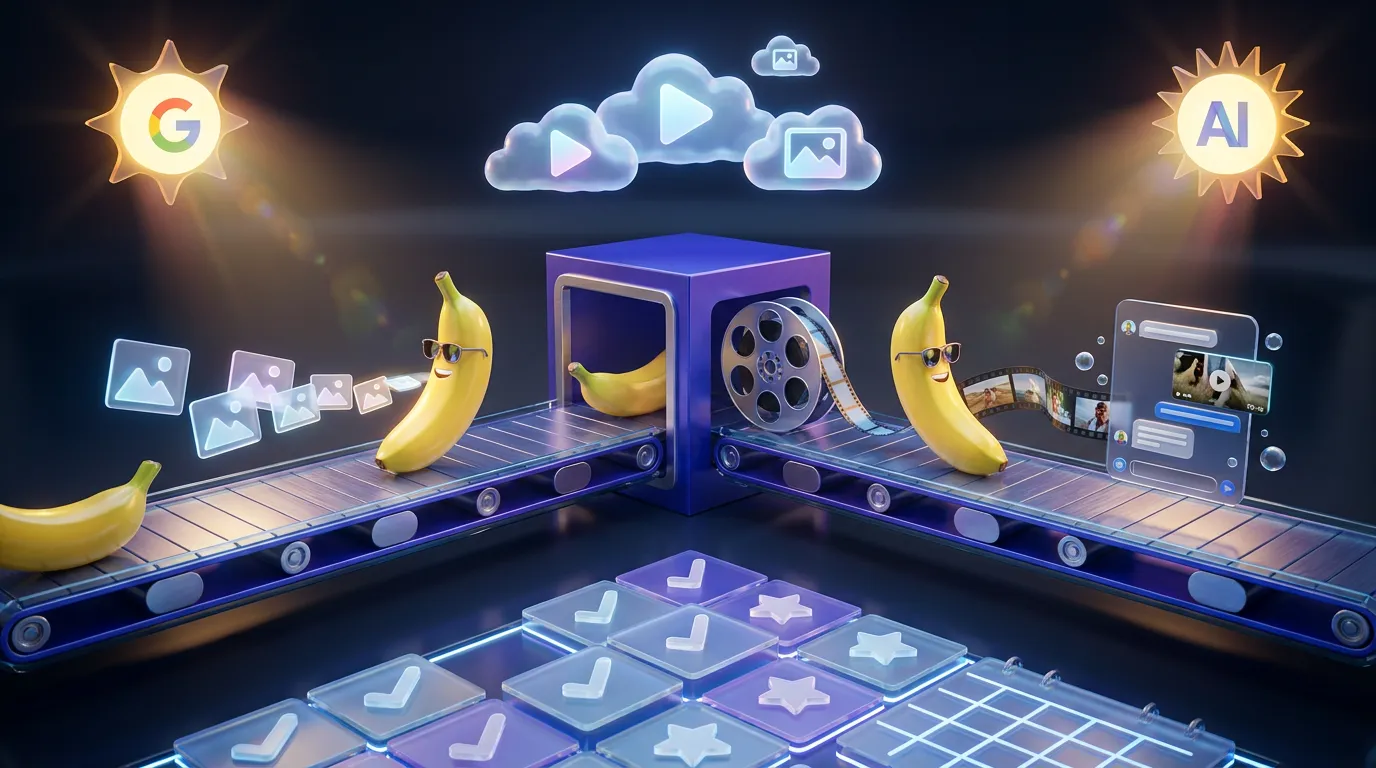
Google is quietly making a loud point: the next wave of generative media is not about one perfect cinematic render. It is about how many usable drafts you can generate, steer, and revise before your coffee gets cold.
That is the bet behind Gemini Omni Flash (public preview) for conversational video iteration and Nano Banana 2 Lite for high-volume image output, both accessible through Google AI Studio and the Gemini API. The cleanest jump-off is Google’s own announcement page: Start building with Nano Banana 2 Lite and Gemini Omni Flash.

This is not Google trying to win the art contest. It is Google trying to win the production calendar.
What actually shipped
Two releases matter, and they are aimed at different parts of the same pipeline:
- Gemini Omni Flash (public preview): short-form video generation plus conversational editing with a chat-style revision loop, available via AI Studio and the Gemini API. Official model reference: Gemini Omni Flash model docs.
- Nano Banana 2 Lite: a cost and latency optimized image model for fast ideation and bulk variant generation, exposed as
gemini-3.1-flash-lite-image. Model reference: Gemini 3.1 Flash Lite Image.
The connective tissue is simple: both products are built around iteration density. Generate more options, refine faster, and stop treating each prompt like a sacred ritual.
If your workflow is “generate 100, pick 10, ship 3,” Google is building for you, not for the gallery screenshot crowd.
Omni Flash: video in loops
Gemini Omni Flash is positioned less like “press button, receive movie,” and more like a stateful edit session where you can keep nudging results without resetting everything.
What “conversational editing” means
The practical win is the back-and-forth approach where the model can preserve context across revisions, using the same workflow surface described in the Omni Flash documentation: Generate and edit videos with Gemini Omni Flash.
Examples of the kind of changes this is built for:
- tweak lighting or time-of-day
- swap backgrounds while keeping subject and action
- adjust pacing or shot feel
- add or remove objects without re-rolling the entire clip
The hard ceiling (by design)
Omni Flash is not a “make me a 90-second ad” tool. For generation, current limits in the model docs are 3 to 10 seconds per clip, with output capped at 720p: Gemini Omni Flash model docs.
That constraint is not a bug. It is Google acknowledging a creator truth: most teams do not need one long AI take. They need lots of short, steerable pieces they can cut together.
Omni Flash pricing: the math that matters
Google’s pricing is token-based, but creators and producers ultimately want the “what does this cost per second?” number.
On Google’s official pricing page, Omni Flash video output is billed using video output tokens. For 720p output, Google publishes the token conversion per second and the output token price, which works out to about $0.10 per second of 720p video output before counting input tokens: Gemini Developer API pricing.
That is meaningful for two reasons:
- It makes rapid A/B video variant testing economically realistic.
- It shifts the question from “can we afford to try?” to “how many rounds of refinement do we want?”
Nano Banana 2 Lite: images as a volume sport
Nano Banana 2 Lite is the other half of the story: cheap, fast images meant for draft velocity and bulk production.
Google’s naming is a little internet-messy, but what is stable is the model endpoint: gemini-3.1-flash-lite-image. Model doc: Gemini 3.1 Flash Lite Image.
What it is optimized for
Nano Banana 2 Lite is tuned for:
- rapid ideation
- campaign asset variants at high volume
- throughput pipelines that are API-first
- drafts you can route to higher-fidelity steps later
The behavior shift is the headline: when images are fast and cheap, creators stop hoarding attempts.
Nano Banana 2 Lite is not trying to be your final render. It is trying to be your fastest decision-maker.
Nano Banana cost: why people keep quoting “$0.034”
A number you will see repeated is about $0.034 per image for Nano Banana 2 Lite. The most reliable budgeting anchor is Google’s own pricing page, since it defines how image output is tokenized and billed: Gemini Developer API pricing.
In practice, the nuance matters less than the impact:
- at this price point, drafts are disposable
- variant generation becomes a default workflow, not a special occasion
What this changes for creators
This launch matters because it formalizes a workflow a lot of teams already hacked together manually: images for exploration, video for selection, edits for polish.
The new normal pipeline
- Explore visually with Nano Banana 2 Lite, flood the zone with options
- Promote winners into motion with Omni Flash, keep it short and cuttable
- Refine via chat edits so iteration does not mean starting over
If you want the COEY context on how this iteration-first approach changes creator workflows, this internal post pairs directly with the thesis: Gemini Omni Flash Speeds Up AI Video Iteration.
Limits worth taking seriously
These models are built for speed, but speed can also amplify mess.
Omni Flash is not a continuity miracle
Conversational edits reduce restarts, but identity drift, text rendering issues, and “almost right” outputs are still part of real-world AI video. The best results usually come from:
- strong references
- fewer simultaneous changes per revision
- tighter constraints, not longer prompts
Lite images will not save bad typography
If you need crisp small text, exact product geometry, or pixel-perfect brand layouts, expect to:
- rerun
- route to a stronger model
- or hand off to human polish
The bigger implication: Google’s stack play
Seen together, Omni Flash plus Nano Banana 2 Lite look less like two disconnected launches and more like Google assembling a media throughput stack that lives in the same ecosystem, with pricing that encourages frequent use.
Not hype. Just a practical message:
The competitive advantage is no longer “best single output.” It is “best iteration loop.”
For creators, studios, and teams building automation pipelines, that is the kind of shift you feel immediately, because it changes how often you can afford to try, revise, and ship.