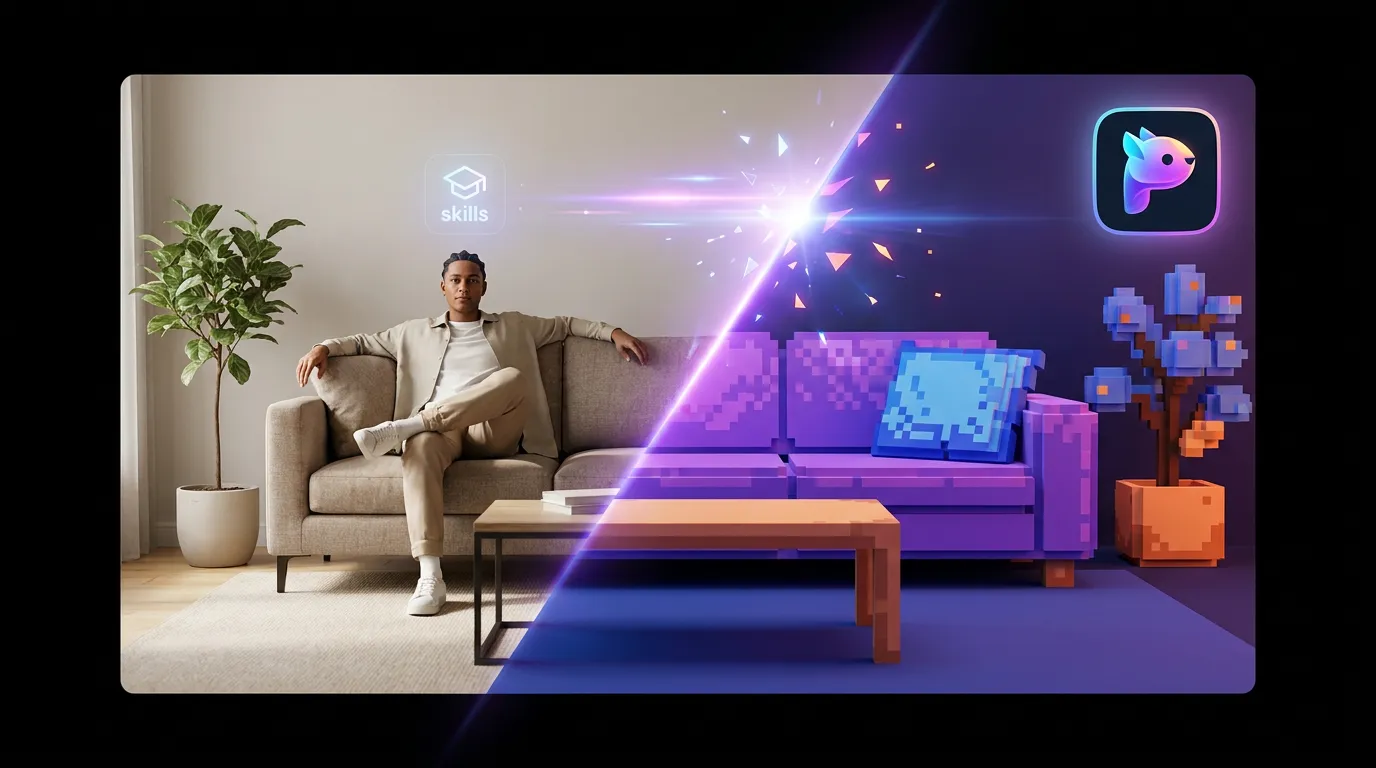
Pika is rolling out a new feature called Skills, a modular layer of one-tap visual transformations that sit on top of its existing image and video engine. It is launching with a very internet-native opener: Voxel-It, an effect that turns scenes into a Minecraft-style voxel world while keeping people looking realistically human. The announcement landed via Pika’s official channels and demo posts, positioning Skills as a faster way to ship trend-ready looks without waiting for the next big base-model release. (Pika announcement post)
If you’ve felt the last year of gen-video tools slowly turning into “all engines, no switches,” this is Pika adding switches, small, shippable ones that creators can actually use on a Tuesday afternoon when a meme format detonates.
What “Skills” are
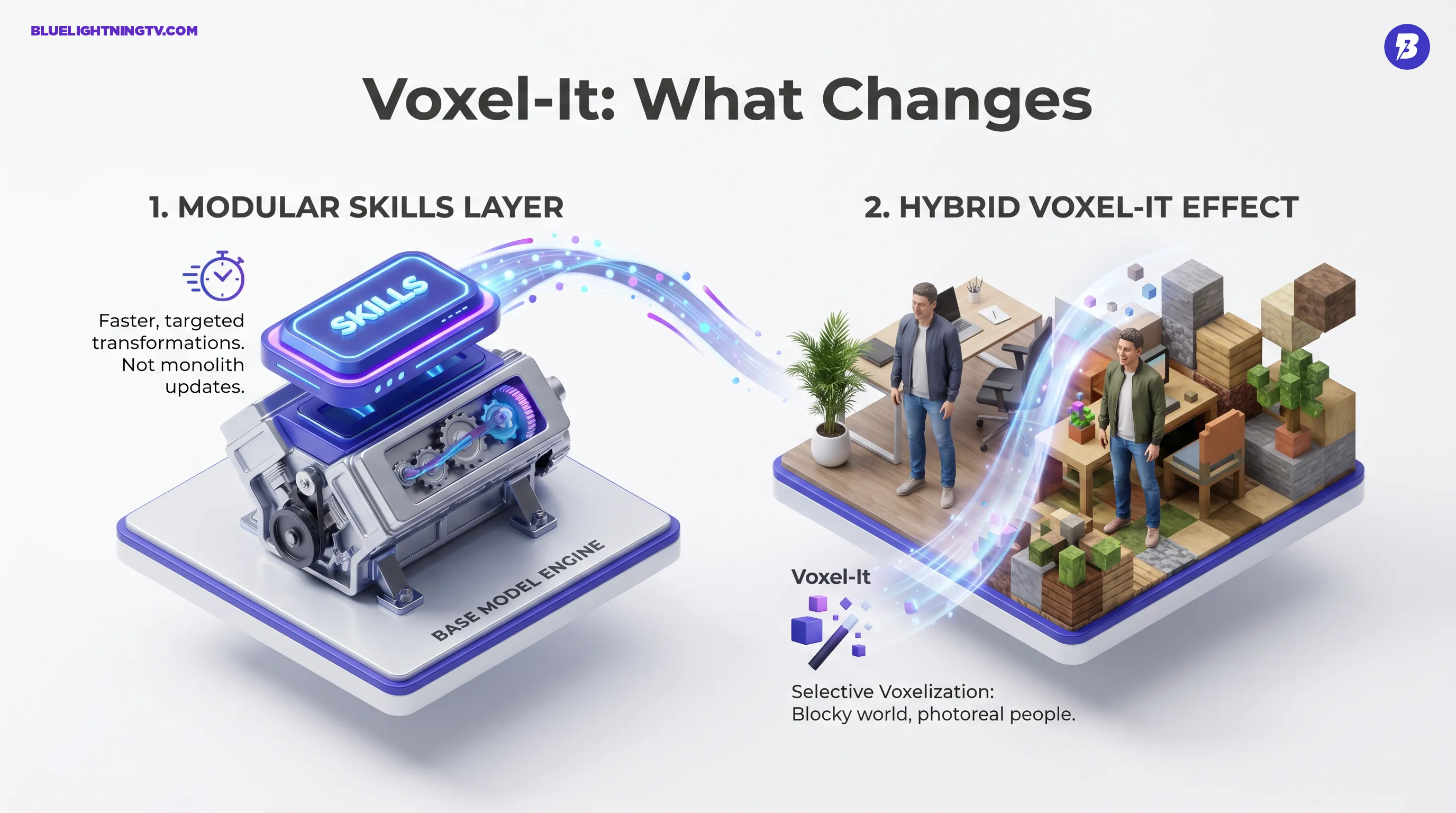
Skills are micro-tools: specific, named effects you can apply to inputs (photos, and in some cases video) without having to wrangle a full model release, learn a new prompt dialect, or gamble on whether the base model “understands the vibe.” Instead of one giant model update doing everything better (eventually), Skills let Pika ship targeted transformations incrementally.
That matters because creator workflows don’t run on quarterly research milestones. They run on:
1. Client wants this style by EOD.
2. This trend is hot for 36 hours.
3. I need five variations, not one perfect render.
Skills are a product decision, not a science flex: Pika is treating style and effects like a library you can expand quickly, rather than a monolith that only improves when the core model gets rebuilt.
Voxel-It, explained
Voxel-It is the first headline Skill and it is engineered for maximum scroll-stopping contrast: blocky voxel environments + photoreal humans.
Per Pika’s own description, Voxel-It turns an uploaded photo into a Minecraft-style world and lets you choose what gets voxelized: the background, the objects, or both, while keeping the people perfectly human. In other words, it is less “full stylization” and more “your world is a game, but you’re still you,” which is exactly the kind of hybrid look that plays well in reaction videos, creator skits, and “IRL to stylized universe” formats.
Pika’s own demo framing leans into that split: the room goes blocky; the person stays crisp. The point isn’t subtlety. It’s legibility plus novelty.
What it does well
1) Keeps the hook intact
Short-form video is face-forward. If you stylize someone into mush, you lose the performance. Voxel-It’s selective approach protects the thing audiences actually watch: expressions.
2) Makes “same clip, new world” easy
Creators constantly reuse setups (desk, couch, bedroom studio). Voxel-It turns familiar sets into something new without requiring a reshoot.
3) Ships as a repeatable look
The big advantage of an explicit Skill over prompt-only style chasing is consistency. If the Skill is stable, you can build a repeatable series aesthetic instead of reinventing the prompt every time.
Where it’ll feel limited
Voxel-It appears to be preset-driven (with a simple choice of what to voxelize: background, objects, or both). That’s great for speed, but it likely means you don’t get granular control over things like block size, palette, voxel density, or how aggressively it segments foreground objects versus background. In other words: it’s designed to be used, not endlessly tweaked.
That’s a trade many creators will gladly take, because “perfect control” is often just “more time spent not posting.”
Why this launch matters
Skills are Pika acknowledging a reality every creator already knows: the fastest-moving part of generative media isn’t model quality, it’s format culture.
A year ago, the conversation was mostly about base model leaps: longer clips, smoother motion, better coherence. That’s still important, but it’s no longer the only thing that matters. Now the battleground is iteration speed and effect velocity, how quickly a platform can give creators something shippable that matches what’s trending.
Voxel-It is a very intentional first pick because it checks three boxes:
1. Instantly recognizable aesthetic (voxel/Minecraft-adjacent)
2. Works on everyday footage (no special shoots required)
3. High meme compatibility (background swaps are remix fuel)
And because Pika launched it inside a broader “Skills” umbrella, the real story is less “Minecraft filter drops” and more “Pika can ship lots of these.”
Skills vs model updates
Here’s the strategic shift, in plain terms: Pika is splitting innovation into two tracks.
| Track | What changes | What creators feel |
|---|---|---|
| Base model upgrades | Quality, motion, coherence, general capability | Bigger jumps, slower cadence |
| Skills | Specific looks and transformations | Faster drops, trend-level agility |
| Stacked workflow | Model quality plus effect library | More consistent output at speed |
Creators don’t need every update to be a “new model.” They need new options that are dependable and quick to deploy.
Workflow implications
The best reason to care about Skills isn’t that they’re flashy. It’s that they reduce the most expensive thing in content production: friction.
Faster iteration loops
When effects are packaged as Skills, your iteration loop becomes:
1. shoot (or grab an existing clip)
2. apply effect
3. export
4. post
…instead of:
1. prompt experiment
2. rerun
3. tweak prompt
4. rerun
5. hope the model behaves today
That’s not just convenience. That’s the difference between making one “hero” piece and building a daily posting system.
More predictable series aesthetics
A lot of creator success is basically “do the same thing, but make it feel new.” Skills help because they can function like repeatable visual identities. If Voxel-It stays consistent, you can do:
1. “Voxel apartment tour”
2. “Voxel cooking series”
3. “Voxel street interviews”
…and viewers instantly recognize the format.
Less reliance on prompt wizardry
Prompt skill still matters, but packaged effects shift power toward creators who are good at ideas and execution, not necessarily those who want to spend an hour negotiating with a latent space.
How it fits Pika’s bigger push
This rollout also lines up with Pika’s broader direction: turning its ecosystem into something more modular and integratable, not just a single web app. Pika Labs maintains a developer-facing GitHub repository called Pika-Labs/Pika-Skills, but note that this repo is for developer or agent “skills” (workflows for AI agents) and is separate from the consumer-facing visual effect Skill announced as Voxel-It. In that context, Voxel-It reads like the consumer-facing proof: “here’s what modularity looks like when it hits creators.”
If you want more context on Pika’s broader agent-facing push, see our earlier coverage: PikaStream Beta Brings Real-Time Video Agents.
And yes, there’s a little subtext here: if Pika can ship a steady stream of Skills, it can stay culturally relevant between major upgrades without pretending every change is a revolution.
The win isn’t that Voxel-It exists. The win is that Pika can drop Voxel-It and then keep dropping things like it.
What to watch next
Pika has not published a detailed public spec sheet for what Skills will include beyond early demos and the initial Voxel-It announcement, but expectations are already forming around more stylized cameras, genre filters, and other “instant remix” looks. The key questions for creators won’t be theoretical. They’ll be painfully practical:
1) Can Skills stack cleanly? (Effect layering without turning people into uncanny soup.)
2) Do Skills behave consistently across footage types? (Indoor lighting vs daylight vs low-light grain.)
3) Does this stay fast at scale? (A feature is only “instant” until everyone uses it.)
4) Are the controls precise enough? (Selective background or foreground control is the difference between “postable” and “almost.”)
Voxel-It is a fun first flag in the ground, but Skills will be judged on cadence and reliability. If Pika can keep shipping useful, culture-aware effects that don’t break the moment you feed them real-world footage, Skills could become the feature that makes Pika feel less like a generator and more like a remix console, which is exactly where modern creator production is headed.