

OpenAI just flipped the switch: GPT-5.5 Instant is rolling out as the default model in ChatGPT. The headline is not “new model hype.” It is that everyday creative work in ChatGPT should now require less babysitting.
OpenAI’s latest move is deceptively simple: most people open ChatGPT and it is already on GPT-5.5 Instant. No model picker ceremony. No “please migrate your workflows by Friday” memo, at least not for casual users. Just a quieter default that is designed to be faster, more factual, and less prone to wandering off into confident nonsense.
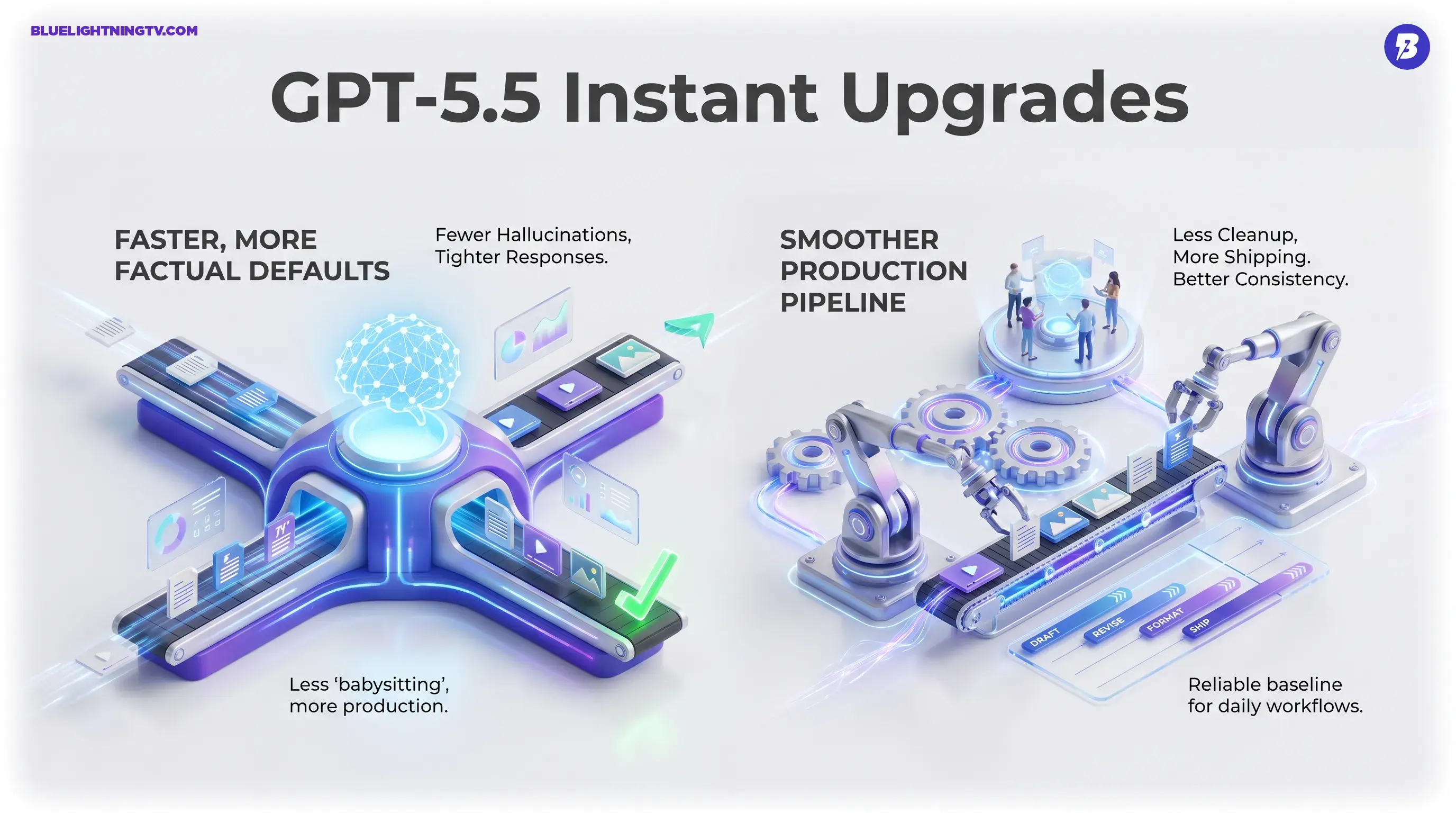
For creators, marketing teams, and anyone using ChatGPT as an actual production tool, not a “look what it can do” demo machine, defaults matter. Defaults decide what happens when a teammate opens a new chat, when an intern generates 40 ad variants, or when you are halfway through packaging a campaign and do not have time to argue with an AI about what year it is.
What changed in ChatGPT
GPT-5.5 Instant is positioned as the new daily driver model. OpenAI’s framing centers on reliability and response quality, not a bunch of shiny new modes.
Two practical changes are showing up immediately:
- Less hallucination, more consistency on factual questions and business tasks (OpenAI reports a 52.5% reduction in hallucinated claims on high stakes prompts versus GPT-5.3 Instant, and 37.3% fewer inaccurate claims in user flagged difficult conversations).
- Shorter, cleaner answers by default, with less over formatting and fewer “here is a 12 step plan you did not ask for” responses.
That second point sounds cosmetic until you have used ChatGPT in a real workflow. When you are drafting hooks, revising scripts, or formatting copy for five channels, verbosity is not helpful. It is friction.
OpenAI is also tying the model update to more controllable personalization behaviors in ChatGPT, especially around memory, so users can see and adjust what information the assistant is pulling from. That matters if you are using ChatGPT across multiple client brands, projects, or tones and do not want it freelancing your identity mid brief.
Why defaults matter
Most teams do not standardize AI usage through written policy. They standardize it through whatever model happens when you hit “new chat.”
That is why this rollout hits harder than it sounds. If GPT-5.5 Instant is genuinely more dependable, then every routine task improves:
- first drafts that do not need as much correction
- less time spent re prompting to get a direct answer
- fewer “wait, that claim is made up” fire drills
And importantly: it nudges teams toward using ChatGPT for more than brainstorming. When your baseline model is stable, you can safely push more steps into the AI assisted pipeline, draft to QA to repurpose to format, without the process collapsing into manual cleanup.
What “Instant” implies
The word “Instant” is not just branding. It signals how OpenAI wants this model to be used: high frequency, high throughput work.
Think less “deep research dissertation” and more:
- tight rewrite loops
- campaign asset packs
- script variants and punch ups
- formatting into platform specs
- structured outputs for downstream tools
In other words: the stuff creators do all day, not the stuff people screenshot once.
OpenAI also describes a tiered ChatGPT lineup built around three modes: Instant, Thinking, and Pro. The strategic bet is that most people should live in Instant most of the time, with deeper modes used when the task actually demands it.
Reliability is the real feature
OpenAI is explicitly leaning into factuality improvements, including internal claims of major hallucination reduction compared to GPT-5.3 Instant. Coverage has echoed the same narrative: this release targets those “why did it just invent a number?” moments that kill trust in production settings.
In creative ops, accuracy is not about being a know it all. It is about not shipping avoidable mistakes at scale, especially when you are generating dozens or hundreds of assets.
If you have ever generated a full email sequence only to discover the AI casually fabricated a feature, a pricing detail, or a product claim, you already understand why “fewer hallucinations” is not a nerd metric. It is a workflow unlock.
Where you will feel it first
GPT-5.5 Instant’s reliability improvements show up fastest in workflows where consistency matters more than inspiration:
- Marketing copy at volume: fewer claims that need emergency verification.
- Editorial packaging: fewer structural misses (missing sections, drifting tone, broken formatting).
- Client work: less “this sounds confident but wrong,” which is the worst genre of wrong.
You still need human review. But you should need less human rescue.
Context and memory upgrades
Long context capability has been the drumbeat of the last year, but GPT-5.5 Instant’s more immediate impact is how it behaves inside ongoing threads.
OpenAI is emphasizing better use of prior chats, files, and connected services in supported experiences, plus new visibility into memory sources so users can manage what is being used.
That matters because ChatGPT is increasingly used as a semi persistent collaborator: brand voice, ongoing series formats, recurring client needs, and the “please do not use this phrase ever again” list.
Pragmatic take on memory
Memory is powerful, but it is also a lever that needs governance in team environments. The better the defaults get, the more teams will rely on them, so the ability to audit and correct what the model remembers becomes less of a privacy feature and more of a production feature.
API and pricing reality
On the developer side, the key reference remains OpenAI’s pricing page (OpenAI API pricing), because that is where “can we afford to run this all day?” gets answered.
As of May 2026, OpenAI lists GPT-5.5 pricing at $5.00 per 1M input tokens and $30.00 per 1M output tokens, with cached input priced at $0.50 per 1M tokens (where caching applies). Always validate current rates on the pricing page, since OpenAI can update tiers and discounts.
OpenAI is also pushing caching and efficiency patterns that reward repeatable workflows, exactly what content ops teams do: reusable system prompts, stable brand constraints, and templated outputs.
| What you are optimizing | What improves with 5.5 Instant | What to still watch |
|---|---|---|
| Throughput | Faster default responses | Latency consistency under load |
| Quality control | Fewer hallucinations, cleaner output | Still requires review before publishing |
| Workflow continuity | Better thread consistency plus memory tools | Team governance of memory and connectors |
Translation: the cost story is not just token price. It is how many retries you need to get something usable. Reliability is cost control.
Implications for creators
If you are a solo creator, GPT-5.5 Instant being the default is mostly a quality of life upgrade: less fluff, fewer rerolls, fewer “why is it doing that” moments.
If you are a team, it is bigger. Defaults create behavior at scale. And the biggest shift here is that OpenAI is trying to make “good enough to ship after review” the normal experience, not the lucky one.
The win is not that AI creates more. The win is that AI wastes fewer of your human minutes on cleanup.
That is the direction we care about: not hype, not vibes, just fewer broken workflows between idea and publish.
For more context on OpenAI’s broader push toward models that actually finish multi step work, this pairs with our recent coverage: GPT-5.5 Signals a Shift Toward Finished AI Work.
Bottom line
OpenAI making GPT-5.5 Instant the default in ChatGPT is a product decision with outsized impact: it upgrades the baseline experience for millions of daily workflows. The most important improvements are not flashy. They are operational: fewer hallucinations, tighter responses, and more predictable behavior across ongoing work.
If you build content systems, this is the kind of update that quietly adds hours back to your week. Not because it replaces creative taste, but because it stops dragging you into pointless corrections.
And yes, you should still review before you ship. But you should have to say “wait, what?” less often.