

OpenAI just rolled out GPT‑5.5, and the vibe is not new chatbot energy. It is production energy, aimed at creators and teams who are tired of AI flaming out halfway through a workflow and leaving humans to do the unglamorous glue work.
GPT‑5.5 is now showing up across ChatGPT and Codex, with OpenAI positioning it as a model that can plan, use tools, and self check in a way that holds together across longer tasks. In other words: less here is a draft, more here is the draft, the variants, the structured output, and the boring formatting you did not want to do.
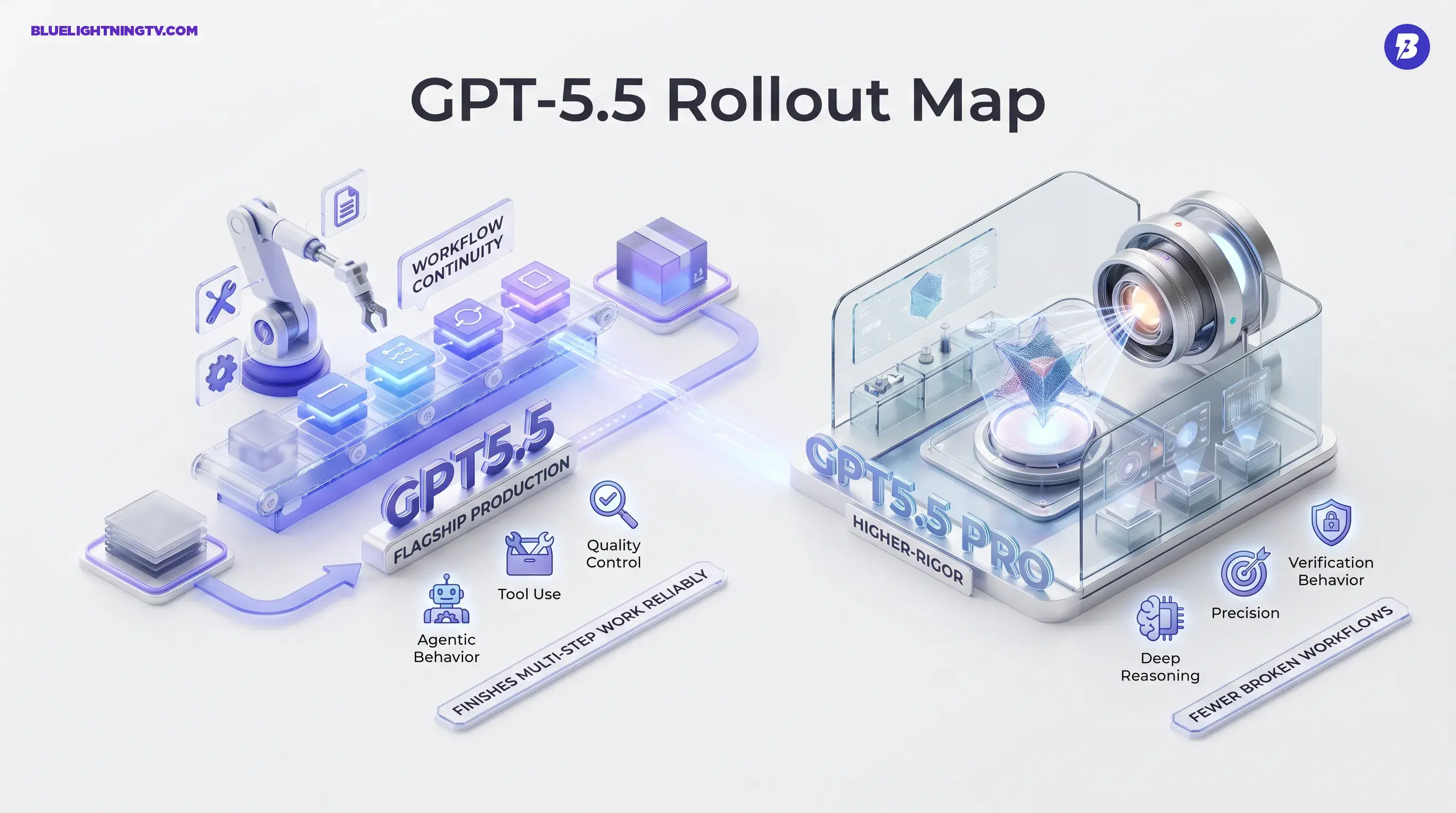
The headline shift: OpenAI is optimizing for AI that finishes multi step work reliably, not AI that just sounds smart for two paragraphs.
What shipped
GPT‑5.5 arrives as OpenAI’s newest flagship family, with a clear split between strong default and higher rigor runs.
Two main variants
- GPT‑5.5: the standard flagship option meant for high capability everyday production.
- GPT‑5.5 Pro: a heavier variant built for higher precision and deeper reasoning, with the expected tradeoffs in cost and latency.
OpenAI’s official docs for the Pro variant live here: gpt‑5.5‑pro.
Quick snapshot
| Area | What changed | Why it matters |
|---|---|---|
| Agentic behavior | Better long horizon task follow through | Fewer step 3 failures |
| Tool use | Stronger tool planning plus execution | Automations become less fragile |
| Quality control | More self checking behavior | Less manual cleanup per run |
Why creators feel it
Most creator workflows are not write me a caption. They are chains: brief, outline, drafts, variants, formatting, packaging, handoff. Models that are great at single outputs can still be exhausting in real production because they require constant steering and correction.
GPT‑5.5 is tuned for workflows that need continuity: keeping requirements stable, staying on task, and not losing the thread once multiple deliverables are involved.
The real enemy: glue work
If you have used AI at scale, you know the time sink is not typing prompts. It is everything after:
- reformatting output into channel specs
- aligning tone across multiple assets
- catching inconsistencies and missing sections
- rerunning because the model forgot constraint 4
GPT‑5.5 is OpenAI trying to shrink that gap: less babysitting, fewer retries, more review and ship.
Pragmatic read: the win is not AI replaces your taste. The win is AI stops wasting your taste on formatting and rework.
Tool use gets serious
Agents as a buzzword is getting tired, but the underlying capability is real: models that can execute multi step jobs with tools without drifting.
OpenAI has been building toward this for a while: Codex workflows, tool calling, structured outputs, longer context. GPT‑5.5 is the model level upgrade intended to make those features feel less like a demo and more like something you can trust in production.
If you want the COEY take on the same shift toward workflow completion, see GPT‑5.5 Targets Real Automation for Creators.
Where that shows up first
For creators and ops teams, tool competence matters most in these spots:
- Content packaging: one source into many channel ready outputs
- Automation handoffs: model into spreadsheet or JSON into CMS or email tooling
- Light dev tasks: scripts, templates, repo changes that need follow through
If GPT‑5.5 does what OpenAI is signaling, more teams will move from AI for drafting to AI inside the pipeline, where the output is structured, checkable, and ready to route.
Multimodal reality check
The original chatter around GPT‑5.5 included multimodal expectations, especially around images. What is supported in current model documentation is that GPT‑5.5 Pro accepts text and image inputs, while output is text.
For production teams: do not plan your pipeline around rumored modes. Plan around what you can consistently run and review.
What to watch in real usage
- Cohesion across assets: does it keep the same concept and tone across a full pack?
- Edit responsiveness: does it handle make 12 variants without quality collapse?
- Verification behavior: does it catch missing requirements before you do?
That is the difference between cool demo and we can operationalize this.
Access and rollout
GPT‑5.5 rolled out in ChatGPT and Codex for paid tiers, including Plus, Pro, Business, and Enterprise. OpenAI has also stated GPT‑5.5 is available via the API, with availability dependent on account access and the current model catalog.
For pricing and model availability, OpenAI’s pricing page is the canonical reference: OpenAI API pricing.
What changes when it is in the API
Once a model is callable, it stops being a tool you talk to and becomes infrastructure. That is when you can wire it into:
- content ops automations (intake, draft, QA, publish prep)
- templated campaign generation
- structured output pipelines (CSV or JSON)
- internal assistants that follow your process, not just your prompts
What this means for production teams
The biggest implication is not that GPT‑5.5 can generate more content. Everyone can generate more content. The implication is that more of the output may be usable on the first pass, because the model is tuned for continuity and completion.
Expect workflow design to matter more
GPT‑5.5 will reward teams who already think in systems:
- clear input specs (what done looks like)
- structured deliverable formats
- cheap verification steps (automated checks before human review)
- routing (not everything needs the Pro variant)
Punchline: model capability is increasingly the baseline. The advantage shifts to whoever builds the cleanest production loops around it.
What to watch next
GPT‑5.5’s success will not be decided by benchmarks or launch day screenshots. It will be decided by three boring but decisive production behaviors:
Reliability under load
Does it stay consistent when you run batch jobs, not single prompts?
Tool failure behavior
When something breaks, does it fail loudly and recover cleanly, or silently invent progress?
Cost discipline
Do teams build routing so GPT‑5.5 runs where it is valuable, not everywhere?
OpenAI is making a direct bet with GPT‑5.5: the next leap is fewer broken workflows. If that holds up in real creator pipelines, this is not just a new model moment. It is another step toward AI acting like a production teammate, one that does not need constant supervision to cross the finish line.