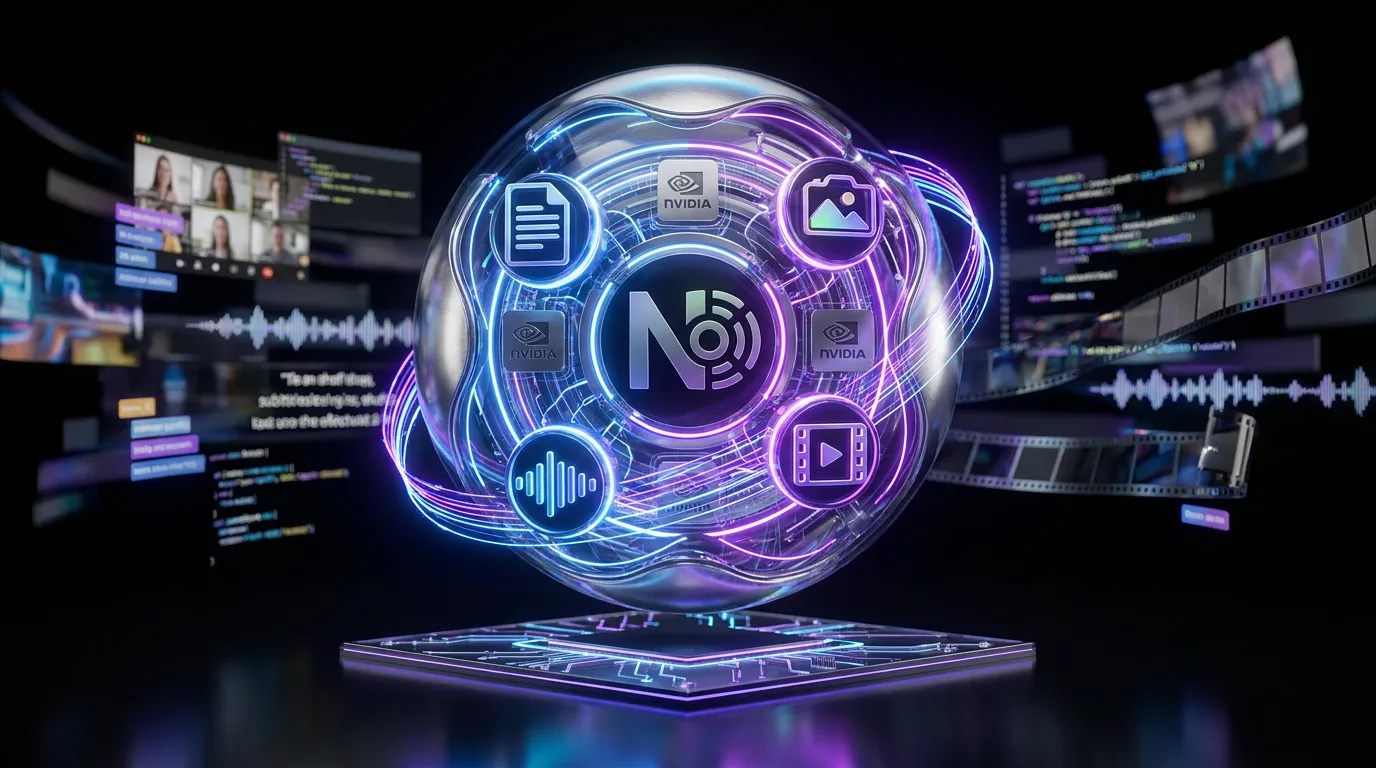
NVIDIA just dropped Nemotron 3 Nano Omni, an open-weights multimodal model aimed at a very specific pain point: real production pipelines that juggle text + images + audio + video without turning into a fragile chain of disconnected subsystems. NVIDIA’s release post frames it as a unified “omni” model for multimodal agents, built to reduce orchestration complexity while staying efficient enough to deploy. Start with NVIDIA’s announcement for the overview and ecosystem links: NVIDIA’s Nemotron 3 Nano Omni announcement.
This is not being pitched as a new chatbot. It’s infrastructure: something you put behind tools that need to see, listen, read, and summarize quickly.

What shipped
Nemotron 3 Nano Omni is NVIDIA’s unified multimodal reasoning model designed to ingest mixed inputs (documents, screenshots, images, audio, video) and produce text outputs that can drive downstream automation like search, tagging, QA checks, timeline notes, or agent actions.
For a more developer-facing breakdown (architecture choices, deployment notes, and why NVIDIA claims it is fast), NVIDIA also published a technical post: NVIDIA Technical Blog: Nemotron 3 Nano Omni.
Why “omni” matters
Most “multimodal” workflows today still look like this behind the curtain:
- ASR model transcribes audio
- VLM reads screenshots or frames
- LLM summarizes, extracts, formats
- glue code tries to align timestamps and references
- and everyone pretends the bugs are “edge cases”
Nemotron 3 Nano Omni’s core promise is: stop chaining three to five models just to answer a question about a video meeting, a screen recording, or a folder of mixed assets.
The real win is not that it can handle multiple modalities. The win is that it can handle them together without your pipeline turning into a synchronization hobby.
Specs without the hype
NVIDIA describes Nemotron 3 Nano Omni as an efficient model built for agentic workloads, using a hybrid Mixture-of-Experts (MoE) design to keep compute practical by activating only a small portion of parameters per token.
Three headline points the official materials emphasize:
- Open weights so teams can run it privately and customize
- Long context so it can keep more of your project “in the room”
- Throughput focused positioning so it is usable in real workflows, not just demos
For model coverage and NeMo AutoModel integration details, NVIDIA points developers here: NeMo AutoModel docs: Nemotron Omni.
Quick snapshot table
| What you care about | What NVIDIA says it delivers | Why it changes workflows |
|---|---|---|
| Fewer moving parts | One model across modalities | Less brittle orchestration and alignment |
| Bigger working memory | Long-context support | Less chunking and better continuity |
| Production viability | Throughput-focused design | More batch and near-real-time use cases |
Context length: the practical effect
In practical terms, long context is the difference between:
- “Here’s the transcript chunk. Now here’s another chunk. Now forget chunk one.”
and - “Here’s the whole meeting, plus the deck, plus the brand guidelines. Now extract only what matters.”
For multimodal work, this is not just about longer documents. It is about keeping audio, frames, and on-screen text aligned long enough to produce useful outputs like consistent notes, structured metadata, or review decisions.
Where it fits in NVIDIA’s stack
NVIDIA is also being intentional about where this model runs.
If you are a creator team that needs privacy (client footage, unreleased assets, internal calls), open weights plus controlled deployment is the point. NVIDIA keeps tying these releases to its serving and packaging story, including NIM. The official product page is here: NVIDIA NIM microservices overview.
What “NIM” implies (in normal language)
- a standard way to serve models
- repeatable deployment across environments
- fewer bespoke inference server situations
That is boring in the best way because boring infrastructure is what lets creative automation run every day without someone babysitting it.
What creators can actually do with it
Nemotron 3 Nano Omni is most interesting in workflows where the bottleneck is not “generate something new,” but understand, sort, and route what already exists.
Content ops and post-production triage
- timestamped highlights from interviews
- “pull every moment where the product name is spoken”
- summaries that include what is visible on screen, not just what is said
Metadata that is not junk
- scene descriptors plus on-screen text extraction
- consistent taxonomy tagging for a DAM
- searchable notes tied to timestamps
Screen recordings become usable
Screen recordings are everywhere: tutorials, bug reports, client feedback, internal SOPs. An omni model that can interpret UI plus narration can turn those into structured outputs teams can actually reuse.
The tradeoffs to watch
Unified does not mean infallible
One model reduces pipeline complexity, but it does not erase multimodal failure modes:
- missed details in dense screens
- inconsistent OCR on stylized text
- temporal misunderstandings in fast-cut video
Long context still has a cost
Even if the context window is big, pushing massive multimodal inputs can increase:
- latency
- memory pressure
- compute cost per request
Open weights still require ops
Running privately is empowering, but it also means your team owns:
- serving reliability
- monitoring
- access controls
- evaluation and regression testing
Open weights do not magically give you a pipeline. They give you the right to build one without asking permission.
The bigger implication
Nemotron 3 Nano Omni is another signal that the market is moving past “multimodal is cool” into “multimodal has to be deployable.” NVIDIA’s angle is consistent: efficient models + long context + run-it-yourself options, optimized to slot into real systems.
For creators and studios, the takeaway is straightforward: multimodal automation is getting less demo-coded and more operational. If your workflow includes lots of review, lots of sorting, lots of tagging, and lots of internal knowledge trapped in recordings, this is the kind of model release that can reduce hours of glue work without pretending it replaces taste, judgment, or final editorial decisions.