
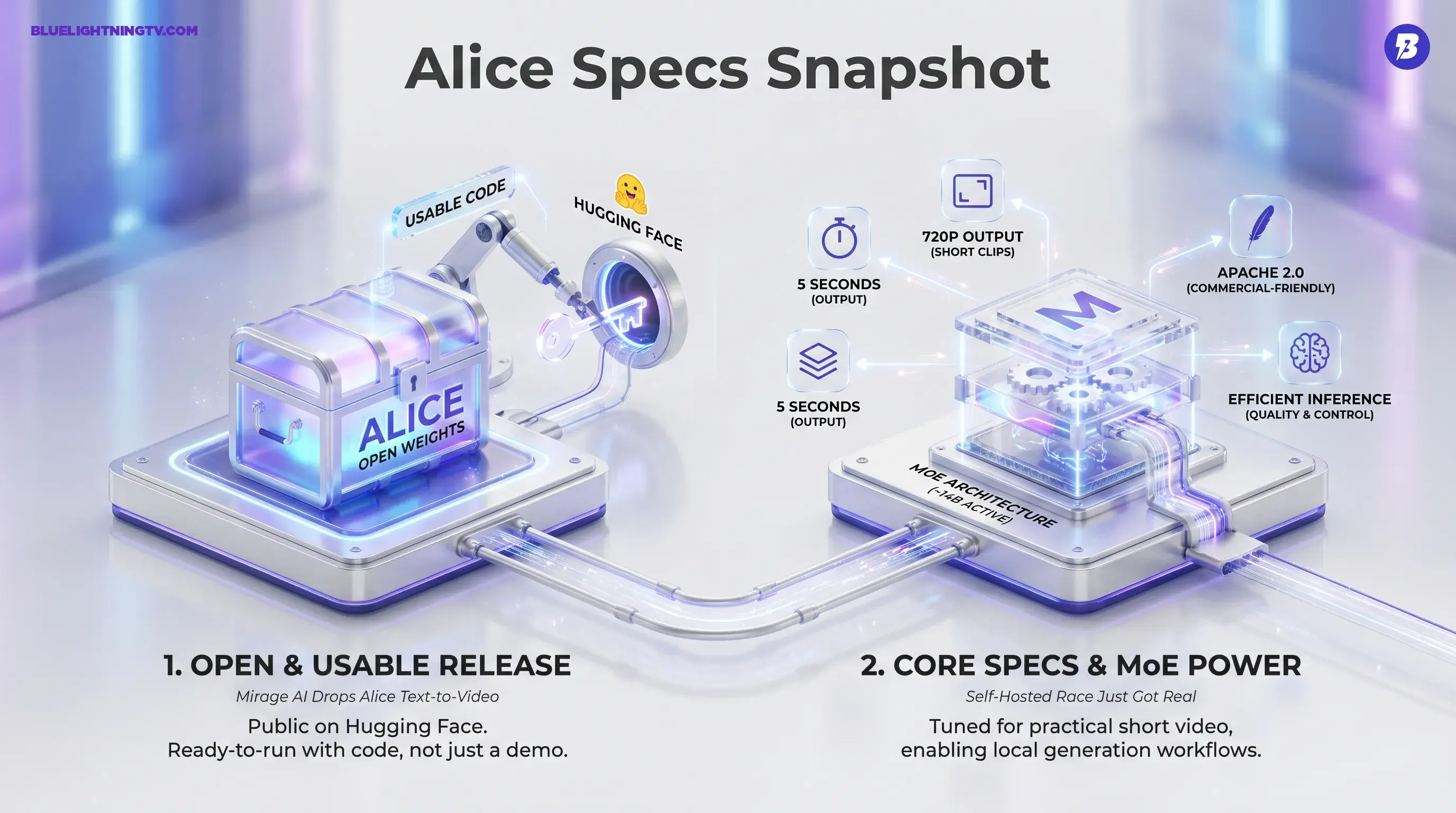
Mirage AI just put Alice, its open-weights text-to-video model, into creators’ hands via a public release on Hugging Face: gomirageai/Alice-T2V-14B-MoE. It is positioned as a Mixture-of-Experts (MoE) model built for short clips, with Apache License 2.0 licensing and enough scaffolding to actually run it yourself instead of staring at a coming soon demo page.
This matters because open video has been stuck in an awkward middle school phase: exciting, messy, and always almost usable. Alice is another shove toward a world where teams can generate video without living inside a vendor UI, pricing model, or content queue.
The signal: Open is no longer just a research flex. It is becoming a workflow choice, especially for studios and brands that want control, repeatability, and the option to keep assets private.
What Mirage shipped
Alice shows up publicly as Alice-T2V-14B-MoE. Mirage also has a second listing with overlapping specs: gomirageai/Mirage-T2V-14B-MoE. The headline claims are straightforward: text to short video, tuned for practicality rather than feature film dreams.
On the public listings, Mirage describes an MoE setup where total parameters are larger, but only a subset is active per step. In the model card, that is described as roughly 27B total parameters with roughly 14B active per step.
The core specs
Here is what is explicitly described in the public model listing.
| Spec | What is stated | Why it matters |
|---|---|---|
| Output length | About 5 seconds | Matches ad and social shot needs and is a realistic unit for gen video today |
| Output resolution | 480p and 720p | Good enough to edit territory, especially with upscalers |
| Architecture | MoE, about 27B total and about 14B active | Aiming for quality without paying full price every forward pass |
| License | Apache 2.0 | Commercial friendly for teams who actually ship work |
Open weights, real leverage
Calling something open is easy. Making it usable is harder. What makes Alice notable is that it is not just a link to weights. It is a release with code and instructions in the repo that help teams actually run it.
Why creators care
Closed video tools are getting better fast, but they come with familiar tradeoffs:
- Cost curves punish iteration, which is the thing creators do most
- Queues and throttles turn fast idea into tomorrow render
- Policy constraints can block legitimate brand work in edge cases
- Asset privacy becomes a legal and compliance discussion instead of a checkbox
Alice does not magically delete those problems for everyone. Local video gen still requires hardware, patience, and a little technical stamina. But it makes the option real for more teams.
Open weights does not mean effortless. It means the bottleneck moves from vendor says no to your workflow says yes.
What Alice is good for
Alice is tuned for the current reality of generative video: short, punchy shots you stitch into sequences. That is not a limitation. It is how most ad and social production works anyway.
Where it fits immediately
- Concepting and pitch drafts: fast visual direction without a full shoot
- Variant factories: same idea, many hooks
- Internal content ops: training, product explainers, quick scene coverage
- Style experiments: fine-tune or adapt around a brand look if your team has the chops
And because it is Apache licensed, the can we use this commercially conversation is far less annoying than the usual open video licensing roulette.
The MoE angle
Mixture-of-Experts can sound like a whitepaper trap, but the point is simple: instead of one monolithic model doing everything all the time, the system routes parts of the job through specialized experts.
Practically, that is Mirage aiming for:
- higher apparent capacity than a similarly sized dense model
- more efficient inference than activating the whole network every step
- a pathway to quality improvements without scaling cost linearly
The Hugging Face listing also references separate components for different denoising regimes, for example high noise versus low noise expert parts. Translation: there is explicit structure meant to help the model behave across the generation process, rather than relying on one blob of weights to do it all.
What Alice is not
No native audio
The Hugging Face listings for Alice and Mirage-T2V describe text-to-video output and do not document built in audio generation. If you need sound, you are still pairing this with your audio toolchain.
Not a one click product
If you are used to Runway style type prompt then download clip, Alice is a different vibe. Open models are powerful, but they come with setup overhead: environment configs, GPU constraints, inference tuning, and the general joy of debugging why your install hates you personally.
Still in the prove it phase
Alice looks legit on paper and in positioning, but open video lives and dies on real world reliability: temporal stability, prompt adherence, and how often you get close enough versus why is the character melting.
In other words, the release is meaningful even if the model is not the category king. The move toward open, inspectable, self hostable video is the bigger arc.
How it changes the market
Alice lands in a moment where open video is getting crowded in a good way. The competitive pressure is not just about who generates the prettiest five seconds. It is about who gives creators:
- control over the pipeline
- predictable costs
- version stability, so your model does not silently change overnight
- integration hooks for real production systems
If you have been following open local video momentum, Alice also adds pressure on closed platforms to justify lock in. Better output is one argument. Better workflow is the one that wins budgets.
A quick positioning snapshot
| Question | Alice likely answer | Implication |
|---|---|---|
| Can I self host it | Yes | Good for privacy and pipeline control |
| Is it built for long scenes | No, short clips | Treat output as shots, not full scenes |
| Does it include audio | Not natively | Plan a separate audio pass |
| Is it commercial friendly | Apache 2.0 | Easier for brand use and product embedding |
What to watch next
The next phase is not another announcement. It is whether Alice gets wrapped into the creator tools people actually use.
Look for:
- turnkey inference wrappers, the difference between available and adopted
- node based integrations, because graph based workflows are where open models go to become usable
- performance tuning, VRAM needs, step counts, quantization options
- quality benchmarks creators trust, same prompts, same settings, side by sides
And inevitably, the most honest metric: how many teams start quietly using Alice for real work because it saves time and keeps assets in house.
Mirage did not just drop a model. They dropped a stronger argument for self hosted generative video and for creators who are tired of renting their own workflow back from a web app, that is the kind of open that actually matters.