A quick reality check before we get excited: “SeamlessTextInpainting” does appear to exist as a newly discussed Google model name surfacing publicly around April 14, 2026, but it does not yet have the kind of durable, sourceable footprint you normally want for a clean “Google just launched X” write-up.
Right now, it’s mostly a name moving through social chatter, without the usual stable artifacts you would expect for a fully public release, like a canonical Google Research announcement page, an official repository under a Google org, or a model card you can cite with confidence.
So we are not going to pretend there is a neat launch page with specs and guarantees. If you want to see the thread that kicked up a lot of the recent attention, here is one example: an X post discussing “SeamlessTextInpainting”.
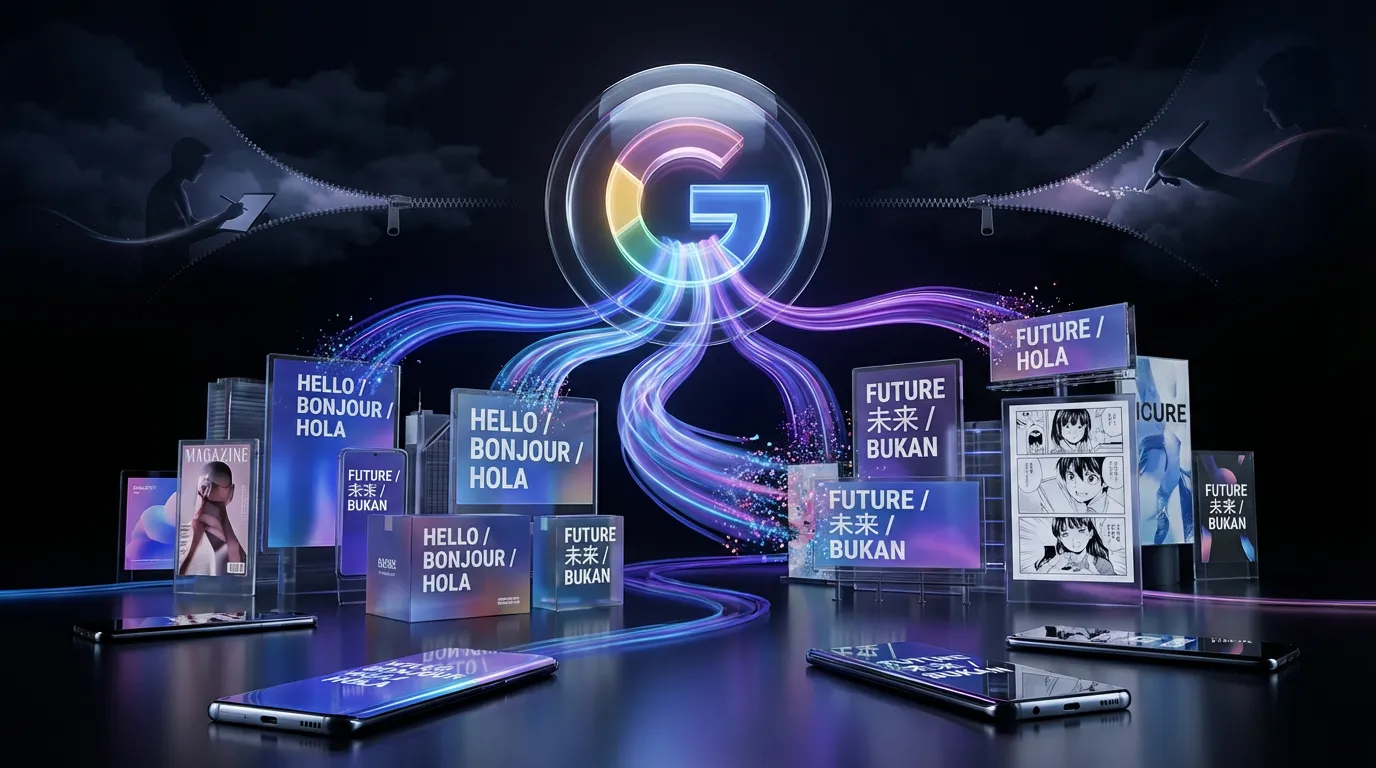
What is real is the underlying problem this post is about: teams still waste an absurd amount of time localizing images where text is baked into pixels. And there are credible, usable approaches available today that map to the same workflow goal.
So here’s the clean update: text-aware inpainting is moving from “cool demo” to “pipeline primitive,” and the best signals right now come from proven image editing research and public repos you can test.
Why this matters
Image localization looks simple until you do it at scale. If you’re shipping:
- e-commerce product images with feature callouts
- game UI screenshots in store listings
- ad creatives with embedded pricing or legal text
- OOH mockups, posters, thumbnails, banners
You already know the pain: translation is the easy part. The expensive part is making the translated text look like it belonged there from day one, with consistent lighting, texture, and perspective, and without obvious seams.
The real bottleneck: replacing text without destroying the design or your production schedule.
What “text inpainting” is
There are three related tasks people often lump together:
| Task | What it does | Localization value |
|---|---|---|
| Text removal | Erase existing text and reconstruct background | Creates a clean plate for redesign |
| Text replacement | Remove text, then insert new text | Fast multi-language variants |
| Text restoration | Repair missing or damaged text | Fixes low-quality captures and scans |
The “SeamlessTextInpainting” chatter reads like a specialized text replacement engine tuned for Chinese typography. That direction is plausible, because CJK scripts punish sloppy rendering hard. But until there is an official, stable Google release package under this exact name, it is safest to treat details like scope, licensing, and capabilities as not fully verifiable.
What’s real right now
If you are looking for credible building blocks you can evaluate immediately, there are two buckets worth knowing.
Google’s editing research
Google has published work on text guided inpainting and editing that is directly adjacent to localization workflows. A strong reference point is Imagen Editor and EditBench, which covers text guided inpainting behavior and how to evaluate it.
It is not a “drop in a Chinese translation and preserve font identity” product, but it reflects the larger trend: editing is becoming a first class model behavior, not an afterthought.
Open repos you can test
On the open side, nickersonj/text-inpainting is a pragmatic example of a workflow many teams can actually run: generate a mask from a text prompt, then inpaint with a Stable Diffusion inpainting pipeline.
For text heavy art styles, manga focused work like MangaInpainting is a reminder that “seamless” depends heavily on the domain. Screen tones and line art behave differently than product photography.
And for text restoration and structure aware approaches, Text Image Inpainting via Global Structure-Guided Diffusion Models (GSDM) is a clear signal that researchers are treating text as structure, meaning layout plus strokes, not just pixels.
None of these are a magic “localize my whole ad library” button. But together they show where the field is landing: better segmentation, better reconstruction, more control.
What actually changes workflows
For creators, “text replacement in images” only matters if it plugs into real production. The workflow shift is operational.
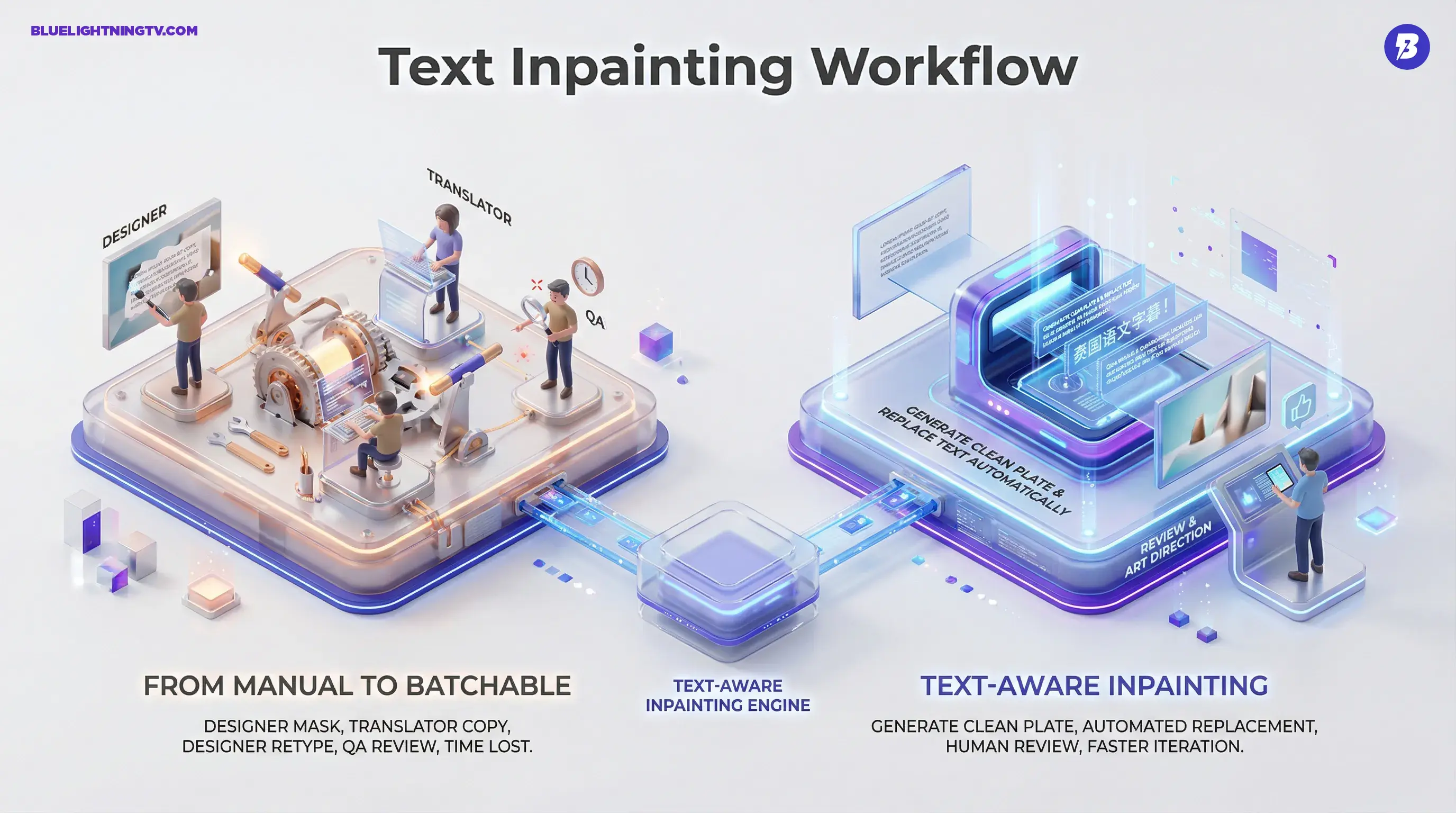
From manual to batchable
Traditional localization is still a relay race:
- designer masks text
- translator delivers copy
- designer retypes and style matches
- QA finds three tiny mistakes
- everyone loses an afternoon
Text aware inpainting makes a different promise: generate a clean plate and or replace the text automatically, then push humans up the chain into review and art direction instead of pixel surgery.
Design consistency becomes measurable
The sneaky win is consistency. When swaps become automated, teams can standardize:
- safe font families per locale
- line breaks and character limits
- placement rules around products and faces
- contrast requirements for readability
Automation doesn’t remove taste. It removes repetitive labor so taste can show up where it matters.
Where this breaks today
Even with improving models, text replacement inside images still has three recurring failure modes in production.
Typography isn’t just pixels
Fonts carry brand identity. “Close enough” can still look wrong, especially in Chinese where stroke thickness, spacing, and weight changes read as instantly non-native.
Background reconstruction is the tell
Great replacement requires great reconstruction. If the model erases a shadow, kills a texture, or invents new detail, audiences will not say “nice diffusion model.” They will say “why does this look fake?”
Layout constraints fight translation
Translations expand and contract. If your system can replace text but cannot intelligently reflow layout, you are still stuck doing manual fixes later in the pipeline.
The implication for creators
The “SeamlessTextInpainting” conversation, whether it lands as a fully public release you can pull today or an early limited drop, points at a direction the industry is moving toward:
- Specialization: models tuned for text, not general inpainting
- Localization at scale: variants become cheap enough to generate routinely
- Creator-first throughput: less Photoshop grunt work, more iteration
Until there is a fully sourceable Google release package under this name, the responsible takeaway is simpler: if localization is a recurring cost center for you, it is worth testing text aware inpainting tooling now, because the building blocks are already public, and the gap between “research” and “deployable” is shrinking fast.