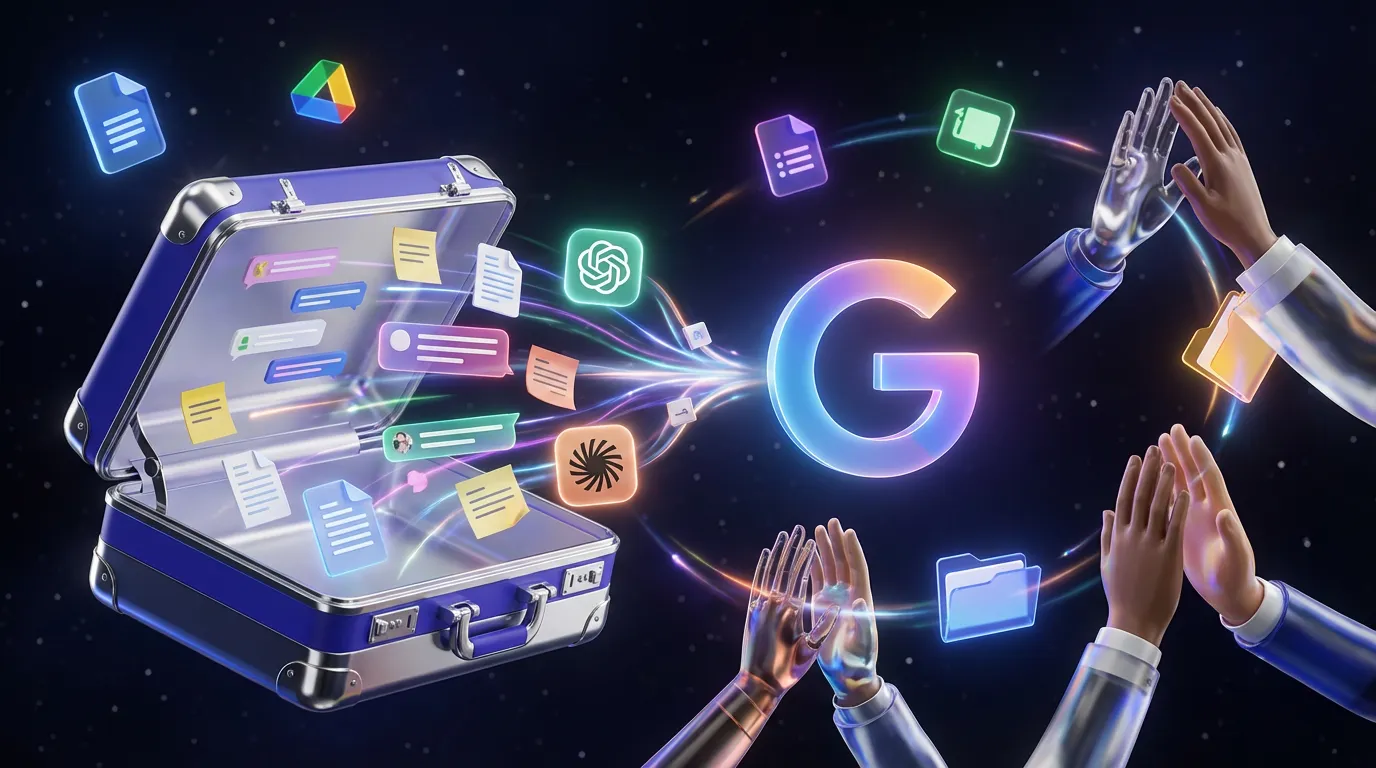
Google is rolling out a Gemini feature that sounds boring until you realize it is basically a crowbar for creative lock in: chat history import. In plain English, Gemini can now pull in conversation exports from other assistants, most notably ChatGPT and Claude, so the work you have already done, prompts, drafts, iterations, and those crucial decision threads, can live inside Gemini.
The feature has been spotted and reported as “Import AI chats” in Gemini’s UI during staged rollout and testing. Multiple reports describe an upload based flow through the Gemini app or web experience, where you bring your exported file into Gemini rather than Gemini pulling data directly from competitors. Gemini Prepares to Let Users Import Chats From ChatGPT and Other AI Bots

This is news, not a vibe shift. It is Google making a practical bet: the next competitive moat is not just model IQ, it is workflow gravity. And nothing creates gravity like letting teams bring their existing prompt IP with them.
What actually shipped
Gemini’s import is best understood as a migration lane, not a magical mind meld between assistants. The core flow being reported looks like this:
- Export your data from another chatbot platform
- Upload it into Gemini via an import option
- Gemini ingests those threads so they are available in your Gemini experience
Coverage and hands on reports frame imported chats primarily as a searchable reference library inside Gemini, not a guarantee that Gemini will automatically treat everything as always on preferences in new conversations. That distinction matters for teams assuming they are moving a full operational brain, not just an archive. Google just fixed the biggest problem with leaving ChatGPT
The practical headline: Gemini is reducing the cost of switching assistants by letting you move your prior work, but you still need to validate how usable that work is once it lands.
Why portability matters
If you run content at scale, you already know the dirty secret: your most valuable AI asset is not the model. It is the accumulated system you built around it:
- tested prompt chains
- brand safe phrasing patterns
- campaign structures that consistently convert
- internal rules of the road for tone, claims, formatting
- revision threads that show how decisions got made
Those live inside chat logs more often than teams want to admit. Until now, moving that asset between platforms meant either manual copy paste purgatory or rebuilding from memory like it is 2014 and you are migrating a Tumblr theme.
Gemini’s import feature is Google saying: stop rebuilding, start migrating.
What gets imported (and what does not)
Early reporting describes Gemini supporting imports from other AI assistants via exported files, with ChatGPT and Claude being the obvious targets. The big question for real teams is not can it import text, it is whether it preserves the parts that make threads operational: structure, naming, continuity, and any embedded assets.
Here is the grounded view of what teams should expect from an early stage import feature:
| Imported element | Likely outcome | Why teams care |
|---|---|---|
| Prompt and response text | High fidelity transfer | Keeps proven workflows intact |
| Thread structure | Partial (depends on export and importer) | Impacts findability and reuse |
| Attachments and media | Inconsistent in early reports | Breaks multimodal continuity |
| Ongoing memory | Not guaranteed for all imported chats | Affects personalization and defaults |
This is also where hype goes to die in a useful way: imported does not automatically mean active context. If your workflow assumes the assistant will behave differently because of old chats, you will want to test whether Gemini is truly using that content as guidance or simply storing it for retrieval.
Switching costs just dropped
For solo creators, switching costs are emotional and time based: you do not want to lose your best prompts, templates, and voice calibration threads. For teams, switching costs become operational:
- training time for new hires
- duplicated libraries across tools
- uneven quality because different people use different assistants
- fragmented source of truth for brand language and decisions
Chat import changes the math. It lets a team trial Gemini more seriously without the we will start fresh penalty.
And Google is pairing this with an ecosystem advantage that is not subtle: Gemini is deeply integrated across Google Workspace surfaces, for example Drive and Docs, in ways that can matter more than raw model performance if you are doing production work daily.
The real winner: onboarding
Importing old chats is not just about nostalgia. It is about making knowledge transferable.
A well run content org already has shadow documentation living inside chats:
- Here is how we write hooks for this channel
- Here is the disclaimer language legal approved
- Here is the structure we use for product pages
- Here is the Q and A style that works for support content
Gemini import turns that into something you can hand to a new teammate without making them reverse engineer the culture from scattered Notion pages and Slack messages.
Onboarding with AI is usually: Here is the tool.
With import, it becomes: Here is how we work.
That is a real shift in how fast people become productive.
How this changes daily workflow
For content teams, the day to day impact is not flashy. It is less rework.
Instead of rewriting foundational prompts every time you try a new assistant, you can:
- pull in your existing prompt library
- reuse proven campaign scaffolds
- search old decision threads when stakeholders ask why did we do it this way
- standardize team output faster because everyone is referencing the same imported base
And if you are already using Gemini for multimodal creation or tighter Google ecosystem integration, imports can act like a bootstrap accelerator. Suddenly Gemini is not a blank slate.
Reality checks
This feature is useful, but it is not a teleportation spell. A few pragmatic constraints matter:
Imported does not mean optimized
A ChatGPT prompt chain built around one model’s habits may not behave the same way in Gemini. You may still need a translation pass: tighten instructions, swap formats, adjust tone nudges.
Mess imports as mess
If your chat history is an uncurated junk drawer, importing it will not magically make it a usable library. It will simply relocate the chaos.
Metadata and multimedia are the risk
Text transfers are usually straightforward. The real failures tend to show up in: file attachments, image references, branching conversation paths, or anything that depends on platform specific features.
Competitive context
This move lands in a moment where assistants are trying to become platforms, not just chatboxes. Import is a distribution tactic, sure, but it is also a standard setting move: if Gemini makes portability feel normal, other tools will be pressured to answer with better export and import tooling.
It also pairs cleanly with Google’s broader make Gemini more operational direction, where the product is increasingly positioned around repeatable workflow improvements rather than pure novelty. If you have been tracking Google’s cadence, this fits the same pattern as Gemini’s more execution oriented feature bundles. Gemini Drops: Ask Plan Act for Creators
Bottom line
Gemini’s chat history import is a workflow feature disguised as a convenience feature. It lowers switching friction, protects accumulated prompt work, and makes it easier for teams to consolidate around Gemini without sacrificing the last year of experimentation they did elsewhere.
The balanced take: it will not instantly make Gemini inherit your entire operating style, and imports will not be perfectly clean for every edge case. But the direction is extremely clear and extremely creator friendly:
Your AI work is becoming portable, and tool lock in is getting harder to justify.