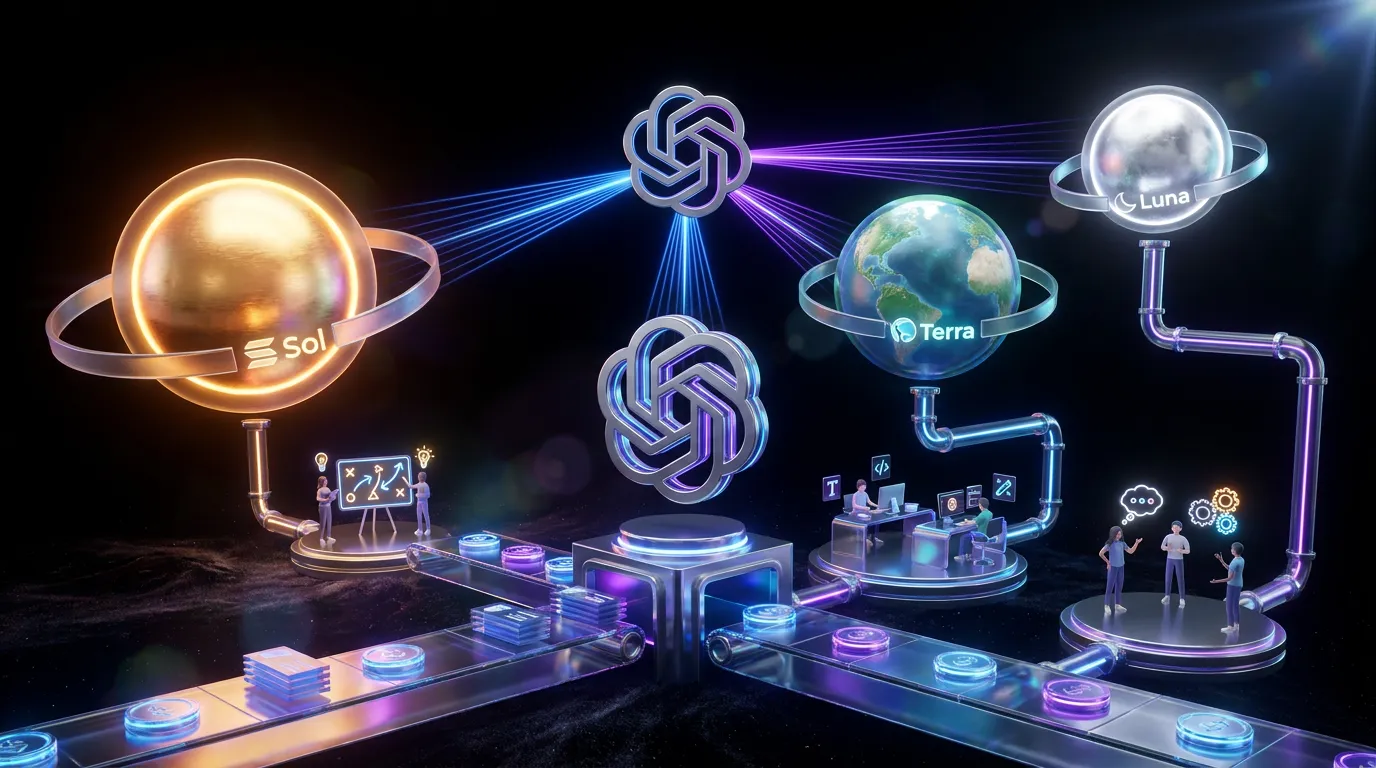
OpenAI just introduced the GPT-5.6 model family, and the most important part is not a single smarter-than-ever headline. It is the fact that OpenAI is now shipping three clearly labeled tiers meant to be routed through real production pipelines: Sol (flagship), Terra (balanced), and Luna (cost first). The official announcement starts here: Previewing GPT-5.6 Sol.
Instead of pretending one model should do everything, GPT-5.6 makes the tradeoffs explicit: pay for depth when you need it, and stop paying flagship rates for the boring but essential stuff like variants, formatting, and bulk localization.
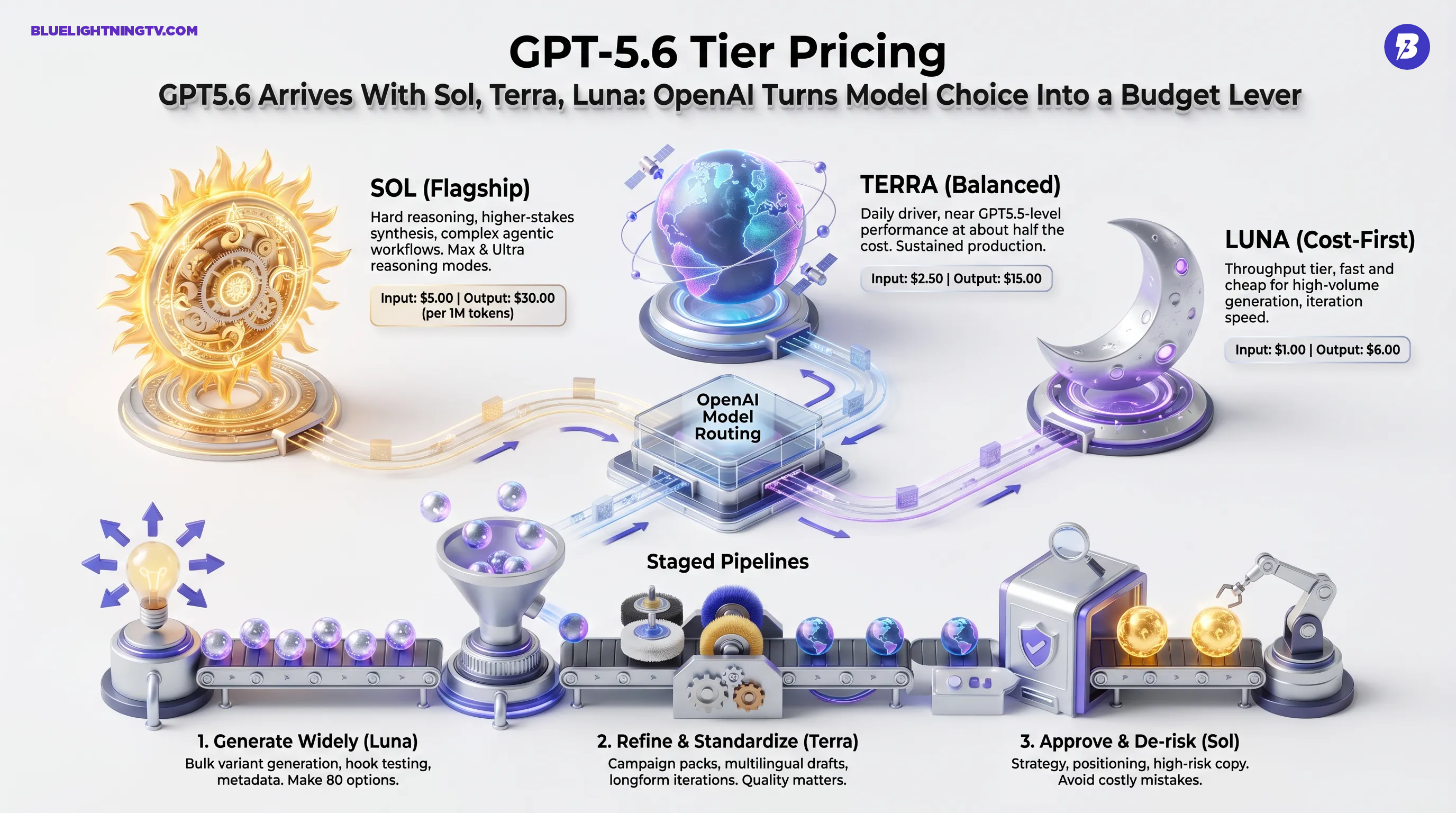
The shift is not new model. It is new operating model. GPT-5.6 is OpenAI saying model routing is now normal, not an enterprise only trick.
What shipped
OpenAI’s GPT-5.6 lineup launches as a family with three tiers that map cleanly to how creators and teams actually work.
The three tiers
- Sol: the top-end model, positioned for hard reasoning, higher-stakes synthesis, and complex agentic workflows. OpenAI highlights new reasoning effort modes on Sol, including max and ultra, aimed at deeper multi-step work.
- Terra: the daily driver tier, positioned as near GPT-5.5-level performance at about half the cost, designed for sustained production use.
- Luna: the throughput tier, fast and cheap for high-volume generation where you are optimizing for iteration speed and budget, not nuance.
If you want the closest recent COEY analog for this idea of “use the right model for the step,” the GPT-5.4 Mini vs Nano breakdown maps cleanly to the same operational mindset: GPT-5.4 Mini vs Nano: Faster, Cheaper Content Ops.
Pricing snapshot
OpenAI published per-token pricing for the GPT-5.6 tiers (per 1M tokens):
| Model tier | Input ($/1M tokens) | Output ($/1M tokens) |
|---|---|---|
| Sol | 5.00 | 30.00 |
| Terra | 2.50 | 15.00 |
| Luna | 1.00 | 6.00 |
This is the quiet reason GPT-5.6 matters to working teams: once pricing is this legible, you can design workflows with intentional cost controls, not hope the invoice is fine.
Why OpenAI tiered it
OpenAI has been drifting toward segmentation for a while. GPT-5.6 makes it unmistakable: capability is no longer a single ladder; it is a set of lanes.
Model names as routing signals
Sol, Terra, Luna are not just branding. They are operational labels that help teams answer:
- Do we need maximum reasoning? (Sol)
- Do we need reliable quality at scale? (Terra)
- Do we need a million cheap iterations? (Luna)
If you have ever watched a team burn flagship tokens generating 200 headline variants, congrats, you have met the exact problem Luna is here to solve.
Ultra and max are a tell
Sol’s additional modes (including ultra, described by OpenAI as a deeper reasoning setting that can coordinate work across sub-tasks) signal OpenAI is leaning into longer-horizon work, the kind that breaks when models lose the plot midstream. That is less about pretty prose and more about keeping multi-step production from turning into a restart festival.
What changes for creators
GPT-5.6 is framed around agency, creator, and marketing workflows, but the practical impact is broader: it is a toolkit for splitting your pipeline into stages without splitting your tool stack into chaos.
Better cost discipline by default
The biggest day-to-day win is simple: you can stop using the most expensive model for everything.
- Use Sol for: strategy, positioning, high-risk client copy, brand voice final passes, complex research synthesis, and anything you will regret getting wrong.
- Use Terra for: campaign packs, repurposing, multilingual drafts, longform iterations where quality still matters.
- Use Luna for: subject lines, CTA permutations, metadata, formatting, tagging, bulk variant generation, and make 80 options so humans can pick 8.
Routing is not a nice to have. With tiered pricing this aggressive, routing becomes the difference between scalable production and a budget bonfire.
Faster experimentation loops
Luna’s pricing practically invites teams to run the kind of experimentation they previously avoided because it felt wasteful. That means more:
- hook testing
- headline matrices
- tone variations by audience segment
- quick angle drafts for creative review
The pragmatic upside: more shots on goal. The pragmatic caution: you can now generate mediocre ideas at industrial scale too, so your human filter matters more, not less.
Rollout reality
OpenAI is not flipping GPT-5.6 on for everyone at once. The company is starting with limited preview access via the API and Codex for a small set of trusted partners, with broader availability expected to expand in the coming weeks.
API first, UI later
This rollout pattern matters because it shapes who benefits first:
- Tool builders and automation teams get early leverage, because they can wire Terra and Luna into batch systems immediately.
- Chat first creators may see it later, once product defaults catch up.
If you operate in a team environment, expect an awkward interim where:
- the backend has GPT-5.6 routing
- the frontend still feels like last gen defaults
That gap is where disciplined teams quietly compound advantage.
Implications for content ops
GPT-5.6 does not just change model quality. It changes how teams should architect production.
The new standard: staged pipelines
The most durable pattern this enables is a three-step loop:
- Generate widely (Luna)
- Refine and standardize (Terra)
- Approve and de-risk (Sol)
This mirrors how creative teams already work, brainstorm broadly, craft selectively, polish carefully, except now the economics align with that reality instead of punishing it.
What half the cost unlocks
Terra’s positioning as close to GPT-5.5 at about half the cost is especially relevant for teams doing ongoing production:
- always on content calendars
- multi-market localization
- ecom catalogs and product storytelling
- creator led brand campaigns that ship weekly, not quarterly
In those workflows, costs do not spike from one heroic prompt. They spike from repetition. Terra is designed to make repetition affordable without forcing a quality cliff.
What to watch next
GPT-5.6 is a meaningful operational release, but the real story will be what happens once it is in everyone’s hands and under real load.
Where reality will show up
- Consistency under batching: Do outputs stay stable when you run 5,000 generations, not five?
- Routing ergonomics: How easy does OpenAI make it to swap tiers inside products, and how many vendors actually expose that control?
- Reasoning modes in practice: Sol’s max and ultra sound like power tools. Teams will quickly learn where they are worth the latency and spend.
For creators, agencies, and builders, GPT-5.6 is less about chasing a shiny new benchmark and more about a welcome piece of maturity: OpenAI is productizing tradeoffs. And when the tradeoffs are visible, you can finally design systems that are fast, scalable, and financially sane, without pretending every task deserves the flagship model treatment.