
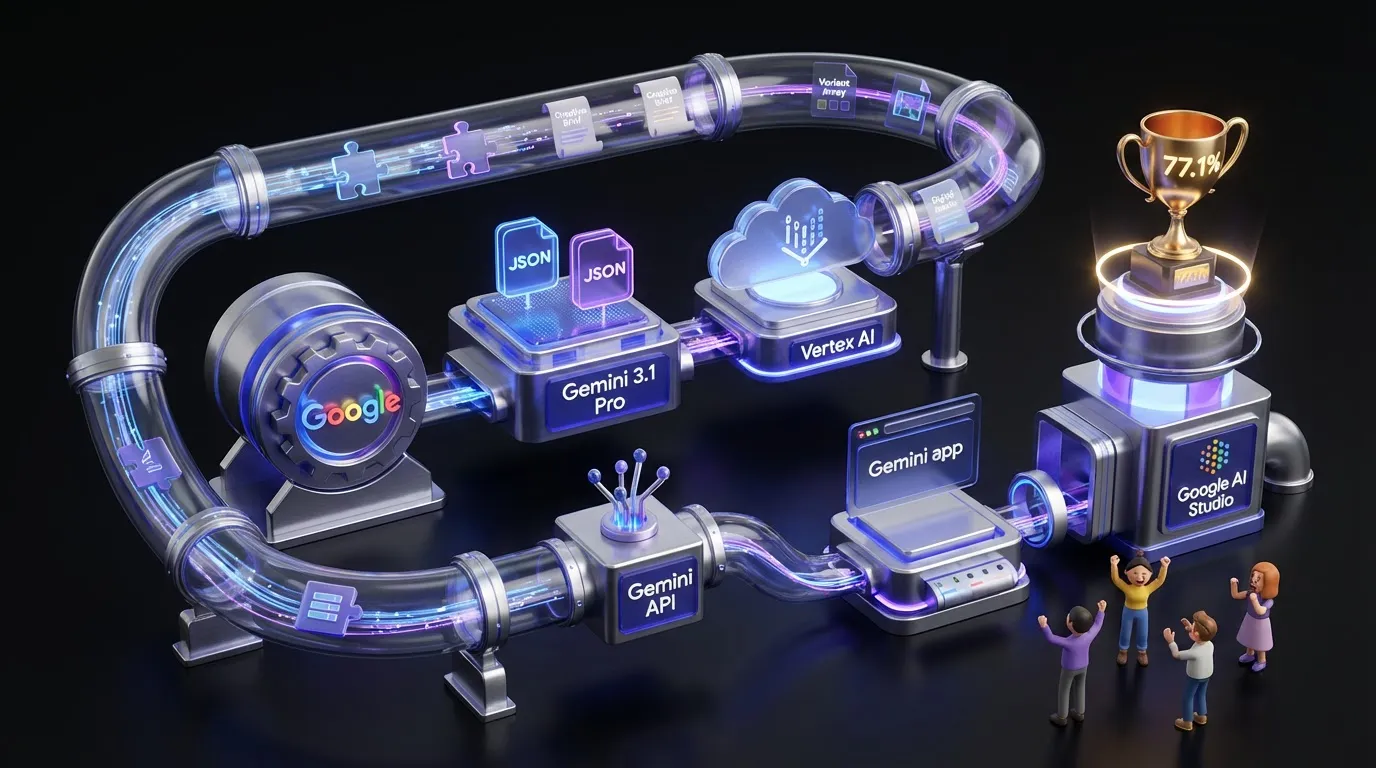
Google just introduced Gemini 3.1 Pro, and for once the headline is not “look how creative it is.” It is “look how often it actually finishes the job.” The release centers on stronger multi-step reasoning (Google cites a verified 77.1% score on ARC-AGI-2) and cleaner, more dependable structured outputs, exactly the unsexy stuff that determines whether generative AI becomes a real production teammate or just another tab you open to brainstorm and then ignore.
Gemini 3.1 Pro is rolling out across Google’s creator and developer surfaces: the Gemini app, Google AI Studio, and enterprise pipes like Vertex AI. It is also available to developers in preview via the Gemini API in AI Studio (and via surfaces Google lists alongside it, like Gemini CLI and Android Studio). The big idea is simple: if the model can plan better, follow constraints longer, and output formats you can trust, you can automate more of the content operations layer, briefs, variants, specs, templates, UI copy, metadata, without babysitting every step.
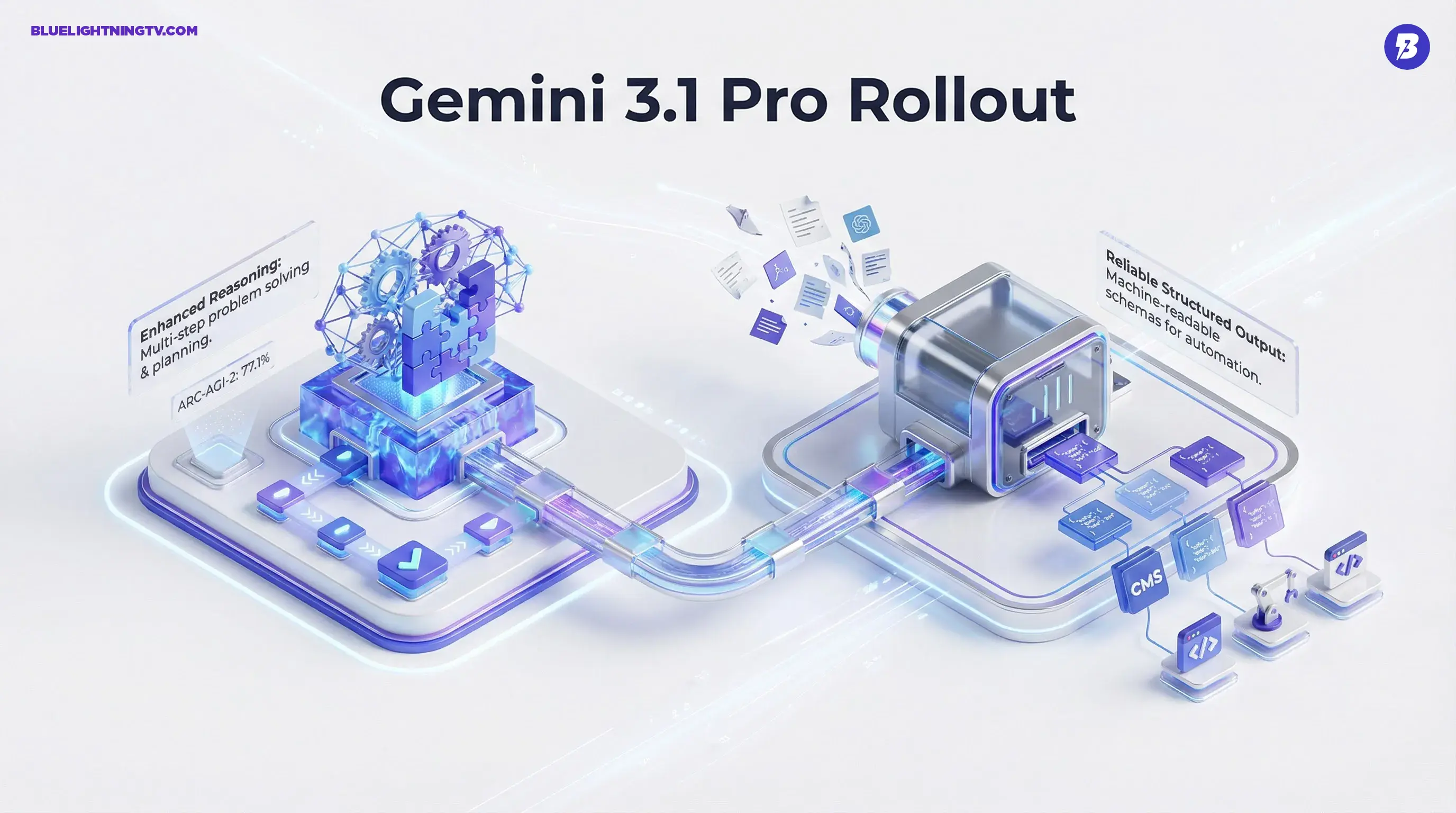
What’s new (in plain English): Gemini 3.1 Pro is positioned as a less chaotic model, stronger at multi-step tasks, more consistent in structured formatting, and easier to drop into pipelines where outputs have to be machine-readable.
What Google actually shipped
Google’s announcement frames Gemini 3.1 Pro as a core intelligence lift, not a niche creative feature. The proof point they lead with is benchmark performance: 77.1% on ARC-AGI-2, an evaluation designed to pressure-test generalized reasoning and multi-step problem solving. If benchmarks make your eyes glaze over, here is the only reason to care: the skills that improve ARC-style performance tend to be the same ones that reduce half-right, half-garbage outputs in real workflows.
ARC-AGI-2 itself is meant to be difficult in a way that is hard to brute-force, with an added emphasis on efficiency. If you want the benchmark’s framing directly from the source, the ARC Prize Foundation maintains an overview here: ARC-AGI-2.
Google also emphasizes broad availability across surfaces creators already touch: the Gemini app for everyday work, Google AI Studio for building and testing, and Vertex AI for teams operationalizing this inside production systems.
Why creators should care
Most creators do not need a model that can write a poem about their brand voice. They need a model that can take messy inputs (notes, constraints, product details, creative rules) and return usable outputs that fit downstream tooling. That means:
- Fewer prompt ping-pong cycles to get something shippable.
- More consistent formatting when output has to be parsed by software.
- Better follow-through on nested instructions (the stuff that usually breaks halfway through).
Gemini 3.1 Pro is aimed directly at the automation middle layer, the part of creative work where teams translate intent into repeatable assets. In 2026, that layer is where time disappears, especially if you are doing high-volume social, localized landing pages, iterative ad testing, or anything with templated production.
If you are tracking Google’s broader “reliability over vibes” direction, we covered a related shift in Gemini tooling in Gemini 3 Flash Agentic Vision That Double-Checks Images.
Structured output gets serious
If you have ever tried to plug an LLM into a workflow tool (or even just a spreadsheet), you have hit the classic failure mode: the answer is correct, but the structure is vibes-based. Gemini 3.1 Pro’s pitch is that structure is now a first-class target.
Google’s developer docs support structured outputs using JSON schema via the Gemini API, where you set response_mime_type to application/json and provide a schema (in response_json_schema) you want the model to satisfy. That is documented here: Gemini API structured output.
Practically, this matters because structured output is not about being neat. It is about eliminating glue-code and manual cleanup. When the model reliably returns:
- Valid JSON that matches your schema
- Predictable keys (within what your validator requires)
- Stable templates for briefs, variants, and content chunks
You can actually automate the handoff to the next step: CMS ingestion, creative QA, asset assembly, A/B testing setup, or batch localization. The model stops being a smart chat and starts being a component in a system.
| Workflow need | What reliable output means | Why it matters |
|---|---|---|
| Creative briefs at scale | Consistent sections plus required fields | Faster approvals, fewer missing details |
| Variant production | Clean arrays of headlines and captions | Easy batch testing without reformatting |
| Ops plus integration | Schema-valid JSON outputs | Less error handling in pipelines |
Reasoning, not just writing
Google’s major advances in reasoning line can sound like marketing until you map it to the annoying stuff models usually mess up: multi-step planning, constraint stacking, and keeping track of what they already decided.
In creator workflows, reasoning shows up when you ask for things like:
- One pass, many deliverables (brief plus shot list plus captions plus metadata)
- Conditional logic (if the platform is TikTok, keep it under X characters)
- Consistency under constraints (tone rules, brand words to avoid, product claims limits)
If Gemini 3.1 Pro truly improves at staying coherent across these chains, it reduces the biggest tax in genAI production: humans doing cleanup not because they are picky, but because the output cannot be trusted as a building block.
The real signal: Google is selling predictability, because predictability is what turns cool model into repeatable workflow.
Where it’s available
Gemini 3.1 Pro is rolling out across:
- Gemini app (consumer-facing creation and everyday drafting, rolling out via phased availability)
- Google AI Studio (testing, prototyping, prompt plus schema workflows)
- Gemini API (developer access, preview availability via AI Studio)
- Vertex AI (enterprise deployment and scaling inside Google Cloud)
For teams that care about operationalizing, not just experimenting, the model’s value will depend on how cleanly it fits into existing pipelines: versioning, review steps, logging, and repeatability. That is why Google pushing it across both consumer and enterprise surfaces matters. It suggests they want the same model family to go from try it to ship it without a full workflow rewrite.
Limits and watchouts
Even if Gemini 3.1 Pro is a genuine reliability jump, the pragmatic view is: better reasoning does not equal perfect automation. A few things creators and teams should keep in mind:
Benchmarks are not your workflow
ARC-AGI-2 is useful as a proxy for reasoning improvements, but production success is measured in much more boring metrics: error rates, formatting failures, QA time, and how often the model almost follows instructions. Treat the 77.1% as a directional signal, then test the tasks you actually run.
Structured output still needs tests
Schema support is huge, but real-world inputs are messy. If you are generating JSON that drives downstream automation, you still want validation gates and fallbacks, because one broken field can cascade into a broken batch.
Speed versus certainty tradeoffs
As models get more thoughtful, some requests may take longer or cost more per call depending on how you configure them. For high-volume variant generation, you will likely want a split strategy: use 3.1 Pro where reasoning and structure matters most, and lighter models where it does not.
What changes next
Zoom out and this release fits a broader pattern: model labs are competing less on who can generate the most impressive demo, and more on who can power dependable content systems. That means strong instruction following, stable formatting, and fewer surprising failures under constraint.
For creators, the upside is immediate: less time arguing with a model to behave, more time shaping output. For teams scaling creative operations, the upside is bigger: structured, machine-readable generation becomes an automation primitive, not a science project.
Bottom line: Gemini 3.1 Pro is Google pushing generative AI toward the job it actually needs to do in 2026: ship usable assets on-spec, with fewer retries. Not magic. Just more reliable. And honestly, that is the upgrade creators have been waiting for.