
Adobe is making a very specific promise with the latest Firefly update: stop counting generations and start shipping. Inside the standalone Firefly experience, eligible subscribers can now get unlimited image and video generations (within offer terms) and, just as importantly, Firefly is leaning harder into being a multi-model switchboard where you can choose third-party models alongside Adobe’s own.
The announcement is live on Adobe’s blog with details on what’s included and how the unlimited period works: Adobe’s announcement post.
If you’re a creator, the headline is not infinite content. It’s less friction in the messy middle: concepting, iterating, and building enough options that you can pick the one that actually works.
What changed
Firefly’s standalone plans have historically been tethered to generative credits, a system that makes sense for compute-heavy workflows, right up until you’re in hour three of make it 10% more cinematic prompt roulette. This update tackles two pressure points at once:
- Unlimited generations for image and video (as an offer, within plan and offer conditions)
- Third-party model access inside Firefly, so creators can pick different engines without leaving Adobe’s environment
That combination is Adobe saying: Firefly is not just a model. It’s the interface where models compete and your workflow stays put.
Unlimited generations, explained
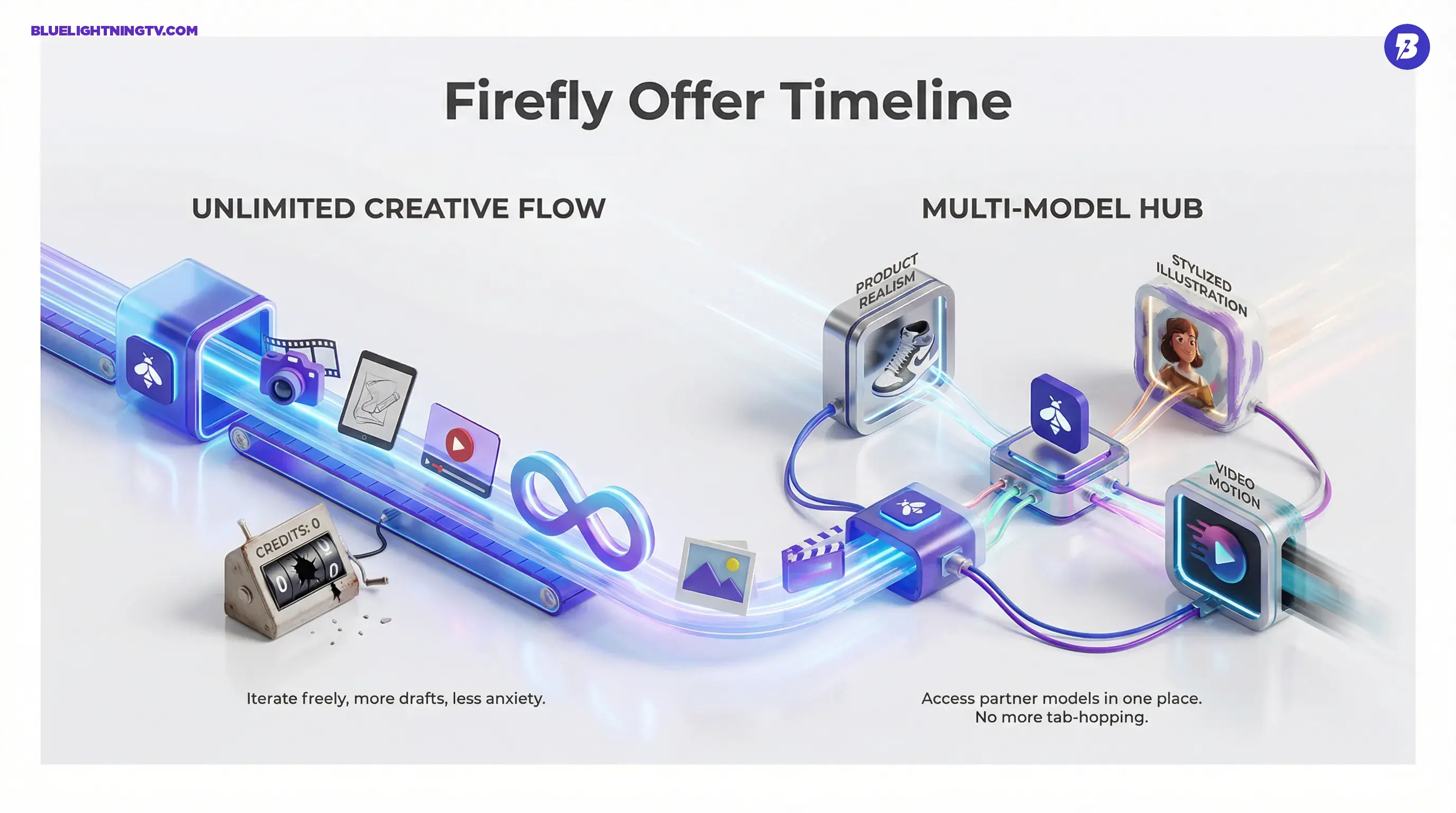
The most practical impact: iteration becomes cheap again. Unlimited generations means you can do what good creative actually requires, try five directions, kill four, polish the survivor, without a mental credit counter running in the background.
Adobe’s ecosystem already trains creators to work in versions (Photoshop history, Premiere timelines, After Effects comps). Firefly’s new posture fits that reality: more drafts, more variations, more A/B options.
Who gets unlimited
This is where you want to read the fine print, because unlimited in AI usually comes with boundaries.
Per Adobe’s announcement, the unlimited-generations access is framed as a limited-time offer for eligible paid customers who sign up or qualify within the offer window, rather than a permanent blanket change for every Adobe plan. The post calls out an eligibility cutoff date of March 16, 2026, and notes an output cap of up to 2K resolution during the offer window.
For pricing and plan structure, Adobe’s plan page is the cleanest reference: Firefly plans.
What unlimited changes day-to-day
Here’s what this actually unlocks in a working creator schedule:
- Prompt exploration without budgeting: try tonal shifts, lighting setups, composition changes, and brand styles like you’re scrolling filters.
- Volume for campaigns: more variants for paid social, thumbnails, product backgrounds, and seasonal swaps.
- Faster pre-production: quick visual direction boards and rough video concepts without pausing to buy more credits mid-sprint.
And yes, it will also unlock people generating 400 versions of retro anime cat barista cinematic bokeh just because they can.
Firefly becomes multi-model
The second part of the update is arguably bigger long-term: Firefly is integrating third-party models so creators can choose the best model for a particular task without hopping between tabs, tools, and export formats.
Adobe maintains a dedicated page outlining which partner models are available and where they appear inside Firefly’s experiences: Firefly partner models.
Why this matters more than it sounds
Most creators already have a model stack, even if they do not call it that:
- One model you trust for product realism
- Another for stylized illustration
- Another for video motion
- Another for weird experimental looks that would get your brand team to schedule a meeting
The friction has been operational: different logins, inconsistent aspect ratio controls, different licensing assumptions, messy asset handoffs, and a where did we generate that Slack spiral. Adobe wants Firefly to become the single front door to multiple engines.
What creators gain immediately
- Side-by-side testing: same prompt, different models, faster decisions.
- Central asset handling: generations stay inside the Adobe universe where they can be picked up by Photoshop and Express workflows.
- Less tool juggling: fewer browser tabs, fewer downloads named final_final_v7_REAL.png.
If you want the COEY angle on Firefly’s multi-model direction, this earlier post is relevant context: Firefly Adds GPT Image 1.5 for Faster Design.
The credit system is not dead
Even with unlimited generations in play, the credit economy still exists, especially for premium features and heavier compute workloads.
Adobe’s documentation distinguishes standard vs premium generative features, with premium features consuming more credits depending on the model and output type. Adobe also notes that some plans include unlimited standard generations, while premium generations remain tied to monthly credit allocations: Adobe generative credits FAQ.
The practical takeaway: unlimited does not mean all compute is free forever, and creators should still expect tiering where higher-cost outputs (think higher resolution or longer video, certain partner models, and priority performance) live behind plan boundaries and terms.
That is not a knock. It is the reality of GPU economics. The important change is that Adobe is reducing the number of times you hit a please go buy more wall while you are still exploring.
Quick impact snapshot
| Update | What you can do now | Who benefits most |
|---|---|---|
| Unlimited generations | Iterate freely on images and video without credit anxiety (within offer terms) | Agencies, social teams, high-volume creators |
| Partner model access | Choose third-party models inside Firefly | Multi-style creators, studios, creative ops |
| Firefly as hub | Keep assets and workflow in Adobe ecosystem | Teams already living in CC and Express |
What to watch next
This update is a platform move, not a one-off feature. The interesting questions are operational.
Model choice will become a skill
When you can pick models like lenses, creative direction gets faster, but also easier to mess up. Teams will need lightweight norms like: we use Model A for product shots, Model B for illustration, Model C for motion tests. Otherwise your brand look becomes a buffet line.
Consistency becomes the premium feature
Unlimited generation is great, but consistency is what creators actually sell. The more models available, the more important it becomes to maintain stable character, style, and product representation across assets. If Adobe can make cross-model workflows feel coherent, Firefly becomes more than a generator. It becomes production infrastructure.
Creative ops gets cleaner
For teams producing at scale, the win is not more images. It is less coordination overhead. Multi-model access inside a single workspace reduces the operational tax of experimentation: fewer handoffs, fewer file format surprises, fewer which tool did you use for this.
The bottom line
Adobe’s Firefly update is a pragmatic push: remove iteration limits and stop forcing creators to pick one model for every job.
In practice, the unlimited portion is a time-bound offer with specific eligibility and output limits (up to 2K, sign-up or eligibility by March 16, 2026), while third-party integrations position Firefly as a central place to compare and deploy different generative engines without breaking workflow.
It is not magic. It is not the end of credits. And it will not automatically make your campaign good (sorry). But it does meaningfully change the day-to-day reality of making modern creative work: more options, faster, with fewer speed bumps.