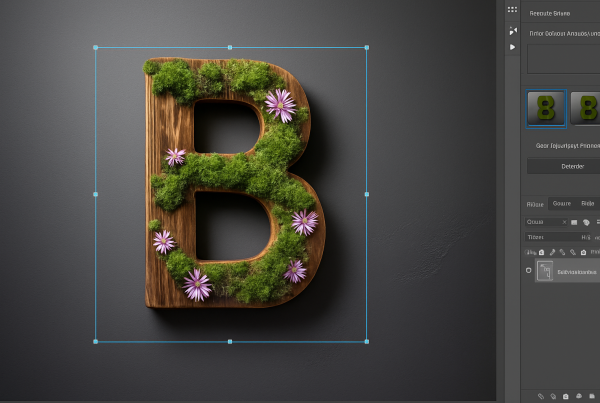

Reflections That Speak Volume
In the ever-evolving world of digital design, sometimes the simplest tweaks can make the grandest impact. Today, we’re diving into the art of creating text reflections in Photoshop—a trick that might sound minor but can elevate your project from mundane to majestic. This guide will unravel the magic behind crafting sleek and sophisticated text reflections, perfect for showcasing your creative prowess or just adding a touch of flair to your next digital masterpiece.
Setting Up Your Digital Canvas
Ready to plunge into the world of Photoshop wizardry? Begin by creating a new document. This will serve as the foundation of your reflection magic. On Windows, that’s just a Ctrl + N away (Cmd + N if you’re part of the Mac contingent). Set your Width to 1550 pixels, Height to 870 pixels, and Resolution at a crisp 150 pixels per inch. This ensures you’re working with a canvas that’s not just capable of showcasing your text beautifully but also of supporting all the graphic tweaks you’ll embark on.
Color Prep and Adjustments
In design, color is king. If your foreground and background colors are uncertain or misaligned, tap D to reset, and X to invert, ensuring you’re starting with a clean black and white slate. Fill the background with the color of choice using Ctrl (or Cmd) + Delete.
Type Tool: Your Text, Your Rules
Now, let’s get to the core—your text. Bring out your Horizontal Type Tool and choose a font that screams You. We’re fans of the American Captain Regular, known for its bold drama—if you want to follow our lead, the font is detailed in the video description. Typing size? 160 points should do the trick. Make sure it’s sharp, center-aligned, and painted crisp white. Once your text is placed, play around with positioning using the Move Tool.
Layering: The Secret Sauce
In the kitchen of digital design, layers are your spices. Convert your text layer into a Smart Object—this non-destructive format means all the effects you smother your text with can easily be reverted. Click on the gear icon in the Layers panel and convert your layer. Now let’s add some textures.
Adding that Three-Dimensional Flair
Click on the “fx” icon and select “Bevel and Emboss.” For an inner depth effect, ensure the Style is Inner Bevel with the Technique set to Chisel Hard. Remember, we want a subtle but noticeable three-dimensional aspect here—Depth at 100% and Size at 5 pixels will do. Set the fixture to face Up, and check Contour. For that extra flourish, select the Ring contour from your presets. Now you’ve got depth and dimension.
Gradient Overlay: Shading with Panache
To add an alluring shade to your text, head to Gradient Overlay. Black to white is the theme, with an angle set to 90 degrees, dial the Opacity back to 60%. This adds a rich contrast underlining your text’s presence on the screen.
Reflection and Highlights
Here’s where the magic truly begins: the reflection effect. Start by creating a new layer and prepare guidelines by enabling Rulers and Snap. The guide snaps smoothly thanks to the forethought of enabling those nifty options. Using the Elliptical Marquee Tool and some precision, create an arc directly above your text, a theatrical setup for its reflection.
The Subtle Arc of Reflection
Fill your selection with sumptuous white (foreground color), then desaturate slightly to soften its presence by lowering the Opacity to 20%. This keeps your reflection grounded without overwhelming the composition. Clip this reflection layer to your original text layer by Ctrl-clicking (Cmd-clicking) the text thumbnail and applying a layer mask to secure that reflection just where you want it.
Creating a Reverberating Spotlight
For added drama, let’s cast a spotlight beneath your creation. Make a new layer beneath your text, fill it with white, and underlay your design with an ethereal glow. By reducing its intensity to 40% and employing a Gaussian Blur, your text isn’t just visible—it’s basking in divine illumination.
Fading Shadows and Final Touches
Lastly, accentuate the reflection with a shadow. New layer, name it Shadow, reduce your brush and lay down a line of darkness at the text’s base. Duplicate your text layer, flip it vertically, and bestow it with an elegance that a mere mundane shadow could never hope to achieve.
Remember to keep each layer adjustable—your goal is a stunning digital artifact ripe with dimension and poise. Not only have you created a mirrored text marvel, but you’ve honed your proficiency in Photoshop’s layered brilliance and selective wizardry.
Happy designing, and may your creativity shine as brilliantly as your newly minted text reflections.