

OpenAI has confirmed it is shutting down the Sora app and Sora API, ending what was arguably the most mainstream on ramp to high end generative video for a lot of teams. The most important thing right now is not debating why. It is protecting work you already made and rebuilding your pipeline so you are not stuck mid campaign holding a folder of dead links. Start with OpenAI’s official Sora 1 export and sunsetting guidance here.
OpenAI’s public reporting around the shutdown frames it as a resource and risk reallocation, and coverage confirms the shutdown applies broadly to the product surface area creators used, not just a version swap. The practical headline: if Sora was a meaningful part of how you prototype ads, pitch concepts, or crank out social variations, you are now in migration mode.
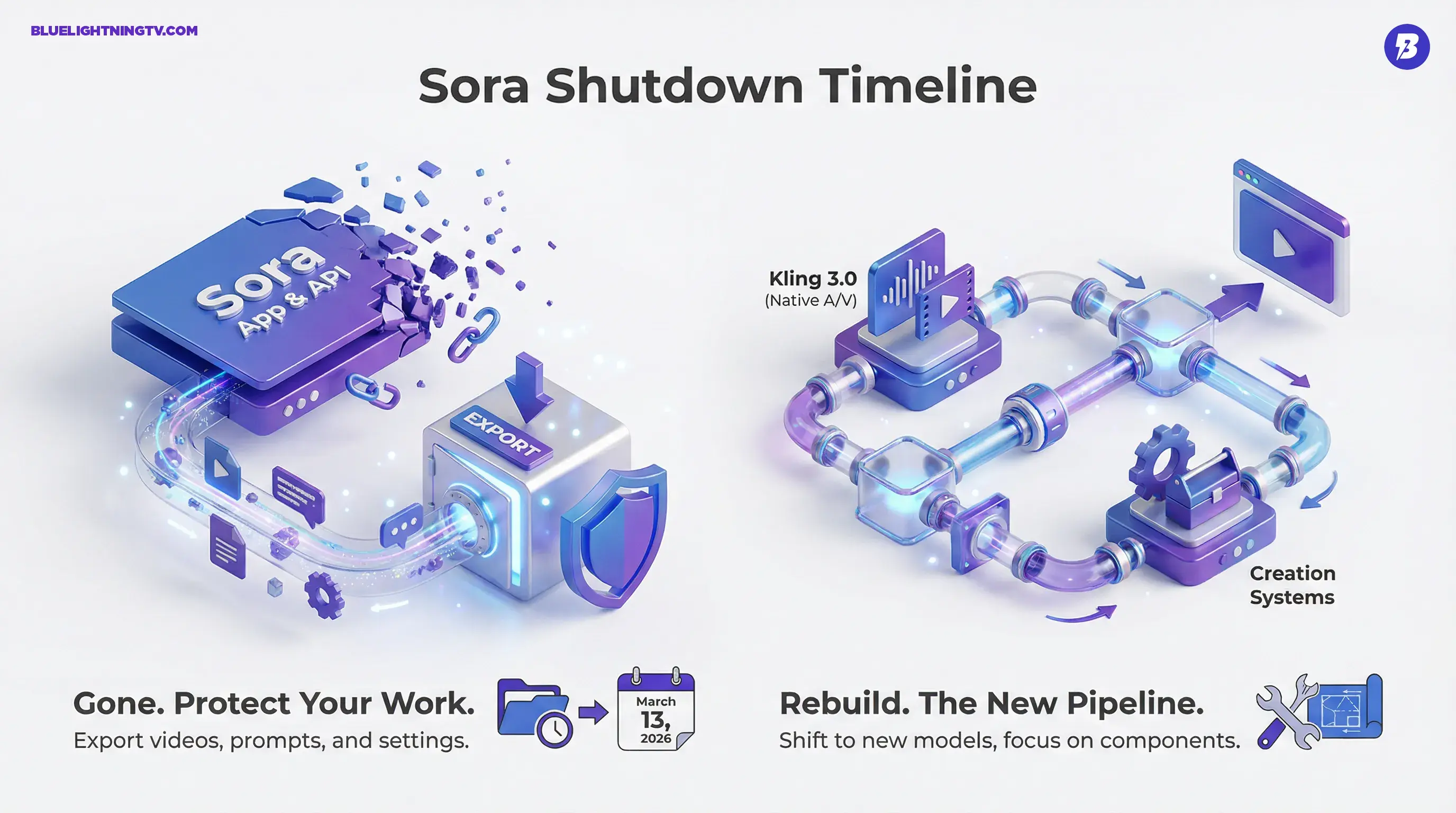
Treat this like a platform dependency outage, not a tool you liked.
If Sora touched your deadlines, you need exports, backups, and a replacement plan fast.
What OpenAI confirmed
There are two overlapping realities creators need to hold in their heads:
- Sora 1 had a retirement path with export instructions and a cutoff window, including a March 13, 2026 retirement date for the U.S.
- OpenAI has now moved to end Sora as a product, including the app and API, rather than simply pushing everyone to the next version.
OpenAI’s Sora 1 sunset FAQ spells out the export workflow and makes one point painfully clear: after retirement and the export window, older generations and related activity may stop being accessible here.
Meanwhile, broader reporting describes OpenAI discontinuing Sora more generally, including the service surface creators relied on here.
What shutdown means in practice
Not all shutdowns are equal. This one lands in three places that matter operationally:
- Access: New usage and new integrations stop first. That is the door is locked moment.
- Retrieval: Existing libraries often stay reachable temporarily, but only long enough to export.
- Workflow: Anything automated, including API calls, scheduled renders, internal tooling, becomes brittle immediately.
If you were using Sora casually, it is annoying. If you were using it professionally, it is a continuity event.
Why Sora mattered (in the unglamorous way)
Sora did not win hearts just because it looked good. It mattered because it helped creators do three boring but expensive things faster:
- First drafts that look real enough to sell an idea internally
- Rapid iteration loops, generate, remix, tweak, repeat
- Multi modal direction, especially after newer releases pushed toward synchronized audio with video as part of the generation experience
Sora was not a replacement for filmmaking. It was a replacement for the slowest parts of pre production: mood boards, rough animatics, speculative visuals, placeholder footage, and those trust me it will feel cinematic later decks.
OpenAI’s product positioning leaned heavily into video generation as a serious creative medium, with the Sora product page as the canonical reference for what the model was built to do here.
The immediate risks teams miss
Let’s skip the drama and talk failure modes, because these are the ones that quietly hurt you a month from now.
1) Lost prompt context
The video file is only half the asset. For repeatable production, you need:
- prompt text (and negative prompt equivalents where relevant)
- seed and settings
- references (images, clips)
- version history
If your team cannot reconstruct how we got this, you cannot reproduce it when a client says, cool, now do 30 more.
2) Library link rot
A lot of teams share Sora outputs as links in Slack, Notion, Asana. When a platform goes dark, that becomes instant archaeology. Exporting is not just downloads. It is rebuilding your internal references.
3) Pipeline assumptions
If you built around Sora’s strengths, fast ideation, certain motion behavior, certain look, your replacements will not match 1:1. That mismatch shows up as:
- more iterations per usable clip
- different artifact profile (hands, faces, fast motion)
- different camera logic
- different consistency across shots
None of this is fatal. But it changes timelines.
What to do next (without turning this into a guide)
You do not need a 47 step checklist. You need a short plan that prevents regret.
Export priorities that actually matter
| Priority | Export item | Why it matters |
|---|---|---|
| Highest | Final videos plus best variants | Client facing and hardest to recreate |
| High | Prompts plus settings | Reproducibility and consistency across a campaign |
| Medium | References plus inputs | Helps port looks to another model |
| Medium | Remix lineage | Lets you trace what changed between versions |
OpenAI’s export mechanism is handled through Sora settings under Data Controls, and the export may arrive via an emailed download package depending on account configuration here.
Where creators go from here
Sora shutting down does not mean generative video slows down. It means the default tool slot is open again, and teams will pick based on reliability, controls, and throughput, not hype.
If you have been tracking the space with us, you have already seen the direction of travel: tools are racing to reduce post glue, especially by generating more of the stack together. For example, Kling 3.0’s headline capability is native audio generation, which is a real workflow upgrade in its own evolution here.
The bigger implication: products are getting unbundled
Sora’s rise made AI video feel like a destination app: open it, make a clip, ship it.
The next phase looks more like this:
- video generation becomes a capability inside larger creation systems
- orchestration and agent like workflows matter more than one perfect UI
- teams will favor tools that plug into existing stacks (editing, asset management, collaboration)
That is not necessarily better for solo creators who just want a magic button. But for studios and agencies, it is the path to something that resembles a real pipeline instead of a collection of tabs.
The shift is not AI video is dying.
It is AI video moving from a product to a component.
What to watch in the near term
Creators do not need speculation. You need signals you can act on.
Signals that affect production decisions
- Export deadlines and retention windows: if OpenAI narrows them, urgency spikes.
- Any replacement endpoint inside OpenAI’s ecosystem: if video reappears as a module elsewhere, it changes vendor decisions.
- Third party wrappers and licensed platforms: if Sora like quality is offered through partners, access may look different (pricing, rights, tooling).
- Model parity on audio plus video: tools that ship cohesive A/V drafts reduce the most annoying part of modern content assembly.
Bottom line
Sora’s shutdown is disruptive because it was genuinely useful: a fast way to turn prompts into believable motion, and later, a way to generate synchronized audio with video as a single creative draft. The pragmatic move now is simple: export everything that matters, capture prompt context, and assume your next video tool will behave differently, because it will.
The teams that recover fastest will not be the ones chasing the closest Sora replacement. They will be the ones building a workflow that can swap models without collapsing, because in generative video, the only stable feature is change.


