OpenAI just dropped GPT-5.3-Codex-Spark, a research preview model aimed at one thing: making AI coding feel instant. The headline number is wild, over 1,000 tokens per second, but the bigger story is what OpenAI tuned around that speed: interactive edits, low-latency streaming, and workflows that do not break your momentum every time you ask for a change.
If you have ever used a coding assistant and felt the vibe die while it thinks, Spark is OpenAI basically admitting: latency is the new bottleneck.
What Spark actually is
GPT-5.3-Codex-Spark is a smaller, faster sibling of GPT-5.3-Codex, built for rapid iteration instead of max reasoning. OpenAI is positioning it as a companion model: use Spark when you want fast implementation and quick back-and-forth, then switch to a heavier model when you need deeper planning or careful review.
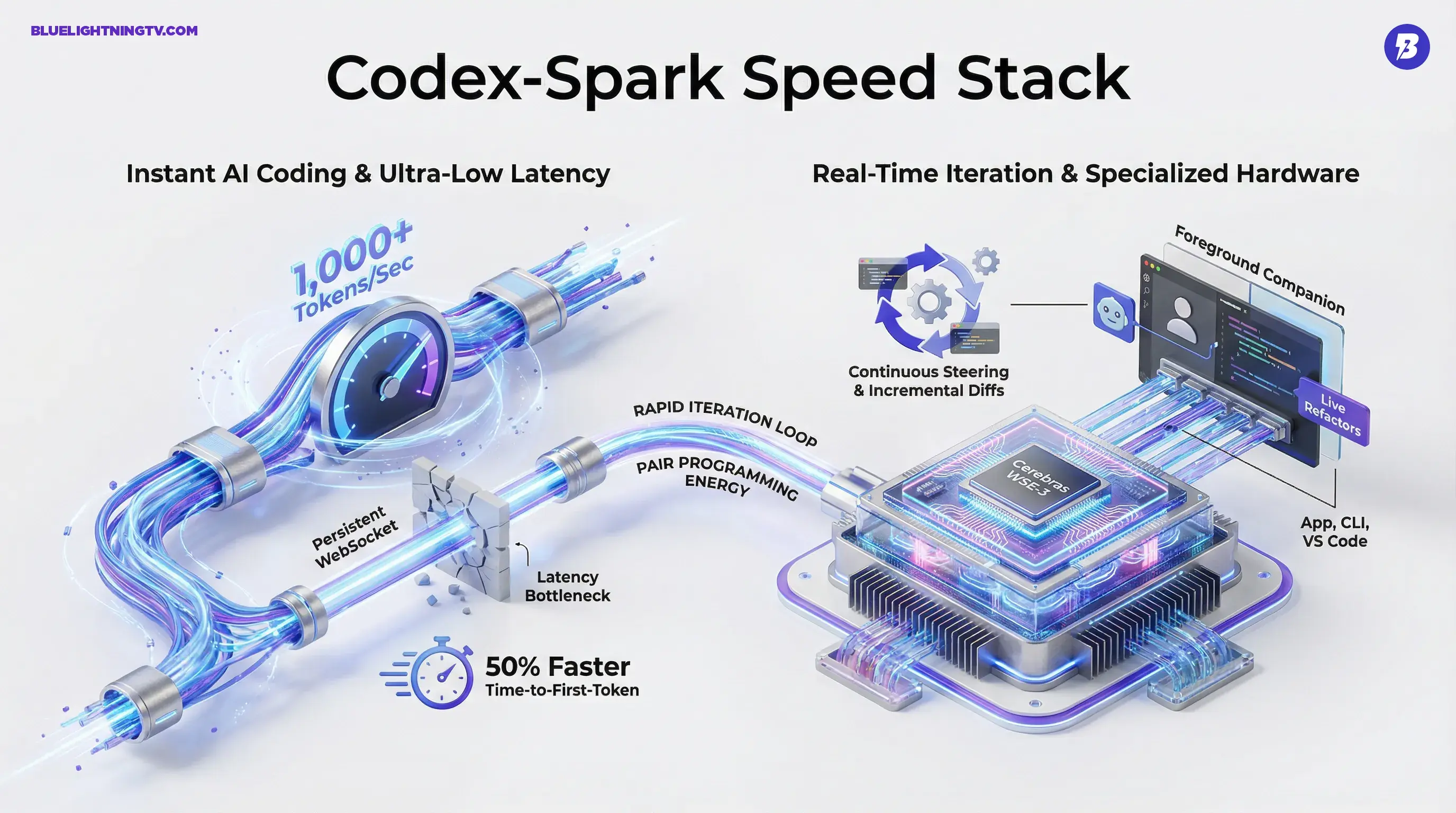
It is also an infrastructure flex. OpenAI says it reduced latency by improving the serving path, including support for persistent WebSocket connections, cutting roundtrip overhead and speeding up time-to-first-token in a way that matters when you are prompting in tight loops. In OpenAI’s launch post, the company reports end-to-end latency gains including an 80% reduction in client-server round-trip overhead, a 50% reduction in time-to-first-token, and a 30% reduction in per-token overhead.
The bet: creators and dev teams will tolerate a little less IQ if the tool feels like a real-time collaborator instead of a ticketing system.
Where it shows up
Spark is available (in research preview) across the surfaces where speed actually matters:
- Codex app
- Codex CLI
- VS Code extension
OpenAI is keeping it in research preview with separate rate limits from other Codex models. At launch, OpenAI’s own announcement frames availability as a rollout for ChatGPT Pro users, though Codex more broadly is included across multiple ChatGPT plans depending on the feature and rollout window. For plan details around Codex usage, OpenAI has a breakdown here: Using Codex with your ChatGPT plan.
If you want the COEY context on how Codex models are showing up in real tooling, we covered the broader rollout here: GPT-5.3-Codex Hits Copilot: Faster Agentic Coding.
Why the speed matters
1,000 tokens per second sounds like a benchmark flex until you translate it into how people actually build.
Most creative-dev work is not one big prompt. It is a loop:
- draft a component
- tweak layout
- fix a bug
- refactor
- wire an API
- patch types
- change the copy
- add analytics
- re-run tests
- repeat until it stops embarrassing you
If your assistant is even 5 to 10 seconds behind you each turn, it becomes a background tab. Spark is tuned to be foreground.
The tradeoff: speed vs depth
Speed-focused models usually come with a catch: they can be less careful.
Early discussion around Spark emphasizes exactly that dynamic: it is designed to be extremely responsive, but you should not assume it is the best choice for:
- complex architecture decisions
- tricky debugging with multiple interacting systems
- security-sensitive review
- read this entire repo and propose a migration plan work
In other words, Spark is the friend who texts back instantly, but you still would not necessarily ask them to rewrite your life plan.
What changes in workflow
Spark pushes coding assistants further into pair programming energy.
Instead of treating the model like a generator you consult occasionally, the intended use is closer to:
- continuous steering (micro-prompts as you edit)
- incremental diffs (quick revisions rather than full rewrites)
- live refactors (small changes applied repeatedly as requirements shift)
That matters for creators because code is now part of the content toolchain. A lot of teams building media and marketing projects live in that middle ground: not hardcore systems engineering, but still shipping real software, microsites, automations, internal tools, interactive experiences, pipeline glue.
When the assistant is fast enough, I will automate that later becomes fine, I will do it now.
Typical Spark-friendly tasks
- Front-end iteration: UI tweaks, responsive fixes, component edits
- Prototype loops: build and test and change and repeat without waiting
- Scripting and automations: quick scripts where correctness is verified by running the output immediately
- Meeting-mode coding: live edits during team reviews without dead air
Under the hood: hardware signal
One of the most interesting subplots: Spark is tied to OpenAI’s work with Cerebras hardware, specifically the Wafer Scale Engine 3 (WSE-3). OpenAI explicitly calls out Spark as running on Cerebras WSE-3 systems, and credits that stack plus serving improvements for its real-time speed profile. Cerebras’ own overview of WSE-3 is here: Cerebras announces Wafer Scale Engine 3.
For creators, the hardware detail is not trivia. It is a clue about what the next phase of generative tools looks like:
- not only better models
- but better response characteristics
- and more specialized inference stacks built around specific creative workflows
Fast enough to feel real-time is a product category, not a feature checkbox.
Spark vs other assistants
Plenty of tools already compete on code quality and convenience: Copilot, Cursor, Gemini Code Assist, and OpenAI’s own broader Codex line. Spark’s differentiator is narrower and more practical:
Speed-first interaction.
Here is the cleanest way to think about it: Spark is for the moment when you already know roughly what you are building and you want to move, not deliberate.
Snapshot table
| Category | What Spark emphasizes | What that means |
|---|---|---|
| Interaction speed | 1,000+ tokens per second streaming | Less waiting tax in iteration loops |
| Workflow surfaces | App, CLI, VS Code | Stays where you already work |
| Model posture | Smaller, speed-tuned | Great for drafts and edits, less for deep reasoning |
Limits you should expect
OpenAI is being pretty explicit that this is a preview with boundaries. The practical constraints to plan around:
- Text-only: At launch, GPT-5.3-Codex-Spark is text-only (no image, audio, or video inputs).
- Gated access plus separate limits: Research preview access can be limited and Spark runs under its own rate limits.
- Not an API-first launch (for most users): The public rollout emphasis is Codex surfaces (app, CLI, VS Code). Separately, OpenAI has also indicated an API is limited to a small set of design partners early on, rather than broadly available on day one.
This is also where the no-hype framing matters: Spark does not magically make code correct. It makes iteration faster. You still need tests, diffs, and a human who knows what done means.
What to watch next
Spark’s launch is a signal that AI coding is splitting into two major modes:
- Deep models for planning, review, and complex tool-driven tasks
- Fast models for implementation and constant iteration
If OpenAI nails the handoff between those modes, fast drafting without losing correctness, plus smooth switching when you need more brain, it is a meaningful upgrade to how creators ship digital projects.
And if nothing else, Spark makes one thing crystal clear: in 2026, the competitive edge is not just can it code. It is can it keep up.