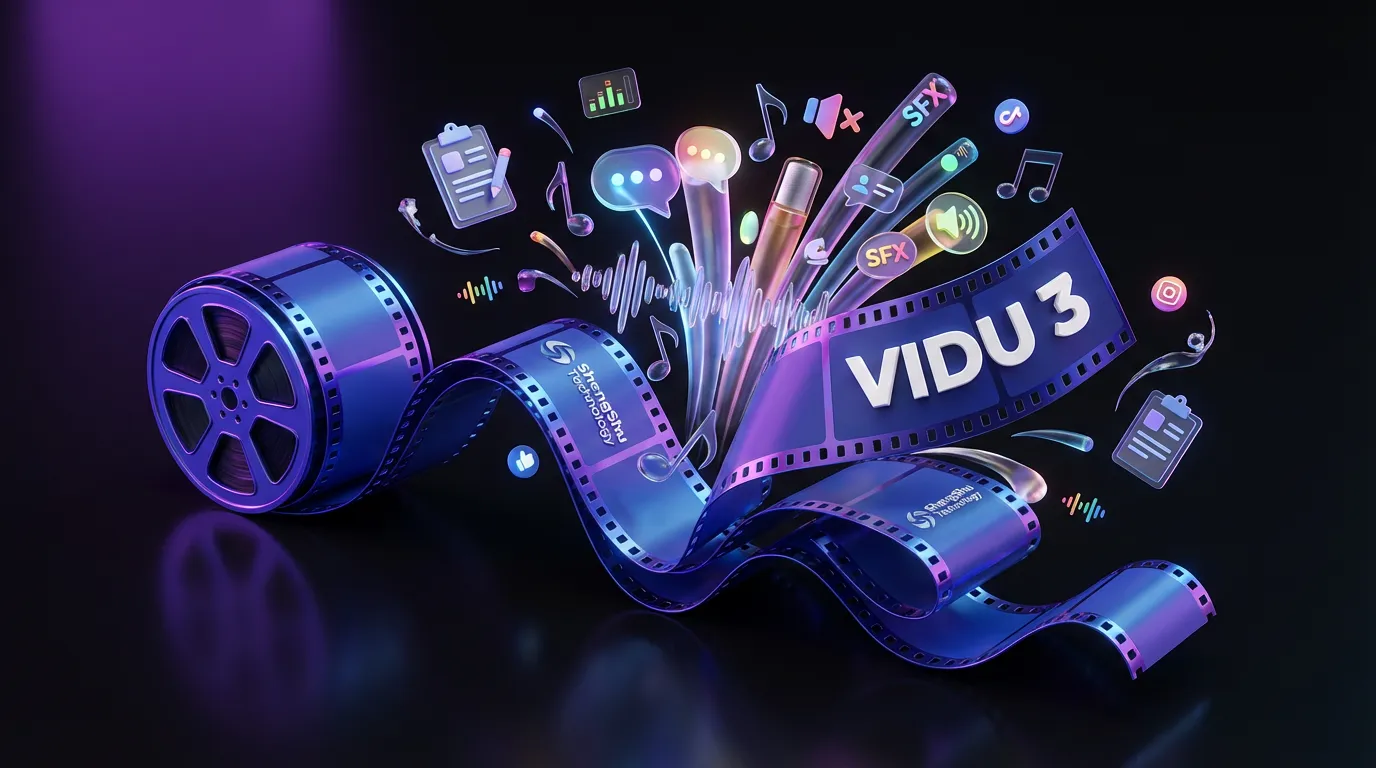
The easiest way to explain ShengShu Technology’s latest VIDU upgrade is this: it’s trying to ship finished AI video, not just pretty silent footage. With VIDU 3 (often referenced publicly as “Vidu Q3”), you can prompt a short scene and get back a clip that includes generated dialogue, ambient sound, sound effects, and music in a single output. The product hub is here: vidu.ai.
That one prompt to one clip idea sounds like marketing until you’ve lived the current reality: generate video in one app, generate voice in another, grab music somewhere else, then spend your evening nudging waveforms around a timeline like you’re defusing a bomb. VIDU 3’s headline is native audio baked into generation, which meaningfully compresses that whole loop, especially for social, ads, and rapid concepting.

What actually shipped
VIDU 3’s core update isn’t a new camera move or a slightly sharper aesthetic. It’s this:
- Video generation with native audio in the same pass
- Audio can include speech plus SFX plus ambience plus music
- Public demos and announcements commonly show up to 16 seconds per clip and up to 1080p output
- The model is marketed as capable of multi-shot sequencing inside a single generation, meaning a mini scene rather than one angle
External coverage around Vidu Q3 has emphasized synchronized audio visual output as the differentiator. One example: PR Newswire’s write-up on the platform’s Q3 showcasing.
The workflow shift
Native audio sounds small until you map it onto a creator’s actual pipeline.
If you’re producing short-form content today with AI video, the normal stack looks like:
- Generate silent video (text-to-video or image-to-video)
- Generate or record a voice track (TTS, voice clone, or human VO)
- Add SFX (library pulls, prompt-to-SFX, manual layering)
- Add music (library track or prompt-to-music)
- Mix plus sync in an editor
- Re-do at least two of those steps when the script changes
VIDU 3 collapses the first four steps into one generation. You still may mix and polish later, but the first draft arrives with a soundscape attached, which makes it feel less like a tech demo and more like something you can actually cut into an edit.
The real win isn’t AI audio exists.
It’s that the clip arrives with sound that reacts to the scene’s pacing, dialogue beats, and environment, so your first iteration is closer to client previewable.
Why native audio matters now
Generative video has been on a quality sprint for a while: better motion, better coherence, better camera language. But for working creators, the friction has moved.
The bottleneck is often post-assembly, not generation:
- Timing dialogue to mouth movement
- Making the world feel alive (room tone, city noise, footsteps)
- Avoiding the sterile vibe of silent AI footage
- Iterating quickly without rebuilding audio each time
Native audio attacks that bottleneck directly. It also changes how teams prototype. Instead of treating AI video as visual boards, you can treat it as rough cuts, because the emotional read of a scene often lives in sound.
Quick spec snapshot
Here’s the practical what you get view based on currently marketed and widely demoed behavior:
| Category | What VIDU 3 targets | Why creators care |
|---|---|---|
| Output format | Video plus audio together | Faster drafts, fewer tools |
| Duration | Up to 16 seconds | Built for ads plus social pacing |
| Resolution | Up to 1080p | Less preview-only energy |
Where it fits best
VIDU 3 isn’t trying to replace a full post pipeline. It’s trying to kill the rough-draft tax. The strongest use cases are the ones where speed and iteration matter more than pristine stems.
Short-form ads
If you’re building campaign variants, audio is usually where speed goes to die. With native audio, the iteration loop changes:
- Swap the hook line, regenerate, and the soundscape updates with it
- Try three tonal directions (cozy, chaotic, luxury) without re-scoring
- Get something that reads like a complete spot even before polish
The result is more shots on goal. And in performance creative, volume plus taste beats one perfect render almost every time.
Concept clips and previsualization
For filmmakers, animators, and studios, a scene with audio communicates:
- pacing
- mood
- intention
- emotional rhythm
A silent clip forces stakeholders to imagine too much. A voiced, scored clip, even if it’s scratch, gets you feedback faster, because everyone reacts to the same thing.
Social storytelling
Social isn’t forgiving about silence. Even cinematic content is usually riding:
- VO
- a music bed
- punchy SFX transitions
VIDU 3’s approach makes it easier to generate something that already has the social-native layer built in.
What to watch in real use
Native audio is a big step, but it comes with very specific tradeoffs creators should notice early.
Audio editability
Right now, the most common output pattern is a single baked track (audio embedded in the exported video). That’s great for speed, less great for control.
If your workflow needs:
- separate dialogue, music, SFX stems
- clean ducking
- precise music edits
you may still end up re-building audio in post. The interesting question is whether VIDU evolves toward stem export later.
Voice personality
Early native-audio systems often sound competent but generic. Expect:
- acceptable reads for drafts
- occasional uncanny cadence
- voices that may not match brand character without extra prompting
For many creators, that’s fine. Drafts do not need Oscar-level performance. They need clarity and momentum.
Continuity across revisions
The make or break for production use is whether you can say:
- same characters, new line
- same scene, quieter ambience
- same pacing, different music style
without the model re-rolling the entire vibe. If VIDU 3 can keep edit-intent stability, it becomes a serious tool for teams, not just solo experimentation.
The competitive context
VIDU 3’s native audio push lands in a market where AI video is increasingly about workflow completeness, not just model aesthetics. We’ve already watched other platforms chase reliability and distribution. If you want that angle, our earlier coverage of Runway’s recent jump is here: Runway Gen-4.5 Makes Image-to-Video More Reliable.
VIDU’s bet is different: ship the clip with sound so the draft feels complete. That’s a very creator-brained move. People do not share almost a scene. They share scenes.
Bottom line
VIDU 3’s big move is native audio inside generative video, turning AI video from silent footage you assemble later into a single prompt-driven scene output that’s closer to ready-for-edit.
It won’t eliminate post-production, and it won’t magically give you perfectly branded voice performance on the first try. But it does remove one of the most annoying parts of the current AI video era: the moment you realize your clip is technically cool and emotionally flat because it has no sound world.
For creators shipping fast, testing ideas, and building short-form at speed, this is a meaningful upgrade, not hype, just less friction.