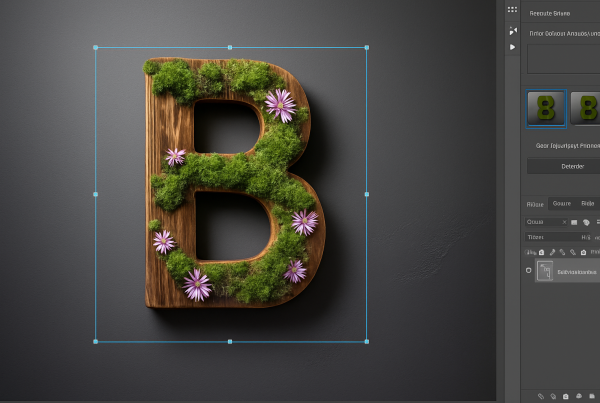

Master the Art of Silver Foil Stamp Design in Photoshop
Are you ready to transform your regular graphic designs into stunning, embossed silver foil stamps? Whether you’re aiming to create high-end invitations, deluxe business cards, or unique artistic prints, mastering the silver foil stamping technique in Photoshop can elevate your projects to a new level of sophistication. In this guide, we’ll walk you through the entire process from start to finish.
Prepping Your Canvas for a Flawless Base
Before you start creating, it’s essential to have the right foundation. The first step is to open a black and white graphic that you intend to use for your project. Remember to leave enough space for text if you’re planning on adding any.
Step 1: Adjusting the Canvas Size
- Navigate to Image > Canvas Size and click the top-center arrow to extend the canvas downward.
- Change the measurement to “Percent” and adjust the height to add more space for additional design elements.
Step 2: Filling the Canvas Background
- Ensure your foreground and background colors are set to their defaults—black and white, respectively—by pressing “D” on your keyboard.
- Use the “Rectangular Marquee Tool” to select the empty area and fill it with the background color (white) using Ctrl/Cmd + Delete.
Adding Text with Panache
Next up is the font. Choose something that complements your design. In this walkthrough, we use “FM College Team Outline Regular,” but feel free to let your creativity decide.
- Set your font size to 270 points with Crisp and Center Alignment. Don’t fret about the color—it’s just a placeholder.
Perfecting the Text Placement
For a balanced layout:
- Use the Move Tool to position the text.
- Center it by selecting the canvas (Ctrl/Cmd + A) and using the “Align Horizontal Centers” feature.
Crafting a Composite Snapshot
After perfecting your layout, create a composite snapshot of your work using Ctrl + Shift + Alt + E on Windows or Cmd + Shift + Option + E on Mac. This step essentially captures everything you’ve done so far onto a new layer.
Establishing the Foundation with Channels and Smart Objects
Head over to the Channels panel, select your design, and use the “Delete” key to remove the white background, leaving your graphic and text floating pristinely.
Convert to Smart Object:
- Click “Convert to Smart Object” in the Layers panel to lock in effects non-destructively, allowing easy adjustments later.
Customizing Layer Styles for the Silver Foil Effect
Now comes the fun part—layer styles and finesse. You’ll create a multi-layer approach to simulate the embossed foil look.
Layer Duplication and Naming
- Duplicate your layer three times, naming them “Bevel,” “Highlights,” “Midtones,” and the original as “Shadows.”
Midtones Layer Styling:
- Inner Shadow: White, 80% Opacity, -135° Angle
- Gradient Overlay: Color Dodge at 70%, hex code 999999
Each layer gets its unique set of parameters, playing with different blends and shades to achieve the desired sheen.
Applying Gaussian Blur
- For a realistic touch, apply a 1-pixel Gaussian Blur to soften transitions and create subtlety in highlights and shadows.
Bevel and Emboss Techniques
For a more pronounced 3D effect:
- Set Bevel & Emboss with an Outer Bevel style and 300% depth to mimic the bulging effect of real-life stamping.
Polishing and Final Touches
Ultimately, this is about creating an authentic finish.
- Reduce layer opacity and utilize the Gradient Tool to make nuanced adjustments and achieve that final, polished look.
This comprehensive process allows you to turn any digital text or graphic into an impressive silver foil masterpiece. Happy Photoshopping!
Conclusion
Congratulations, you’ve just mastered the creation of a custom embossed silver foil stamp using Photoshop! By understanding and leveraging layer styles, gradient overlays, and smart objects, you can apply these techniques for various projects to create visually stunning professional designs that capture the essence of luxury. Dive further into Photoshop’s capabilities and keep exploring!