
OpenAI just launched Prism, a free, browser-based writing workspace that bakes GPT-5.2 directly into a LaTeX-native editor. If you’ve ever written anything with equations, citations, and collaborators (aka: the holy trinity of “why is this taking so long”), Prism is OpenAI’s attempt to pull drafting, formatting, review, and collaboration into one place, without the usual tool-juggling.
On paper, Prism targets scientists and researchers. In reality, it’s also a very loud signal that “AI inside the doc” is no longer a plug-in vibe, it’s becoming the product. And yes, if you’re a creator who ships technical content (whitepapers, reports, product docs, deep-dive newsletters), this matters.
What Prism actually is
Prism is a cloud workspace where you write in LaTeX, collaborate in real time, and use GPT-5.2 as an embedded co-writer and reviewer. OpenAI’s framing is simple: scientific writing is fragmented across too many tools, and the friction is eating time that should be spent thinking.
Instead of bouncing between a LaTeX editor, PDF previews, citation managers, comment threads, and “final_final_v7” folders, Prism aims to keep the whole workflow in one browser tab, and make the AI aware of the full document context (equations, references, figures, structure).
The bet: AI is most useful when it can see the whole document system, not when it’s guessing from one pasted paragraph at a time.
OpenAI positions Prism as free for anyone with a ChatGPT personal account, with access for organizations planned to roll out later via ChatGPT Business, Enterprise, and Education.
What Prism ships with
Most “AI writing tools” are basically: generate text, rewrite text, check grammar, repeat. Prism’s differentiator is that it’s built around technical structure, LaTeX, citations, and the little details that tend to break when you copy/paste into a generic editor.
Core capabilities OpenAI highlights include:
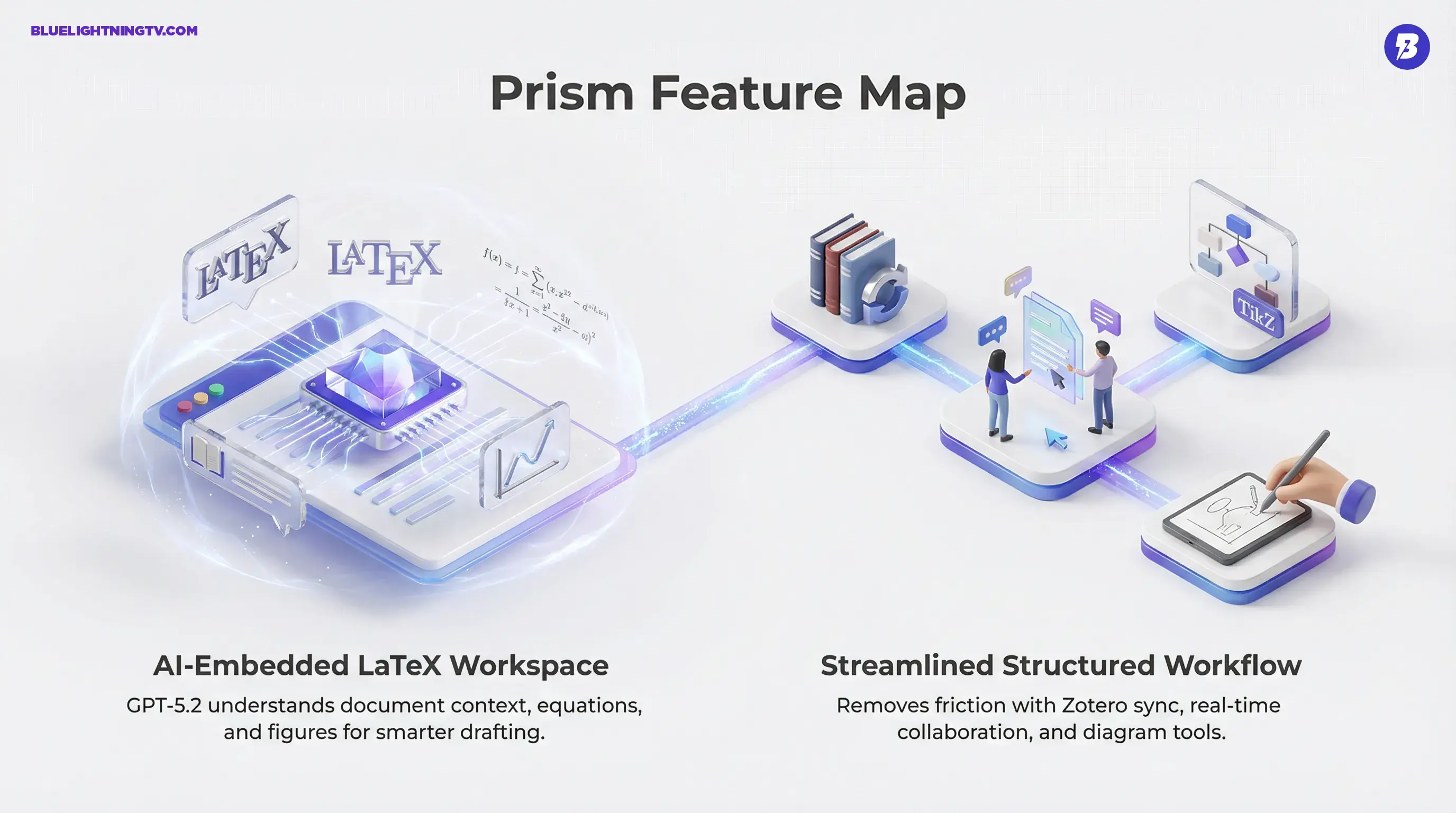
- LaTeX-native editing in the browser, with built-in compiling and document-structure awareness.
- GPT-5.2 embedded assistance for drafting and revision that can reference the full manuscript context (including equations, citations, and figures).
- Integrated citation flow, including Zotero syncing and support as shown on OpenAI’s Prism page: Prism workspace overview.
- Real-time collaboration with no seat limits described in OpenAI’s launch materials (OpenAI also markets unlimited collaborators and projects for personal accounts at launch).
- Sketch-to-LaTeX for diagrams via image-to-TikZ style conversion that turns a sketch or image into editable LaTeX diagram code.
- Voice-based editing for quick, hands-free revisions (as described by OpenAI in the launch announcement).
Not every feature will matter to every creator, but the pattern is clear: Prism isn’t just “generate paragraphs.” It’s “manage the messy parts of structured writing.” That’s where time disappears.
Why this launch matters
Prism is less about one new app and more about a platform shift: AI moving from “assistant on the side” to “operator inside the workflow.” This is the same arc we watched in coding, first you asked the model questions, then you let it live in the IDE, then it started handling whole chunks of the loop.
Technical writing is a perfect next target because:
- It’s structured. Models do better when there’s a strong scaffold (sections, references, definitions, equations).
- It’s repetitive. Formatting, refactoring, citation cleanup, consistency checks, high leverage for automation.
- It’s collaborative. Human review is non-negotiable, but AI can reduce the “what changed?” overhead.
Also: LaTeX is famously powerful and famously allergic to casual users. If Prism makes LaTeX workflows feel more like a modern collaborative doc, while still producing publication-grade output, that’s a meaningful unlock for teams that currently avoid technical formatting until the very end (and then suffer).
Who Prism is really for
OpenAI’s headline audience is researchers. But the product design fits a broader set of “structured writing” jobs where mistakes are expensive and formatting is not optional.
| Team | What they produce | Why Prism fits |
|---|---|---|
| Technical marketing | Whitepapers, benchmark posts | Equations, figures, citations without doc chaos |
| Product + engineering | Specs, RFCs, internal docs | Consistency checks and refactors across long docs |
| Education creators | Course notes, problem sets | Math + formatting, faster revision cycles |
| Analysts + research teams | Reports, literature reviews | Source handling + structured summarization |
If your writing includes math, citations, or “please don’t break the formatting,” Prism is aimed straight at you, even if you’ve never called yourself a scientist.
Workflow changes to expect
Prism’s biggest promise isn’t that it writes for you. It’s that it reduces the drag that makes good writing feel like a bureaucracy.
Draft with document context
With GPT-5.2 sitting inside the workspace, the model can operate with awareness of the document’s structure. That’s a practical difference from the usual “paste a section, hope it remembers the rest” loop.
Implication: you can ask for changes like “tighten the introduction, but keep all variable definitions consistent with section 3” and the request is at least structurally possible without manual babysitting.
Refactor equations and notation
In technical docs, tiny inconsistencies explode: a variable name changes, an equation shifts, a reference breaks, and suddenly the whole thing feels untrustworthy. Prism’s LaTeX-native approach suggests OpenAI is going after these “paper cuts” with deeper structural awareness, not just surface-level rewrite.
Implication: less time doing mechanical cleanup, more time checking whether the story is actually correct.
Citations get less painful
OpenAI emphasizes built-in citation management and Zotero syncing on the Prism page. This matters because citations are where AI writing products often faceplant: you can’t hand-wave sources in serious work, and you can’t ask a team to manually repair dozens of references after the fact.
Implication: if Prism’s citation workflow is solid, it becomes viable for “real” deliverables, not just drafts.
Collaboration stops being a merge fight
Real-time collaboration with technical content usually means someone breaks something and nobody knows who did it until the PDF looks cursed. Prism pitching unlimited collaborators isn’t just generosity, it’s a clue that OpenAI wants this to be a shared workspace, not a solo tool.
Implication: more teams can treat technical writing like a living artifact, not a once-a-quarter fire drill.
Tradeoffs to watch
Prism is ambitious, and ambitious products come with real-world questions creators should keep in mind, without spiraling into doomposting.
Here are the pragmatic watch items:
- Quality control is still on you. An AI-native doc flow can speed up drafting, but it doesn’t remove the need for domain review. Faster writing can also mean faster mistakes.
- Workflow lock-in is a factor. If your team lives in Google Docs or Notion today, moving to LaTeX-native writing is a mindset shift, even if Prism makes it easier.
- Literature search needs restraint. OpenAI markets literature search as part of Prism’s workflow (including arXiv-style discovery in demos and discussions). Treat it like an assistant researcher, not an oracle. Your credibility is the deliverable.
Translation for creators: Prism can reduce the grind, but it won’t replace your editorial judgment. It just makes you faster at applying it.
What to do next
If you write technical content as part of your creative output (AI explainers, product docs, research-backed newsletters, education materials), Prism is worth a serious look because it targets the parts of writing that don’t feel creative at all: formatting, consistency, citations, and collaboration overhead.
And if you’re already in the OpenAI ecosystem, Prism is also a preview of where “documents” are going: not just places to type, but environments where models can reason over structure, sources, and revisions as a system.
Bottom line: Prism isn’t trying to make writing magical. It’s trying to make the boring parts disappear, so the work that actually matters (clarity, accuracy, story) can move faster.