
Grok Imagine goes API
xAI just made a very specific bet: creators don’t only need another shiny “type a prompt, download a clip” toy. They need infrastructure. The new Grok Imagine API exposes Grok Imagine’s video generation and editing as a programmable service meant for apps, internal tools, and production systems that generate lots of content on purpose.
That’s the headline. The bigger signal is strategic: xAI is aiming Grok Imagine at the part of the market where budgets live, automation, iteration, and scale, rather than the part where people post a single demo clip and log off.
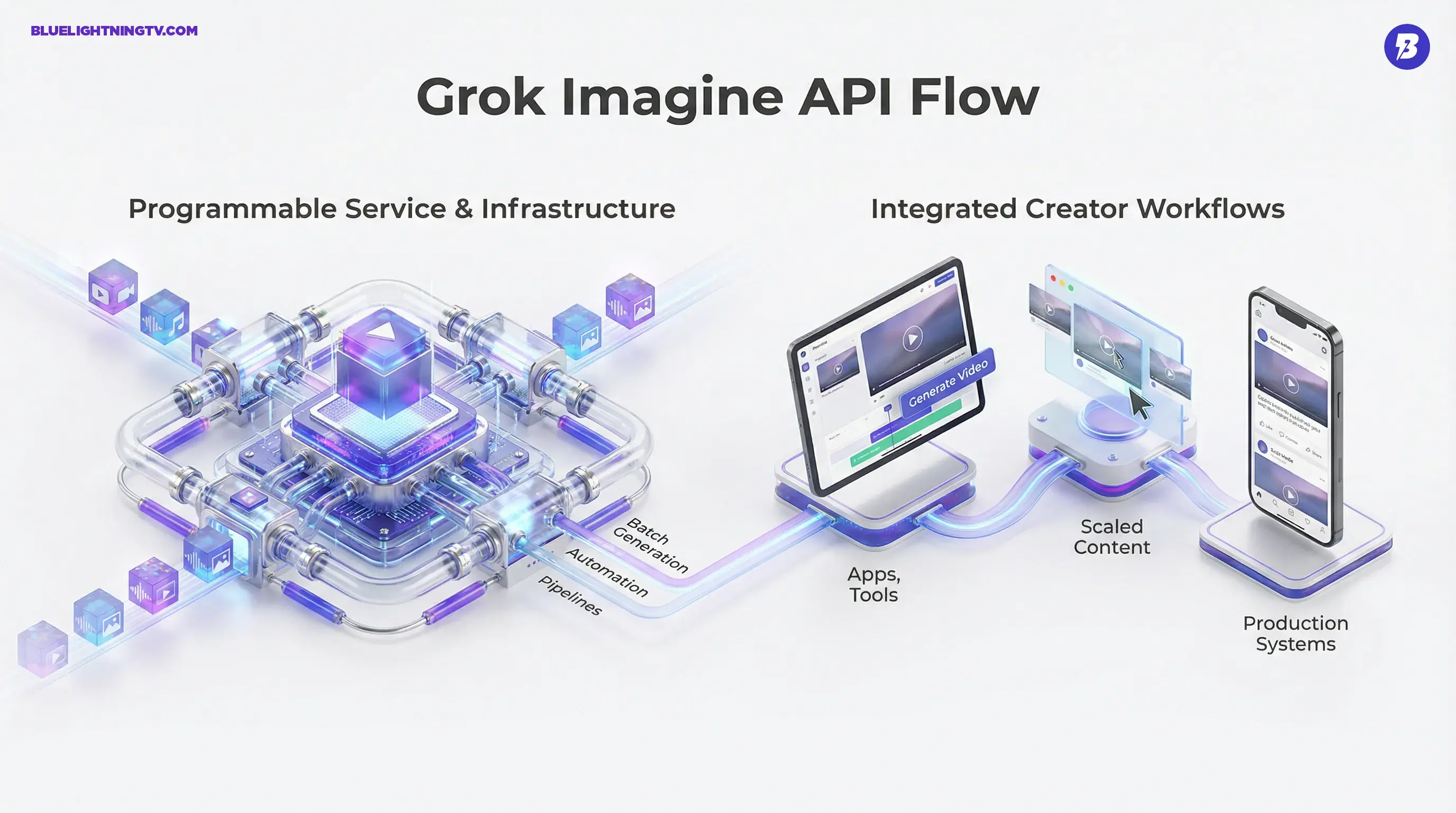
What xAI actually shipped
The announcement positions Grok Imagine as a suite: generation plus editing across image and video, delivered as an API surface rather than a consumer-first playground. The API pitch is about repeatable workflows: render variations, revise selectively, and chain steps together without dragging assets through five different tabs.
Video, plus editing hooks
xAI describes Grok Imagine as supporting text-to-video and image-to-video creation, alongside editing-style operations like restyling, object changes, and scene adjustments. In practice, that matters because a lot of “video generators” still behave like slot machines: if you don’t like take one, you reroll from scratch. Editing endpoints imply you can iterate within an output rather than constantly starting over.
Multimodal is table stakes
In its launch write-up, xAI positions Grok Imagine as capable of native video-audio generation, not just silent clips. If that claim holds up in production, it puts Grok Imagine in the same strategic lane as other “unified media” systems where the goal is fewer handoffs between tools and fewer missing pieces between draft and publish.
Why API-first matters
Launching API-first isn’t a vibe choice. It’s a workflow choice. It means xAI is prioritizing teams who:
- need batch generation (variants, versions, placements)
- build creator products (apps, plugins, marketplaces)
- run content operations (campaign pipelines, templated production)
Apps beat tabs
The real win isn’t “we can generate video.” Everyone can generate video now. The win is: can you generate video where the work already happens? If an agency can trigger renders from a campaign brief, or a SaaS tool can generate clips from product feeds, that’s not a demo, it’s throughput.
Automation changes behavior
When a tool becomes API-accessible, teams stop treating it like a special occasion. It becomes a background process: a generator you call the way you call a transcription endpoint or a render farm. That’s when you see:
- more A/B testing of creative angles because variants are cheap
- faster approvals because drafts appear automatically
- more templated content because consistency becomes programmable
How it compares now
AI video is currently split into two product shapes:
Clip apps optimize for “make one great thing.”
APIs optimize for “make 200 usable things.”
Grok Imagine is clearly planting its flag in the second camp. That puts it closer, conceptually, to “pipeline video,” where the bottleneck is no longer generation, it’s orchestration and review.
| Decision | UI-first tools | API-first tools |
|---|---|---|
| Best for | One-off clips, quick experiments | Batch output, product integration |
| Iteration style | Reroll, download, repeat | Chain steps, automate revisions |
| Operational fit | Creator solo workflows | Teams, pipelines, platforms |
What creators should expect
Even though this is developer-facing, creators feel the impact whenever the tools they use start embedding these endpoints. If Grok Imagine gets picked up by platforms and plugins, the creator experience becomes less about learning a new interface and more about getting a new button inside the interface you already live in.
Versioning becomes default
API access makes “generate five variations” feel like the minimum, not the deluxe feature. That’s a practical shift for ad workflows, social teams, and anyone doing iterative hooks. If you’re building content for performance marketing, you already know the game: the edit is the product, and volume is the strategy.
Previs gets cheaper
For studios and agencies, the underrated use case is automated previs: turning scripts, shot lists, or rough boards into motion drafts that speed up decisions. Not final footage, decision fuel. That’s where time savings compound.
What’s still unclear
As with most new generative video APIs, the announcement leaves some details creators and toolbuilders will immediately pressure-test in real usage:
- Latency under load: early impressions can be positive, but sustained concurrency is what matters for pipelines.
- Control depth: “editing” can mean everything from a simple restyle to true object persistence and selective changes.
- Consistency over series: the difference between a cool clip and a usable campaign engine is identity stability across outputs.
Those aren’t gotchas. They’re the normal gap between an announcement and the moment teams try to ship with it.
Where this is headed
The most important thing about Grok Imagine API isn’t that it exists, it’s what it represents: generative video moving from a front-end experience to a back-end capability. When video generation becomes an API call, it starts behaving like infrastructure: composable, repeatable, and increasingly invisible.
And for creators, “invisible” is a compliment. It means less time babysitting renders and more time doing the part only humans can do: picking the idea worth making 200 versions of.