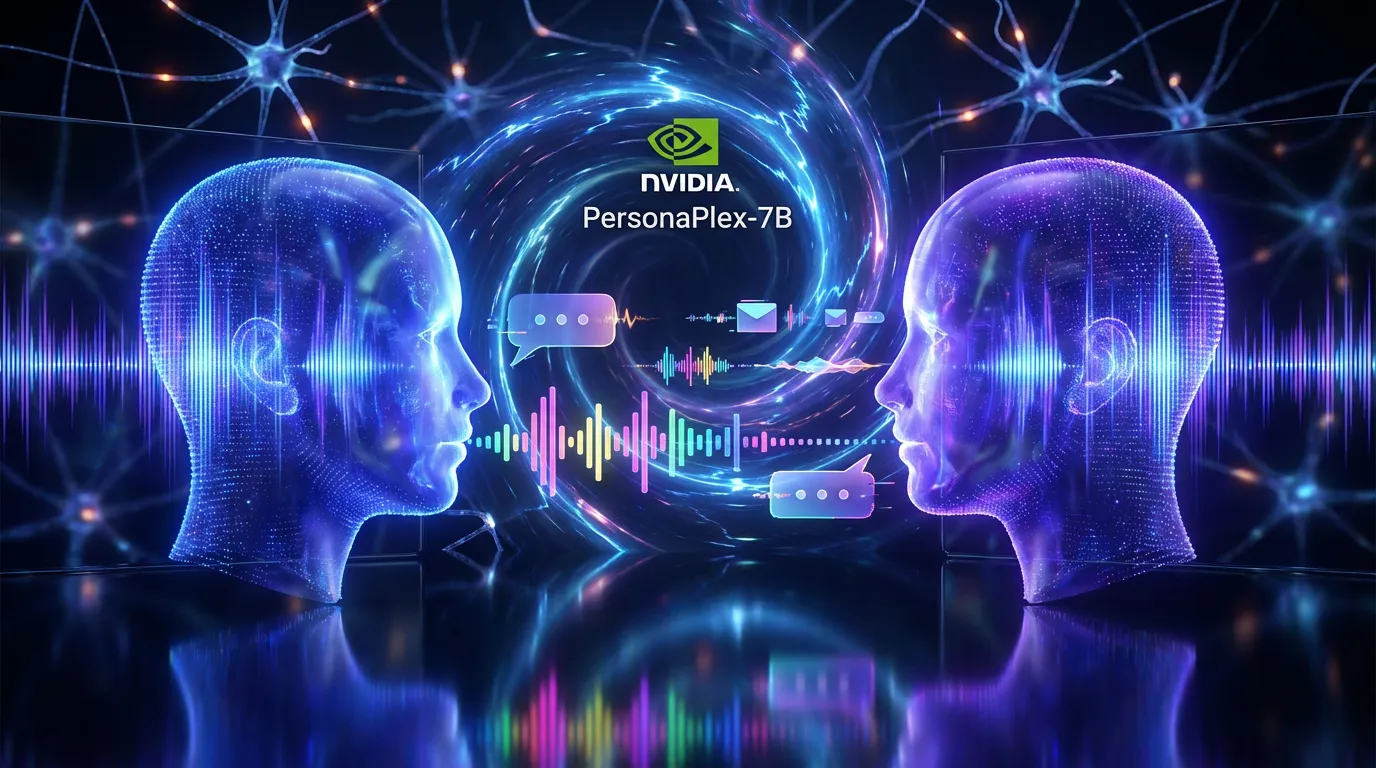
NVIDIA just open-released PersonaPlex-7B-v1, a speech-to-speech model built for actual conversation, meaning it can listen and talk at the same time, handle interruptions, and keep the flow moving like a human would. For creators building interactive characters, voice agents, live companions, or audio-first apps, this is one of the most practical voice drops we’ve seen in a while because it targets the thing that usually breaks the illusion: timing. The official project hub is here: NVIDIA PersonaPlex.
Most voice AI still behaves like a walkie-talkie: you talk, you stop, it thinks, it answers. PersonaPlex is NVIDIA’s push toward a full-duplex agent that can respond while you’re still speaking, backchannel naturally (mm-hmm), and recover when you cut it off mid-sentence, which is how people talk.

If you’ve ever tried to run a voice agent live and felt the vibe die in the pauses, PersonaPlex is aimed directly at that pain.
Under the hood, NVIDIA positions PersonaPlex as an end-to-end Transformer that skips the classic ASR to LLM to TTS assembly line. That design choice matters because each handoff in a modular pipeline adds delay, failure modes, and weird mismatches between what it meant and how it sounded.
What NVIDIA released
PersonaPlex-7B-v1 is open in the ways that matter for builders: you can grab the weights, run it yourself, and integrate without waiting for an API roadmap. The model card and files are here: Hugging Face: nvidia/personaplex-7b-v1.
Licensing is split the common open model way:
- Weights: NVIDIA Open Model License (linked from the model card)
- Code: MIT license
Note: the draft referenced a GitHub repo at github.com/NVIDIA/personaplex, but an official NVIDIA repository at that address was not findable via search, so it has been removed.
Full-duplex, explained
Full-duplex is not just a label here, it changes what you can build.
Half-duplex is the bottleneck
Most voice systems still enforce turn-taking:
- User speaks
- System waits for silence
- System transcribes
- System generates text
- System speaks
That creates the signature robotic rhythm. Even with fast models, the structure forces awkward timing.
Full-duplex feels human
PersonaPlex is designed to:
- Listen while speaking so it can react in real time
- Handle overlap like interruptions and interjections
- Use backchannels like right, got it, mm-hmm while you talk
- Reduce perceived latency because it does not need perfect silence to proceed
For creators, that means less interactive demo and more on-camera chemistry.
What’s new technically
NVIDIA’s framing is that PersonaPlex is a single model that directly maps audio-in to audio-out while tracking conversation state. That avoids glue code and awkward seams where transcription errors cascade into weird replies.
Dual streams, one brain
The model uses a dual-stream setup (user audio stream plus agent stream) while sharing state so it can adapt mid-utterance. This is the part that makes interruptions and overlap feel less like a crash and more like a conversation.
Persona control without voice cloning drama
PersonaPlex supports hybrid prompting:
- Text prompt sets role, background, scenario
- Audio prompt sets voice characteristics
That is a practical creator control panel approach: specify character and voice feel separately.
Performance signals that matter
NVIDIA reports results using a benchmark called FullDuplexBench, focusing on takeover behavior and latency in those moments. In the PersonaPlex reporting, smooth turn-taking latency is 0.170s and user interruption latency is 0.240s.
Useful translation: PersonaPlex is targeting response timing fast enough that humans stop noticing the system is waiting.
A voice agent doesn’t need to be perfect to feel alive. It needs to be on-time.
Quick spec table
| Detail | What NVIDIA shipped | Why creators care |
|---|---|---|
| Model size | 7B parameters | Big enough for rich dialogue, small enough to be runnable on serious GPUs |
| Modality | Speech-to-speech | No forced text-only middle step in the product experience |
| Interaction | Full-duplex | Interruptions, overlap, and backchannels become first-class features |
Where this lands for creators
PersonaPlex is not make podcasts with one click. It is infrastructure. And infrastructure is where creative unlocks happen because it changes what is even possible in the moment.
Live content gets a new sidekick
If you stream, host live rooms, or do audience call-ins, full-duplex voice makes an AI co-host feel less like a delayed soundboard and more like someone who can riff quickly, clarify mid-thought, react to interruptions, and keep momentum without babysitting turn-taking.
The difference is not just speed. It is rhythm.
NPCs and companions stop waiting politely
In games and interactive stories, half-duplex voice is immersion poison. Players interrupt. They talk over characters. They change their mind mid-sentence. A full-duplex model is built for that chaos.
Branded characters get less scripted
Marketing activations and interactive brand characters often feel like:
- user speaks
- dead air
- agent responds like a phone tree with a better voice
PersonaPlex is aimed at making those experiences feel like a real-time exchange, especially when a user is excited, confused, or talking fast.
The pragmatic caveats
This is an exciting release, but it is not magic, it is better engineering and a clearer target.
GPU reality check
Open weights does not mean it runs on your laptop while Chrome has 94 tabs open. The project is optimized for NVIDIA hardware, and real-time behavior will depend on your GPU and how you serve it (streaming, batching, audio I/O).
Full-duplex raises product stakes
When an agent can talk while listening, you get more natural conversation, but also more chances for it to step on the user, mishandle barge-ins, or backchannel at the wrong time.
Timing is a feature and a responsibility.
Open does not mean turnkey
You are getting serious building blocks (weights plus model documentation), not a polished creator app. Teams still need to design conversation rules, safety rails, persona boundaries, and the UX of interruptions.
Why this release matters now
Voice is having its video model moment: a lot of progress, a lot of demos, and very few systems that hold up under real-time pressure. PersonaPlex is notable because it is not just chasing prettier voices, it is chasing the interaction mechanics that make voice feel real.
If you work in live content, interactive media, or brand experiences, PersonaPlex-7B-v1 is one to watch, test, and potentially wire into your next production.