An AI-driven leap for creative guitarists
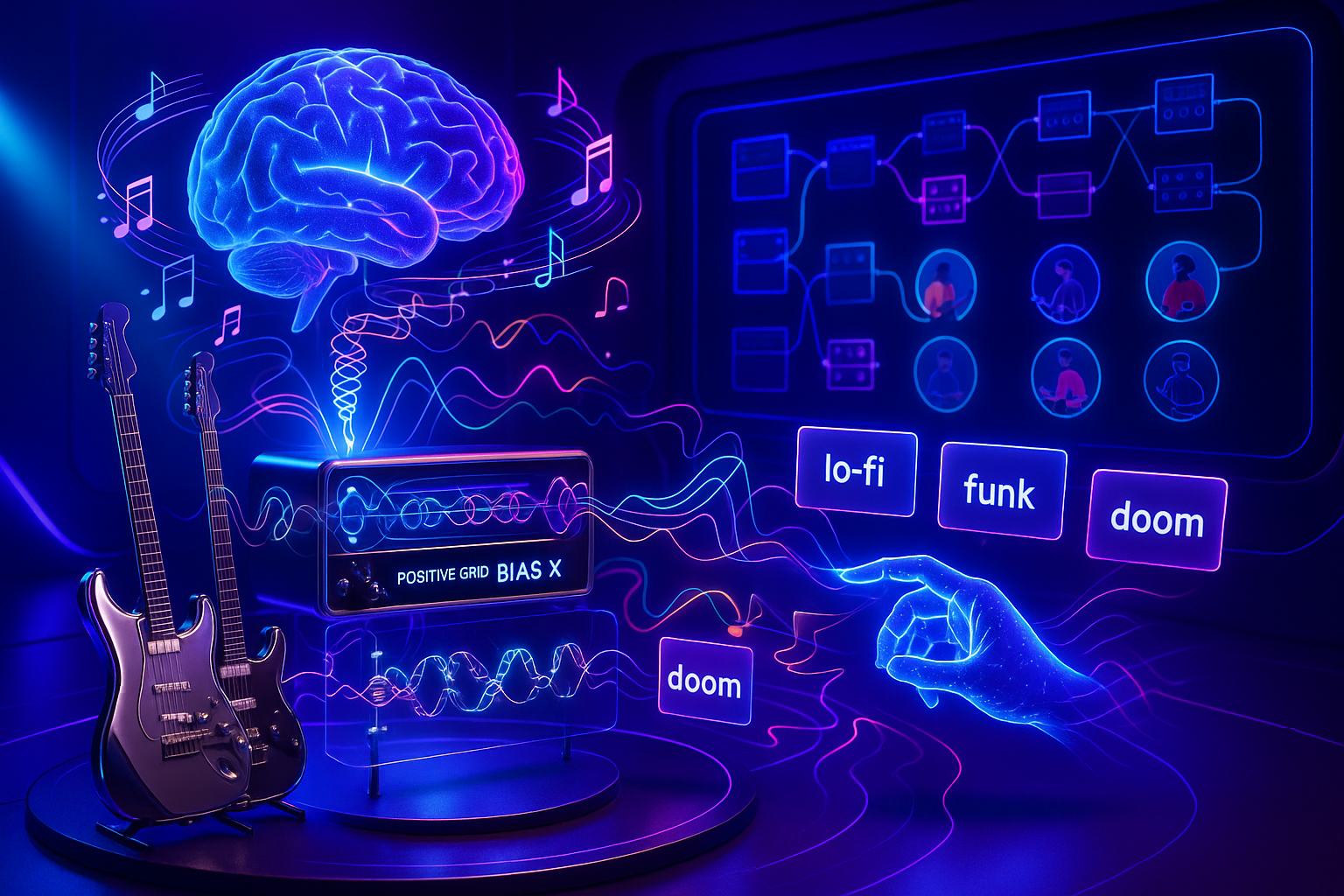
Positive Grid has launched Project: BIAS X, an AI-powered guitar tone creation suite designed for musicians, producers, and content creators working in guitar-heavy genres. BIAS X is available as both a plugin (VST3/AU/AAX) and a standalone desktop application for macOS and Windows. The headline feature is a generative, agentic AI engine that turns natural-language prompts and audio references into finished, record-ready tones for modern production.
The first fully generative, guitar tone design software tool powered by agentic AI. – MusicRadar on Project: BIAS X
How BIAS X Works: Natural Language and Audio-to-Tone Creation
The core innovation in BIAS X is its AI system for tone generation. Type a prompt like “lo-fi ‘90s alt-rock riff,” “glassy funk comp a la Nile Rodgers,” or “doom wall of gain,” and the platform proposes a complete signal chain: amp, cab, and effects. Prefer to copy a tone by ear? Drop in a clip of a guitar part and let Music-to-Tone analyze and recreate the sound. From there, users can iterate in plain English with prompts like “more bite,” “less reverb,” and “warmer cleans,” or dive under the hood and tweak parameters the traditional way. The result is a faster path from idea to usable tone, especially when matching references from client briefs, social clips, or catalog tracks.
Under the Hood: Studio-Grade Models and a New Cab Engine
BIAS X’s generative workflow sits on top of a deep library: 33 amp models trained from more than 200 real-world reference amps and 63 studio-grade effects. The cabinet section has been overhauled in collaboration with Spectre Digital, with IR support and detailed mic placement tools that make the amp-to-speaker-to-room feel less like a guess and more like dialing in a live room. For creators who care about the push and response of virtual rigs, that cabinet realism is a big deal.
Routing Built for Content Workflows
A dual-signal-chain architecture lets players run two fully separate paths in parallel (think tight, mid-forward distortion on one side and spacious, modulated ambience on the other) without destructive routing. It is a flexible setup for creators juggling streaming, short-form content, and studio deliverables. Preset organization is also revamped, with drag-and-drop convenience, fast auditioning, and straightforward sharing for teams and collaborators who need consistent tones across projects.
What’s New versus the Field
If you have been tracking AI-flavored tone tech, you have seen modeling approaches that capture existing rigs. That is useful, but not exactly type a vibe and get a rig. BIAS X swings for that generative use case.
- MusicRadar frames it as a category pivot toward promptable tone design and confirms a $149 price point with discounted upgrade pricing for existing Positive Grid users here.
- IK Multimedia’s TONEX line, by contrast, centers on AI machine modeling that faithfully captures specific amps, cabs, and stomp combinations, plus a community library for sharing those captures. It is powerful, especially if you already love a particular rig and want that sound anywhere. See how TONEX positions its approach on IK’s product page here.
Quick comparison at a glance
| Tool | Core Approach | Notable Angle for Creators | Availability |
|---|---|---|---|
| Positive Grid BIAS X | Generative “Text-to-Tone” and “Music-to-Tone” with agentic AI | Type a prompt or drop a reference clip to auto-build a full rig | Mac/Windows, VST3/AU/AAX; standalone |
| IK Multimedia TONEX | AI Machine Modeling captures real amps/cabs/pedals | Create and share captures; integrate with AmpliTube ecosystem | Mac/Windows; plugin + standalone |
| Neural DSP Archetype suites | Signature-focused virtual rigs and effects | Deep, manual control for highly stylized tones | Mac/Windows; plugin + standalone |
Specs, Formats, and the Practical Stuff
Here are the essentials creators care about: what you can load, where it runs, and how quickly you can get it into your workflow.
| Category | Details |
|---|---|
| AI Features | Text-to-Tone and Music-to-Tone generation; plain language refinements |
| Amps & FX | 33 amp models (trained on 200+ real references), 63 studio-grade effects |
| Cabinet Engine | New section developed with Spectre Digital; IR loader; visual mic placement |
| Routing | Dual, parallel signal chains; stereo-friendly configurations |
| Compatibility | macOS (including Apple Silicon) and Windows; VST3, AU, AAX; standalone desktop |
| Price | $149 MSRP; upgrade and discount pricing for existing Positive Grid users |
Why it Matters for Creators
Consistency and speed are the biggest wins. For creators who live on quick turnarounds (YouTube uploads, brand cues, TikTok riffs, sync briefs), BIAS X promises repeatable tone palettes you can spin up from a vibe line or a reference clip, then lock for a series. That reduces tone-chasing and keeps attention where it belongs: performance, arrangement, and delivery.
It also nudges tone design closer to creative direction. Instead of technical chain-building, you are describing intent: “dreamy chorus sparkle,” “hyped pop-rock crunch,” “bold, mid-forward lead.” That language maps to how editors, producers, and clients already speak, which helps with approvals and avoids the “can we make it more purple?” feedback loop many of us know too well.
For producers balancing multiple collaborators or remote sessions, the dual-signal-chain setup and preset system mean less time reconciling rigs and more time printing keepers. And for guitarists running hybrid workflows (recording one day, streaming the next), having a standalone app plus DAW plugin covers both use cases without extra software.
Industry Context: AI Tone Is Splitting into Two Camps
Zoom out and you will see two clear approaches emerging:
- Generative “describe it and we will build it” systems, with BIAS X as a current flag-bearer.
- AI capture and modeling systems like IK Multimedia’s TONEX, which excel at cloning known gear and sharing captures across a community.
Both paths serve creators. If your workflow leans on fast reference matching and genre-hopping, generative fits. If you are chasing an exact favorite amp persona across sessions or live, capture tech is still king. Expect cross-pollination ahead as vendors fold promptability into capture ecosystems and vice versa.
Early Reception and Positioning
Early coverage emphasizes the shift to prompt-driven tone design, dubbing BIAS X a turning point for how guitar sounds get made in the box. MusicRadar’s breakdown highlights the agentic AI claim and dual text and audio workflows while confirming the price and upgrade path for Positive Grid users.
Availability and Pricing
BIAS X is out now for macOS and Windows in VST3, AU, and AAX formats, plus a standalone desktop app. The retail price is $149, with discounted upgrade pricing for existing Positive Grid customers including BIAS FX and Spark owners. Platform specs, feature lists, and purchase options are available on the official page here.
Bottom Line
BIAS X pushes guitar tone into the prompt era. For creators, that means less menu-diving, faster reference matching, and tones that stay consistent across episodes, clients, and campaigns. It will not replace every modeling workflow (nor should it), but it clearly reframes how fast you can get from “sound like this” to “print it.” In a feed where attention is measured in seconds, that is a competitive edge.