

Adobe is making its biggest “this is for real production” move yet with Firefly Foundry, a service built to help studios, agencies, and enterprise creative teams develop custom generative AI models tuned with their own approved assets. The pitch isn’t “make cooler AI art.” It’s “make AI that can survive brand review, IP constraints, and the 43rd round of feedback.”
Firefly Foundry is essentially Adobe packaging up something enterprise teams have been asking for since generative AI entered the chat: control. Control over what goes into the model, what comes out, who can use it, and how outputs can be audited across a pipeline. In Adobe’s framing, it’s a path to “proprietary and on-brand” generation across media types, without relying on the vibe-based roulette of general-purpose public models.
What Foundry is
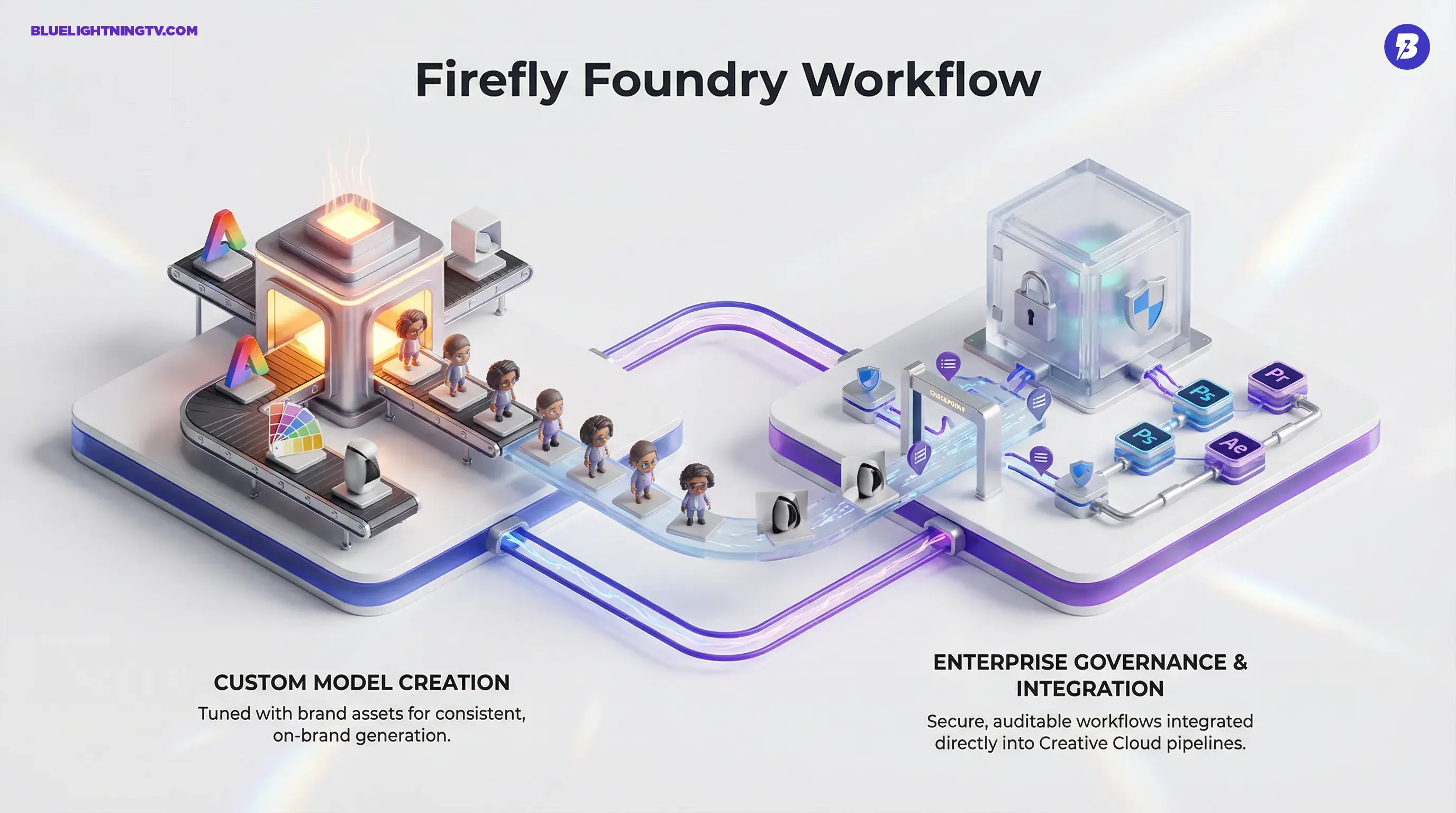
Firefly Foundry is a custom model-building service for businesses. Instead of using only Adobe’s default Firefly models, organizations can work with Adobe to create models tuned to their specific brand, franchise, or visual system, using company-owned and approved assets as the training and tuning source. Adobe positions this as part of its broader Firefly-for-business stack, with integration into Creative Cloud and enterprise workflows.
The shift: Adobe isn’t trying to win on “one model to rule them all.” It’s trying to win on being the place where multiple models (and custom ones) become usable in real creative operations.
Adobe has also been spotlighting media and entertainment partnerships around this launch, emphasizing that Foundry is meant to fit studios where authorship, provenance, and rights boundaries are non-negotiable. Adobe’s announcement focusing on M&E positioning is here.
Why it matters now
Generative AI is everywhere, but most production teams still treat it like a side sandbox: fun for moodboards, risky for deliverables. The reason is rarely “quality.” It’s governance.
For studios and agencies, the list of real constraints is brutally practical:
- Brand consistency across campaigns, markets, and formats
- IP boundaries (no accidental style bleed, no questionable training provenance)
- Workflow continuity (assets need to move into Photoshop, After Effects, Premiere, etc.)
- Review + approvals (audit trails, versioning, accountability)
Foundry is Adobe acknowledging that the “cool demo” era is over for a lot of teams. The new bar is: can AI integrate into a pipeline without creating legal and operational chaos?
How custom models work
Adobe’s core claim is straightforward: Firefly Foundry lets businesses build proprietary models tuned on their own IP, so the model learns the organization’s visual language instead of pulling from the general aesthetic soup of the internet.
It’s important to be clear about what this does and doesn’t mean in practice:
- It increases on-brand probability, so teams spend fewer iterations fighting drift.
- It helps standardize outputs across multiple creators and teams.
- It does not remove taste: creative direction still matters, and bad inputs still produce bad outputs.
The operational payoff is less “AI magic” and more “fewer hours lost to cleanup.” If your team has ever generated 60 images just to get 3 that don’t violate a brand system, you already understand the math.
Governance and safety
Foundry’s strongest story isn’t creative, it’s administrative (said with love). Adobe is leaning hard into enterprise expectations: data boundaries, permissions, and traceability.
Here’s the practical governance angle teams will care about:
- Approved-data tuning: custom models are built around the assets you provide, rather than an unknown third-party dataset
- Isolation: models and datasets can be kept separate by client, project, or org needs (important for agencies)
- Controls: enterprise access management for who can generate and how models are used across teams
- Auditability: Adobe positions the workflow around clearer provenance and enterprise review needs
This is also where Adobe’s broader positioning matters: Firefly isn’t just a generator, it’s meant to be a production-friendly layer that works with enterprise risk tolerance. That’s not exciting in a trailer. It’s extremely exciting when you’re trying to ship.
Workflow integration
Adobe’s advantage is obvious: most studios already live in Creative Cloud. Foundry becomes valuable if it plugs into the apps people actually use, instead of forcing a parallel “AI toolchain” with exports, re-imports, and file-sprawl chaos.
Adobe is explicitly framing Firefly’s ecosystem as the connective tissue, generation upstream, finishing downstream. If you’ve been following Adobe’s recent push to embed Firefly deeper into editorial workflows, this fits the same strategy direction we covered in Firefly AI Lands in Premiere Pro and After Effects.
Production truth: most teams don’t need AI to make the whole thing. They need AI to make the pipeline faster without breaking the pipeline.
What changes for teams
Foundry’s real impact shows up when you think in systems, not single outputs. It’s designed for teams making lots of content under constraints: campaign variants, episodic social, localization, multi-format deliverables, and cross-team asset production.
| Workflow need | Before Foundry | With Foundry |
|---|---|---|
| Brand consistency | Prompt gymnastics + manual fixes | Custom model tuned to brand system |
| IP risk management | Unclear boundaries with general models | More controlled, enterprise-style process |
| Scale production | High iteration cost per usable output | Higher “usable draft” rate |
| Agency multi-client work | Hard to separate styles + assets | Cleaner isolation and governance options |
Who it’s for
Adobe is clearly aiming Foundry at organizations where “just use Midjourney” is not an acceptable workflow answer:
- Film/TV studios doing concepting, previsualization, and franchise-consistent exploration
- Agencies building high-volume campaigns with strict client guidelines
- Brands maintaining global consistency across many creators and vendors
- Media teams producing rapid variants where approvals and provenance matter
Smaller teams can benefit too, but the value proposition scales with complexity. If you’re a solo creator, you might not need an enterprise service layer. If you’re managing five brands, twelve stakeholders, and a folder called “FINAL_final_v9_useTHISONE,” you probably do.
Rollout reality
Adobe has described Foundry as rolling out through enterprise channels rather than as a simple self-serve toggle. That’s consistent with what it is: a service-oriented offering, not just a feature dropdown. As of this launch window, Adobe does not publish standard self-serve pricing for Firefly Foundry, and access is typically via enterprise sales engagement.
It’s also consistent with Adobe’s broader Firefly business positioning, which has been moving steadily toward “AI you can operationalize,” not “AI you can demo.” For background context on Adobe’s earlier enterprise framing of Foundry, TechCrunch covered the service angle when Adobe introduced it as a custom-model initiative for enterprises here.
What to watch next
Firefly Foundry raises a few practical questions that will determine whether it becomes a true studio staple or just another enterprise slide deck:
Model quality under constraints
Custom models live or die by whether they can deliver repeatable outputs that still feel creatively useful. Too loose, and brands drift. Too tight, and everything looks like a template.
Cost vs. iteration savings
Foundry’s ROI won’t be measured in “wow.” It’ll be measured in reduced rounds, fewer manual fixes, faster approvals, and less rework across campaigns.
Workflow fit, not feature count
Studios will care less about the marketing list and more about whether Foundry behaves like a good pipeline citizen: predictable outputs, manageable versions, clean handoffs into the apps teams already use.
Bottom line: Firefly Foundry is Adobe taking a clear stance that generative AI is entering its enterprise era, where the competitive edge isn’t just generation quality, but control, integration, and shippability. That’s not hype. That’s the difference between AI as a toy and AI as part of a real creative business.