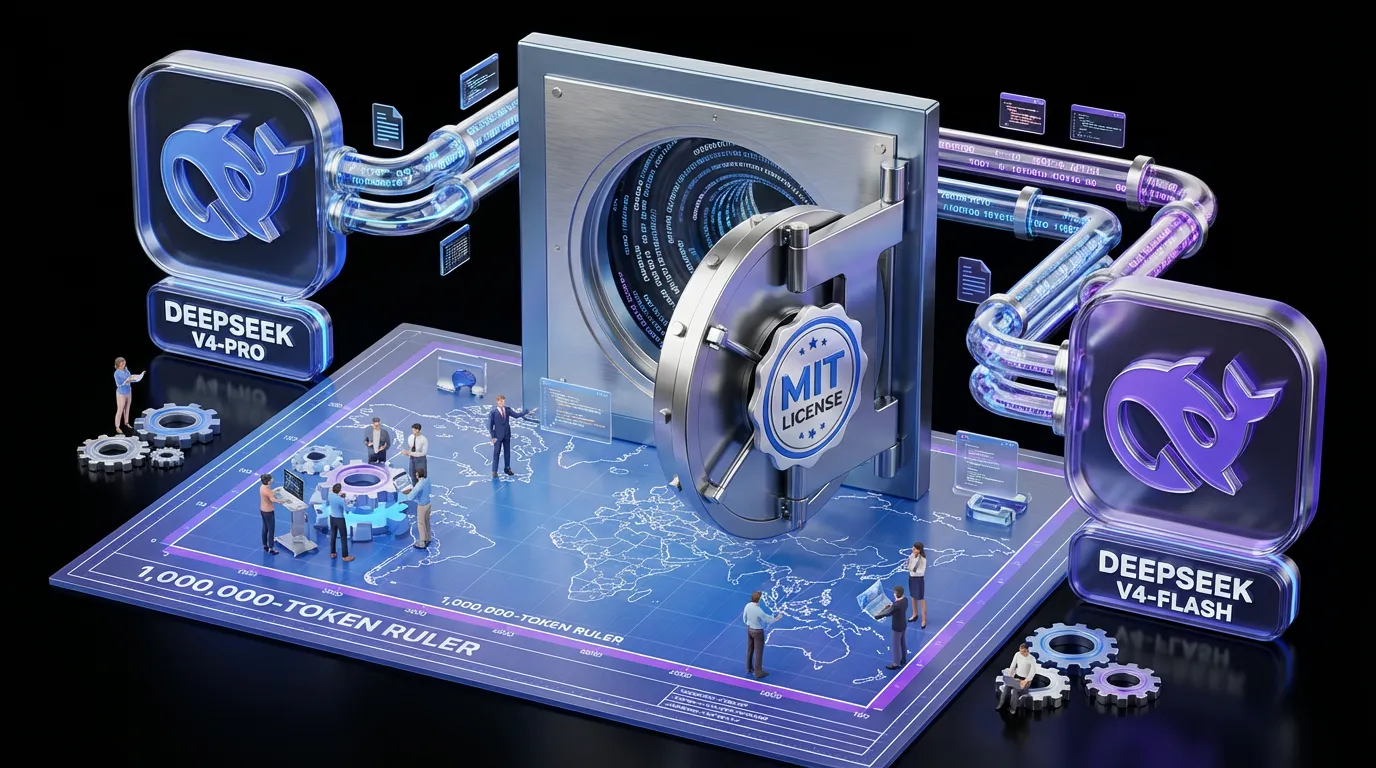
DeepSeek-V4 Preview just landed with a very specific vibe: “Yes, you can have open weights and serious long-context performance, now go build something that actually ships.” It’s a preview release, but the headline features are loud: MIT-licensed weights, two MoE variants (Pro + Flash), and a native 1M-token context window aimed squarely at coding-heavy automation and multilingual production pipelines.
This isn’t a “new chatbot” announcement. It’s a drop-in option for teams that already have agent-ish workflows, code review bots, content ops pipelines, and internal tooling, especially if you’re tired of treating closed APIs like the sun (powerful, expensive, and somehow always judging you).
What DeepSeek shipped
DeepSeek’s preview includes two Mixture-of-Experts models designed to cover the two realities of modern AI work:
- “I need maximum capability.”
- “I need this to run a lot, fast, and not bankrupt the project.”
Both models are positioned for practical build work: coding, tool use, long document reasoning, and automation chains. DeepSeek is also leaning into compatibility, offering API options that map closely to the patterns many teams already use.
The real story here: DeepSeek is betting that “open + scalable + long-context” is now a baseline requirement for serious creator and engineering teams, not a niche preference.
Two variants, two budgets
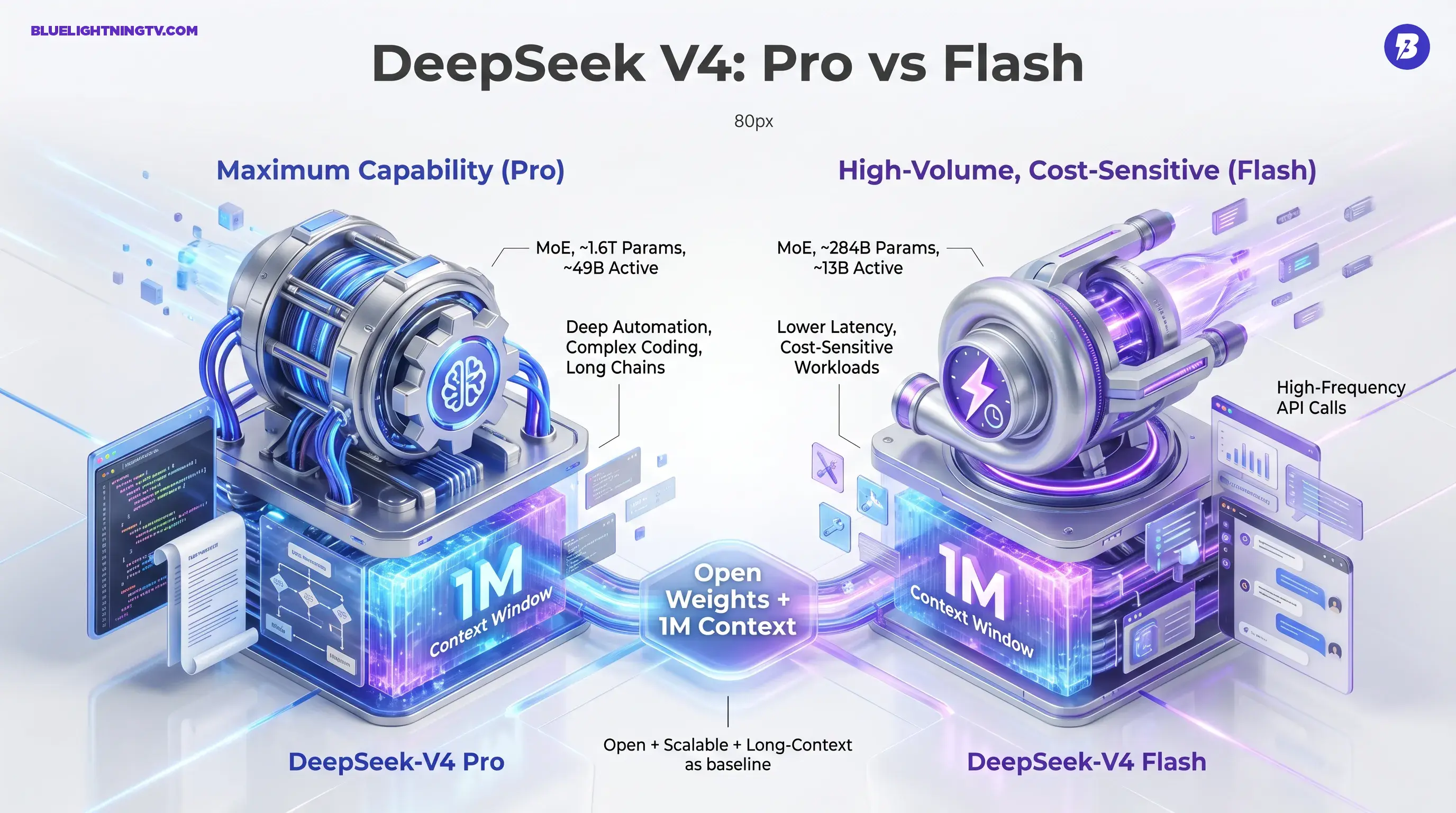
DeepSeek-V4 Preview ships as V4-Pro and V4-Flash. Both are MoE models, meaning only a portion of the network is “active” on any given token, one of the key ways DeepSeek can swing huge total parameter counts without making every inference as heavy as a dense model of the same size.
| Model | Architecture + scale | Best fit |
|---|---|---|
| V4-Pro | MoE, ~1.6T total params, ~49B active | Deep automation, tough coding, longer agent chains |
| V4-Flash | MoE, ~284B total params, ~13B active | High-volume pipelines, lower latency, cost-sensitive workloads |
The preview framing matters. DeepSeek is clearly signaling “use this now,” but also “expect iteration.” For builders, that usually translates to: pilot it in parallel, don’t rip out your existing stack overnight, and keep an eye on breaking changes.
The 1M-token headline
The marquee capability is the 1 million token context window, native. In human terms: entire repos, massive production docs, long meeting transcripts, multi-episode story bibles, and “why is this log file basically a novel?” debug sessions can live in one prompt space without aggressive chunking gymnastics.
That changes the shape of workflows where context loss is the silent killer. If you’ve ever watched an LLM do great for 20 messages and then suddenly forget the plot like it got bonked on the head Looney Tunes style, you already understand why long context is not a party trick.
Where long context matters
- Repo-scale coding tasks: multi-file refactors, dependency reasoning, “find the one config that breaks prod” hunts.
- Content ops at scale: ingest a full brand archive, then generate consistent variations without re-feeding half the internet every step.
- Agent pipelines: long context makes multi-step tool workflows less brittle because the model can keep more “state” inside the prompt itself.
DeepSeek also claims major efficiency improvements at full long context compared to its prior generation. In the V4-Pro model card, DeepSeek reports that at 1M tokens it uses about 27% of the inference FLOPs and about 10% of the KV cache compared to V3.2 at the same length (source). For Flash, vLLM’s recipe page summarizes the 1M-token configuration with roughly 10% of FLOPs and 7% KV cache versus V3.2 (source).
API compatibility, mostly
DeepSeek is also pushing “don’t rewrite your whole app” energy. The V4 preview can be used through DeepSeek’s API, and the official docs include an Anthropic-compatible base URL option (DeepSeek Anthropic API guide). The announcement-style overview page for the preview models is also available via DeepSeek’s model listing (DeepSeek V4 Preview page).
In practice, compatibility claims usually mean: your request and response shapes will look familiar, but you should expect feature mismatches around tool calling, message types, and “thinking” controls. DeepSeek’s Anthropic-format guide explicitly notes unsupported message content types (including image and document content types) in that format, which is a real-world constraint if your current pipelines lean multimodal.
Why builders should care
If you’ve got internal tools already wired to OpenAI-style chat schemas or Anthropic’s messages format, “close enough” compatibility is the difference between:
- Trying it this afternoon (swap base URL plus model name)
- Trying it next quarter (after a rewrite nobody wants)
Open weights, real control
The weights being MIT licensed is a big deal, not because “open” is automatically better, but because it gives teams options that closed APIs simply can’t:
- Self-hosting for sensitive inputs (client docs, proprietary code, internal analytics)
- Fine-tuning or domain adaptation for your style, your repos, your workflows
- Reproducibility for pipelines where “the model changed” is not an acceptable postmortem
Of course, open weights don’t magically remove engineering reality. V4-Pro is enormous. Storage footprints for practical deployments (and the GPU memory needed for long-context serving) are not small. “Open” doesn’t mean “runs on your laptop,” unless your laptop is actually a small data center wearing a hoodie.
Automation implications now
For creators and teams building production pipelines, the pragmatic impact of DeepSeek-V4 Preview comes down to three shifts:
1) Fewer brittle steps
With 1M context, you can reduce how often you split inputs, summarize intermediate state, or maintain elaborate retrieval scaffolding just to keep the model “aware.” That means fewer failure points in agent chains and fewer “wait, why did it ignore the spec?” moments.
2) Better model right-sizing
V4-Pro and V4-Flash create a clearer split between “premium reasoning” and “high-volume throughput.” That makes it easier to build systems that route tasks intelligently, Flash for routine transforms, Pro for the gnarly stuff. (Yes, this is the part where your pipeline starts acting like a producer: cheap shots for coverage, expensive shots for hero moments.)
3) Realistic migration paths
DeepSeek is meeting the market where it is: existing API patterns, existing agent frameworks, existing expectations. The migration story isn’t “burn it all down.” It’s “swap, test, measure.”
Balanced reality check: a 1M-token window doesn’t automatically make outputs smarter. It makes it possible to include more context. Your prompting, retrieval quality, and evaluation discipline still decide whether that context helps or just adds noise.
What to watch next
Because this is a preview, the next few weeks matter as much as the launch itself. The questions that will decide whether DeepSeek-V4 becomes a daily driver for builders:
- Stability under load: how consistent is quality across long contexts, not just in cherry-picked demos?
- Tooling maturity: how smooth is deployment in common stacks (vLLM, inference endpoints, internal gateways)?
- Real agent behavior: does it reliably execute multi-step tasks, or does it “agent” like a raccoon with a keyboard?
Even with those open questions, DeepSeek-V4 Preview is a meaningful release: open weights, serious context length, and a two-tier lineup that maps to how teams actually ship content and software. If you’re building automation workflows that need both control and scale, this is one of the more practical launches to evaluate right now.