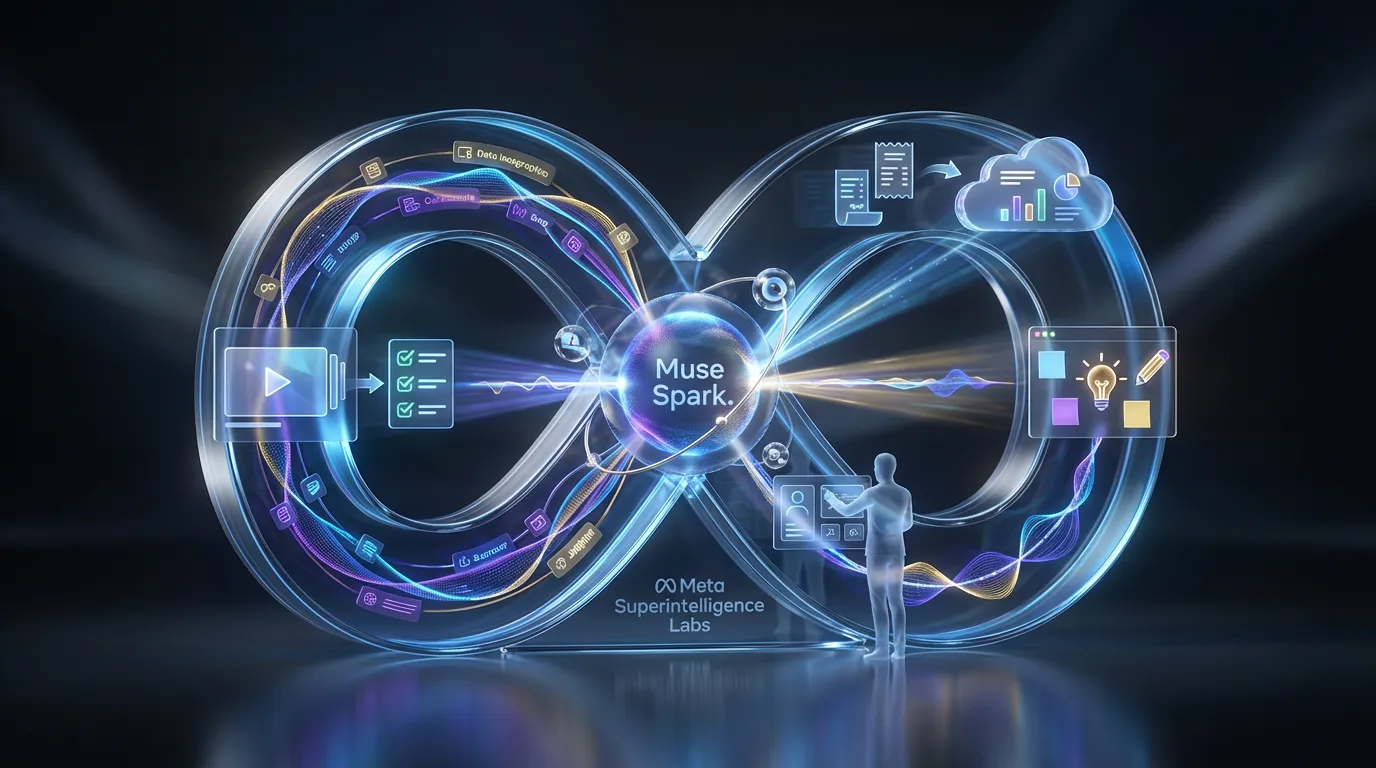
Meta just introduced Muse Spark, the first flagship model out of its newly formed Meta Superintelligence Labs, and it reads like a push toward multimodal, agent-style automation inside real products, not just chat inside social apps. The primary announcement is here: Introducing Muse Spark: Meta Superintelligence Labs.
Muse Spark is positioned as small and fast by design, natively multimodal, and capable of switching into deeper reasoning modes that can spin up parallel subagents. It is also, notably, not open-weight, a meaningful departure from the expectations Meta set with Llama.
If you build content pipelines, creative ops systems, or document-heavy automations, this launch matters less for headline benchmarks and more for a practical question: is Meta building a model you can actually operationalize inside real workflows? Muse Spark looks like a step in that direction, with some real caveats.
What shipped
Muse Spark is the first model in Meta’s new Muse family, developed under Meta Superintelligence Labs.
A few concrete elements from Meta’s positioning and early reporting:
- Native multimodal reasoning across text, images, and voice inputs (pitched as one unified system, not bolted-together modules).
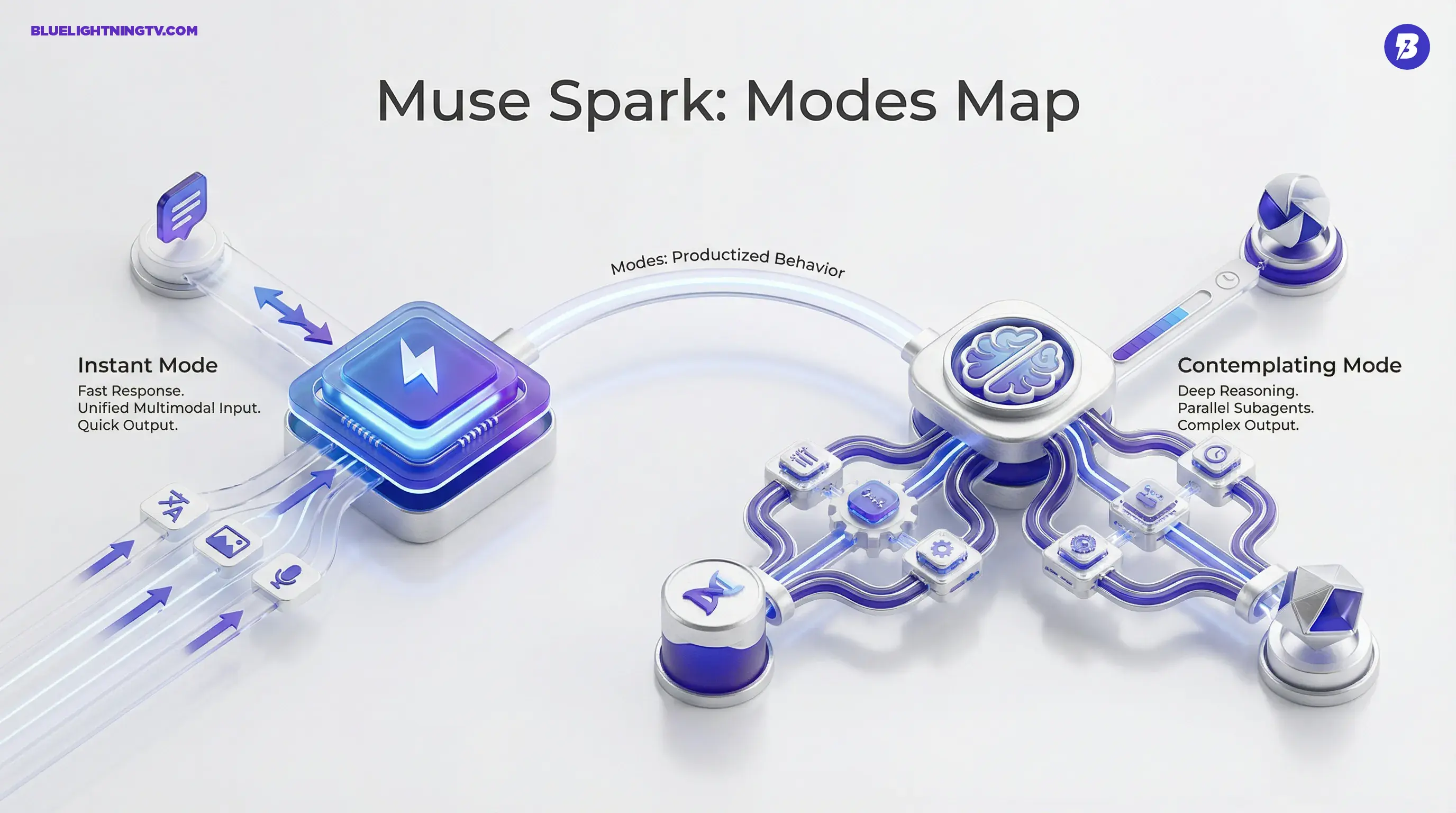
- Multiple operating modes that trade speed for deeper reasoning and multi-agent behavior, including Instant, Thinking, and Contemplating modes.
- Product-first distribution via Meta’s own surfaces first, with private preview API access for select partners rather than immediate broad developer availability.
For additional reporting context, Ars Technica’s overview captures the early public stakes and performance tradeoffs: Meta’s Superintelligence Lab unveils its first public model, Muse Spark.
Why this feels different
Meta has released powerful AI before, but Muse Spark reads like a different kind of move: less research flex, more platform primitive.
Two shifts stand out.
Multimodal is now default
Muse Spark is not being introduced as a text model that can also look at images. Meta is pitching it as a multimodal reasoning model at the core, meaning a single system that can interpret across modalities in one continuous workflow.
That matters because creator and business workflows are rarely pure text anymore. Real work is:
- screenshots, decks, PDFs
- creative references, comps, brand boards
- product photos with copy constraints
- forms, receipts, and messy this came from a phone camera inputs
Muse Spark is being aimed at that reality.
Modes are productized behavior
Meta is leaning into the idea that one model should behave differently depending on the job. In external coverage, Muse Spark is described as offering faster responses in an Instant mode, more deliberate step-by-step reasoning in Thinking, and multi-agent orchestration in Contemplating.
One mainstream rundown of these modes is here: Meta unveils Muse Spark with Contemplating mode.
This is an important product signal: speed vs depth is no longer just a model-choice problem. It is becoming a UI knob.
Translation: creators will not have to guess which model do I pick as often. The platform will increasingly offer how hard should I think as the control.
How Muse Spark works
Native multimodal reasoning
Muse Spark is built to reason across text plus image inputs as a unified task and can also accept voice input, per Meta. That unlocks practical automation that used to require stitching together multiple systems (vision OCR, a separate LLM, and an orchestration layer).
Where this lands in the real world:
- Read this screenshot, extract the UI copy, rewrite it in our brand voice.
- Here is a creative brief plus three reference images. Give me eight concepts that match the visual language.
- Summarize this slide deck and pull out action items with owners.
Subagents for parallel work
Meta describes Muse Spark as able to run internal subagents in parallel for complex tasks, especially in Contemplating mode. This is the agentic trend, but with a specific promise: less external workflow scaffolding.
Instead of you building a fragile chain like:
1) extract
2) summarize
3) outline
4) draft
5) QA
…the model claims it can coordinate multiple lanes and merge results more smoothly.
Pragmatic view:
- If it works, it reduces prompt babysitting.
- If it does not, it can create confidently merged nonsense faster than ever.
Access and rollout
Muse Spark is available through Meta’s consumer-facing surfaces first, including Meta’s AI app and the web experience at meta.ai. Meta also indicates private preview API access for select partners, rather than an immediate public API or open release.
This distribution choice is the whole chess move.
Proprietary, by design
Meta built massive goodwill with open-weight Llama releases. Muse Spark is the opposite posture at launch: closed, controlled, and rolled out through Meta-owned channels.
That does not make it worse. It does change what teams can do:
- You cannot self-host.
- You cannot fine-tune weights.
- You likely cannot deeply integrate until Meta opens broader API access.
If Llama made Meta a default pick for builders, Muse Spark is Meta betting on being a default pick for end users, then backfilling developer access behind that demand.
What creators can expect
Muse Spark’s biggest near-term impact will not be a new model to benchmark. It will be new baseline expectations for how multimodal assistants should behave inside mainstream products.
Here is a grounded snapshot of what it enables versus what it complicates:
| Area | What Spark improves | What stays tricky |
|---|---|---|
| Multimodal workflows | Text plus image tasks in one loop | Accuracy on dense visuals still needs testing |
| Multi-step automation | Parallel subagent execution (Contemplating) | Merging outputs can amplify errors |
| Adoption speed | Access via Meta AI surfaces | API access is gated (private partner preview) |
Implications for automation teams
Less glue code (eventually)
If Muse Spark’s multimodal plus agentic stack becomes broadly available via API, it could reduce the amount of orchestration teams build just to get baseline results (vision extraction -> LLM reasoning -> structured outputs).
That is meaningful because automation costs are often dominated by integration complexity, not model pricing.
Platform gravity increases
Meta’s advantage is distribution. If Muse Spark becomes the default assistant across Meta’s ecosystem, you will see:
- more creators using AI inside their daily social workflows
- more audience expectations for fast, on-platform content transformation
- more pressure on other assistants to match multimodal plus agent modes in consumer UX
The balanced reality check
Muse Spark is being positioned as fast, multimodal, and capable of deeper reasoning. Early reporting also suggests it may lag top competitors on some tasks (commonly cited areas include coding and longer-horizon planning), which is normal for a first model in a new family.
The practical takeaway for teams: treat Muse Spark as a new workflow surface, not a universal replacement. Use it where Meta’s strengths are obvious: multimodal consumer UX, content-adjacent tasks, and high-frequency make this usable transformations.
Bottom line
Muse Spark is Meta’s cleanest pivot yet from open-weight model provider to closed, product-integrated multimodal automation platform. The launch matters because it is not just another model name. It is Meta trying to make agentic multimodal behavior feel normal inside everyday tools.
For creators, the win is speed: less jumping between apps, fewer stitched workflows, more show it plus say it collaboration. For builders, the watch item is access: the real impact depends on how quickly Meta expands beyond partner preview into usable, scalable APIs.
Either way, the direction is clear: multimodal plus modes plus agents is not a research trend anymore. It is becoming the default shape of AI products.