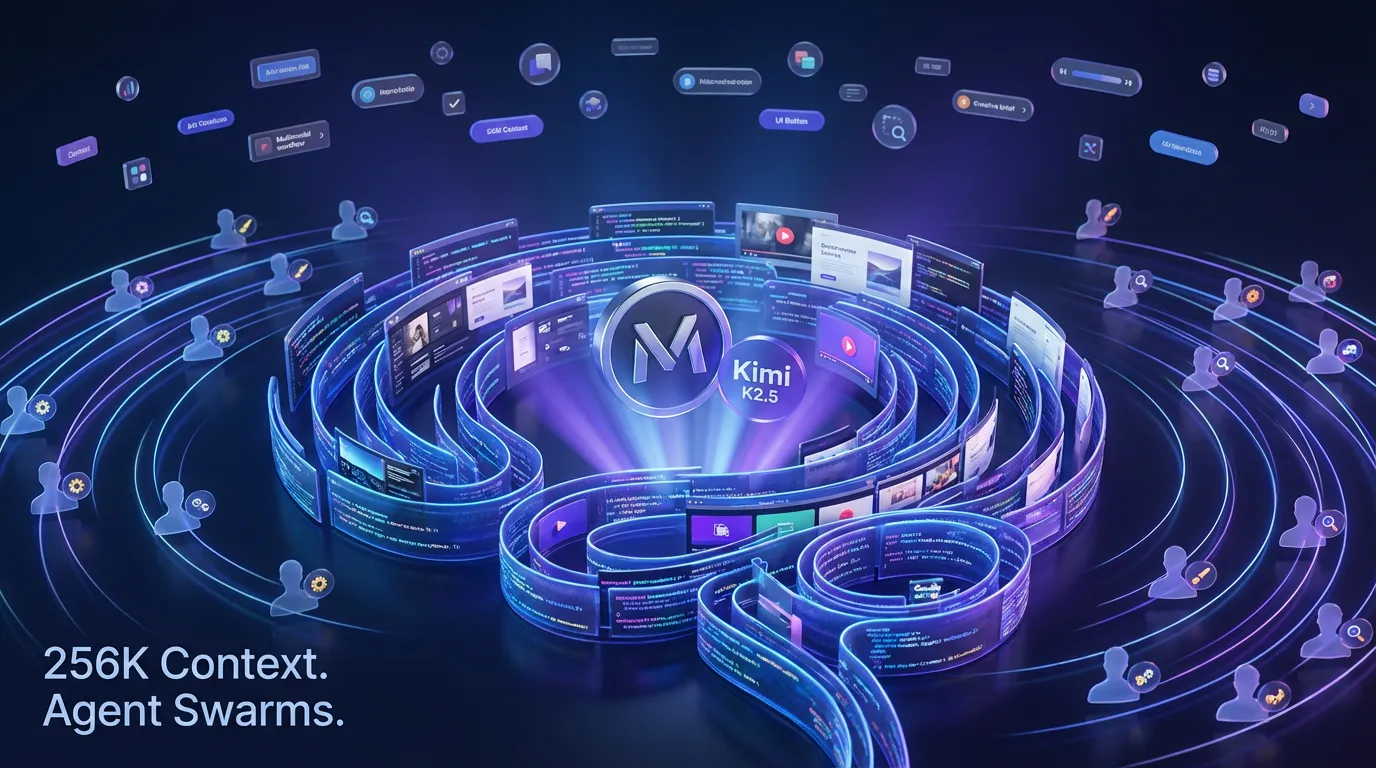
Moonshot AI has shipped Kimi K2.5, an open weight, native multimodal Mixture of Experts model with a 256K token context window and a built in Agent Swarm mode that can spin up to 100 parallel sub agents for tool using, multi step work.
On paper, this sounds like two trendy buzzwords stapled together: long context plus agents. In practice, it is a very specific kind of upgrade that creators and tool builders can feel immediately: fewer split the doc into chunks workarounds, and less waiting around for a single agent to do sequential busywork like it is 2019.

The real story here is not bigger model. It is that Moonshot is packaging long context plus parallel execution as a single product primitive so teams can run wide, not just deep.
What actually shipped
Kimi K2.5 is positioned as an open weight multimodal model and it is available via an OpenAI style API endpoint on Moonshot’s platform. If you want a concrete third party technical overview of the release positioning, architecture, and the swarm framing, MarkTechPost’s writeup is one of the clearer summaries.
There are four headline pieces that matter for production teams:
- 256K context for single pass work across long scripts, big briefs, multi file code, and giant research dumps.
- Agent Swarm mode (up to 100 sub agents) for parallel tool calls and multi role task decomposition.
- Multimodal inputs for working with images and other creator native artifacts, not just text.
- Aggressive token pricing that makes big context less financially scary for high volume teams.
Why 256K matters
Long context has been having a moment, but most teams still treat it like a luxury feature: nice, but not essential. That changes when your work is inherently long form: podcast transcripts, course modules, series bibles, creative briefs, brand guidelines, localization packs, contract language, product docs, and multi week revision threads that keep returning like a cursed boomerang.
With 256K tokens, K2.5 can hold a lot of your project reality in one place: the thing you are making and the constraints around it. That is the difference between an assistant that writes pretty text and an assistant that can stay consistent across versions.
Where it hits creators first
- Script and narrative work: fewer continuity slips because the model can keep earlier scenes, character notes, and rewrites in memory.
- Brand and marketing: better adherence when the model can see the full positioning doc, voice rules, and campaign variants at once.
- Editing and post: more reliable summaries and cutdown plans when the model can ingest full transcripts plus notes, not just highlights.
- Design and product docs: stronger synthesis across specs, feedback, and changelogs without flattening everything into a summary first.
Long context does not make a model smarter. It makes your workflow less fragile. The fewer times you compress, summarize, or remind the model, the fewer opportunities you create for it to drop something important.
Agent Swarm, explained
Agents have been everywhere, and a lot of them are just one model wearing a trench coat pretending it is a team. Kimi K2.5’s Agent Swarm pitch is more concrete: it can coordinate up to 100 specialized sub agents in parallel for complex tasks, with early reporting describing large scale parallel tool calling as a core design goal.
Moonshot and early coverage frame this as a speed and throughput play: instead of one agent doing research, then outlining, then drafting, then QA, you can run those lanes at the same time and merge outputs.
What parallel agents change
Parallelism does not just make work faster. It changes what you attempt in one session.
- Creative production: one agent pulls references, one writes hooks, one drafts a script, one checks brand voice, one generates alt headlines.
- Video workflows: one agent creates a chapter map, one pulls pull quotes, one suggests b roll beats, one drafts social cutdowns.
- Tool heavy pipelines: one agent runs web lookups, one formats into a deck outline, one builds a shot list, one does consistency checks.
The key is coordination: swarm style execution only pays off if the system can reconcile outputs into something coherent. That is the part to watch as people push it with real, messy projects.
Multimodal, but useful
K2.5 is described as natively multimodal, with training across large mixed visual and text corpora. The practical implication is not it can see images. The implication is: you can hand it screenshots, UI mockups, PDFs, and other creator native artifacts and keep the workflow in one place.
For creator teams, multimodal becomes valuable when it supports production chores you already do:
- Design review: Here is the mock. Here is the brief. Tell me what violates our layout rules.
- Packaging and decks: Extract the copy and rebuild it into a clean structure.
- Creative QA: Does this thumbnail match the title promise? What is unclear at a glance?
This is also where long context pairs nicely with vision: you can include the style guide, the brief, the draft copy, and the mockup without turning it into an endless chain of uploads and re prompts.
Pricing and access
Pricing is one of the more pragmatic parts of this release because it determines whether teams will actually fill that 256K window. Moonshot is pushing developers through its platform API, and most third party summaries converge on pricing in this band: roughly $0.60 per million input tokens (cache miss), roughly $0.10 per million input tokens (cache hit), and roughly $3.00 per million output tokens. Teams should confirm the exact rates in the live docs before budgeting.
| Item | Reported spec | Why creators care |
|---|---|---|
| Context | 256K tokens | Fewer chunking hacks; better consistency |
| Agent Swarm | Up to 100 sub agents | Parallel tasks; faster multi step output |
| API pricing | $0.60/M input (cache miss), $0.10/M input (cache hit), $3.00/M output | Big context workflows become affordable |
For teams doing high volume content ops (or building products on top), pricing matters as much as model quality. A 256K window is only useful if you are not terrified to fill it.
What to watch next
Kimi K2.5’s pitch is strong, but creators should keep expectations adult sized. Long context can still get weird at the edges. Agent swarms are only as good as their orchestration because parallel work can easily become parallel nonsense if merging is not disciplined.
The practical questions that will determine whether K2.5 becomes a daily driver:
- Consistency under full load: does it stay reliable when the window is actually packed, not half empty?
- Swarm coherence: can it merge 10 to 100 agents without producing Franken docs?
- Tool use stability: do tool calls behave predictably, or does it spiral when tasks get real?
- Multimodal accuracy: can it read what creators need it to read (UI details, layouts, doc structure) without hallucinating?
If those land well, Kimi K2.5 is not just another big model. It is a signal that the next competitive axis is throughput plus orchestration: models that do not just answer prompts, but run real production pipelines in parallel without turning your workflow into a science fair project.