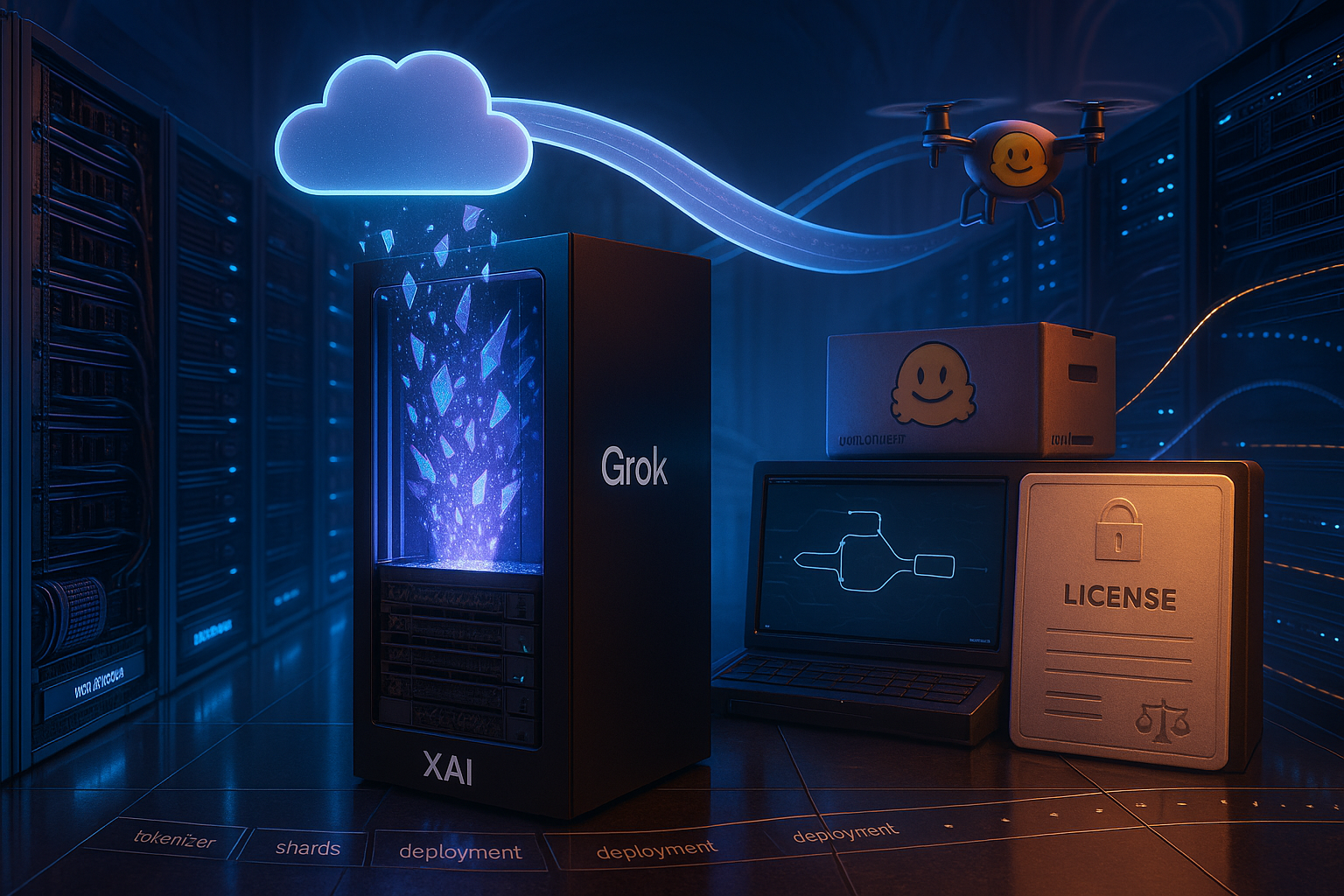
Elon Musk’s xAI has released the Grok 2.5 model weights for public download, making one of its most advanced large language models available via Hugging Face under a bespoke community license. The move signals a notable moment in the ongoing debate over openness in AI, broadening access to frontier-scale systems while also asserting clear boundaries around how those systems can be used.

What’s New and Where It Lands
xAI’s Grok 2.5 weights are hosted on Hugging Face alongside supporting artifacts like tokenizer assets and deployment references. The hosting footprint is substantial, with many shard files totaling hundreds of gigabytes. A central repository page captures the distribution and ongoing updates, with xAI positioning this as part of a broader cadence of model disclosures. Repository: xai-org/grok-2 on Hugging Face.
As a headline development, the release extends xAI’s work to place Grok-family models into the hands of researchers and organizations assessing real-world performance, safety behavior, and interoperability across emerging inference stacks. The company has also publicly signaled plans for future model disclosures, including a target window for Grok 3, framing today’s release as part of a longer-term roadmap rather than a one-off event. Coverage has underscored both the significance and the limits of open in this context, reflecting a sector-wide conversation about how to balance access with guardrails.
At a Glance
| Aspect | Details |
|---|---|
| Model | Grok 2.5 (Grok 2 family, xAI) |
| Distribution | Hosted on Hugging Face under the xAI organization |
| Included Assets | Weights, tokenizer assets, deployment references |
| License | xAI Community License (Grok 2 Community License Agreement) |
| Key Restrictions | Limits on using materials or outputs to train or improve other foundation models; revenue-based conditions for certain commercial use |
| Reference Serving Stack | SGLang-based inference examples referenced by xAI |
| Indicative Footprint | Large multi-hundred-GB download; multi-GPU systems commonly referenced for serving |
| Forward Signal | Public indication from xAI of plans to open source Grok 3 within about six months |
License and Guardrails
The weights ship under xAI’s Community License, which differs from OSI-style open-source licenses by imposing explicit usage constraints. The license text, published alongside the repository, sets expectations for attribution, branding, and acceptable use. It also includes revenue thresholds for certain commercial scenarios and delineates where separate licensing is required for larger enterprises. License: Grok 2 Community License Agreement.
Key license takeaway: the agreement restricts using the materials or their outputs to train, develop, or improve other foundational or large-scale AI models, while permitting modifications and fine-tuning of the Grok model itself under stated terms.
This approach is increasingly seen in foundation model releases. It enables experimentation and benchmarking without enabling model-to-model bootstrapping at scale, a distinction that draws scrutiny within the AI community and highlights differences between open in AI and open source in software.
Compute Considerations and Serving Context
Weight availability lowers barriers for access, but operational realities remain. The reference ecosystem around Grok emphasizes high-performance inference stacks and multi-GPU systems. xAI’s examples call out SGLang, a serving framework adopted across vendors and research teams for its efficiency features, including speculative decoding, attention optimizations, and multiple forms of parallelism. Reference stack: SGLang on GitHub.
Context, not instruction: the Grok 2.5 release aligns with an inference pattern that favors multi-GPU nodes with large-memory accelerators, and includes references to SGLang for runtime orchestration. Organizations will evaluate hosted, hybrid, or on-prem paths based on footprint, latency targets, and governance needs.
Given the checkpoint size and memory profile, this release is most immediately practical for research institutions and enterprises with access to modern data center GPUs. Public availability also enables third parties to explore quantization, performance tuning, and alternative runtimes over time.
Industry Significance
The disclosure arrives at an inflection point for model distribution strategies. In the past 18 months, developers have seen a spectrum from fully permissive weights to community licenses with guardrails. xAI’s move places Grok 2.5 in a category that boosts transparency and third-party evaluation while preserving business and safety levers. For research groups, the availability supports side-by-side benchmarking against contemporaries. For vendors and integrators, it informs roadmap decisions around compatibility, safety overlays, and deployment economics.
Market reaction has focused on two axes: the availability of high-performance weights for independent verification, and the license architecture. The first accelerates empirical evaluation outside vendor-controlled sandboxes. The second underscores a growing consensus that open in AI will often mean accessible under conditions, and that license nuance is part of the competitive dynamic among frontier labs. Coverage: Reuters report on the Grok 2.5 release.
Broader Context
Grok 2.5’s arrival on Hugging Face builds on xAI’s earlier disclosures, including the 2024 release of Grok-1 weights, and tracks with a wider movement toward auditable AI. In such a model, communities outside the originating lab can test claims, probe edge cases, and propose mitigations, activity that is harder to sustain when access is mediated exclusively through hosting APIs. The tradeoff is that license architectures must enable meaningful scrutiny and utility while setting clear lines on derivative model creation and enterprise-scale monetization.
In that light, Grok 2.5 stands as both a resource and a signal. It is a resource in that qualified teams can pull the checkpoint and subject it to their evaluation batteries. It is a signal in that xAI is aligning its release strategy with a growing expectation for transparency, even as it codifies limits to ensure the model is not a turnkey source for training competitors.