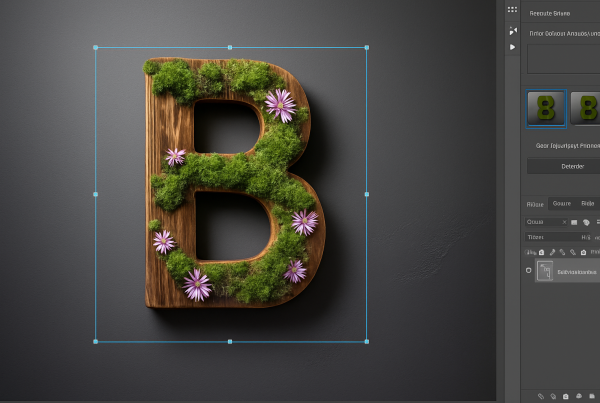

Transform Your Text into Elegant Embossed Designs
If you’ve ever wondered how to make your text look like it’s been elegantly carved into leather or another material, you’re in for a treat. This blog post takes you through the process of creating thick embossed text and shapes in Photoshop, injecting texture and depth into your digital designs. Roll up your sleeves, sharpen your Photoshop skills, and get ready to add a touch of sophistication to your projects.
Setting Up Your Canvas
Embossing text in Photoshop starts with a well-prepared digital canvas. A recommended starting size might be 1280 x 720 pixels at a 72 PPI (Pixels Per Inch) resolution. Naturally, these numbers are flexible depending on your project’s needs. For this tutorial, you can freely download an appropriate leather texture from resources like CG Textures.
Choosing the Right Font
The font you choose can significantly impact the appearance of your embossed design. For this demonstration, we embrace the boldness of the “Black Oak” font, available for free at fonts.com. This particular font’s naturally extended form benefits from a slight horizontal scale tweak; we’ll decrease it to 70% to fit our visual needs better.
Crafting the Emboss Effect
Creating the Text Layer
- Call up your Type Tool and click on your canvas to start typing.
- Use the Move Tool to reposition your text as needed.
- Once in place, it’s time to rasterize your text by going to Layer > Rasterize > Type.
Adding Depth and Dimension
- Create a new layer and select the text layer.
- Press
CtrlorCmdas you click to select the text shape. - Hide the original text layer by clicking its eyeball icon.
Here’s where the magic begins. You’ll now head over to Edit > Stroke and apply a 20-pixel stroke with the color set to black, positioned outside the original text shape. Next, rename this to your “Stroke” layer.
Applying Layer Styles for Embossing
Your text now looks like it has a clean outline, but it’s missing depth.
- Fill Opacity: Adjust it to zero.
- Drop Shadow: Set the blend mode to Multiply, with 70% opacity, a distance of 1 pixel, and uncheck Global light. Change the angle to -56 degrees. Set the size to 3 pixels.
- Inner Shadow: Switch the blend mode to Hard Light, 48% opacity, using a distance of 6 pixels, choke at 177%, and size at 9 pixels.
- Color Overlay: In the color box, input a Hue and Saturation of 0, with 60% brightness. Change the blend mode to Linear Burn.
Finally, to bring out the effectiveness of the emboss, make the text shape visible and apply a bevel:
- Use the Inner Bevel option with a smooth technique and the direction set to up.
- Set the size to 6 pixels, and soften the effect with a 2-pixel adjustment.
- For the highlight, change the mode to Linear Dodge at 14% opacity, and for shadows, use Linear Burn at 8% opacity.
Refining and Experimenting with the Final Look
- Combine all visible layers into a composite by selecting the top layer and pressing
Ctrl+Shift+Alt+E. - Create a layer mask, choose the Elliptical Marquee Tool, and draw a selection.
- Feather the edges via Select > Refine Edge, setting it to about 60 pixels for smooth transitions.
By pressing Alt or Option and Delete, you can fill this selection with black, and finally, tweak the midtones and light tones in the Levels window (Ctrl or Cmd + L) for a polished, professional finish.
Bring Texture to Life
With these techniques at your fingertips, creating visually stunning embossed text and shapes on materials like leather is a straightforward process. Every designer knows the excitement of adding texture and depth to a flat design—it transforms a simple text layer into something tactile and alive. Adding embossed effects isn’t just a skill; it’s your passport to more dynamic, engaging, and professional digital designs.
Go ahead and give it a try—stand out with elegantly crafted visuals that speak volumes of your creative prowess. Hit that like button on the video above if you found this guide useful, and don’t forget to subscribe for more tips and tricks!