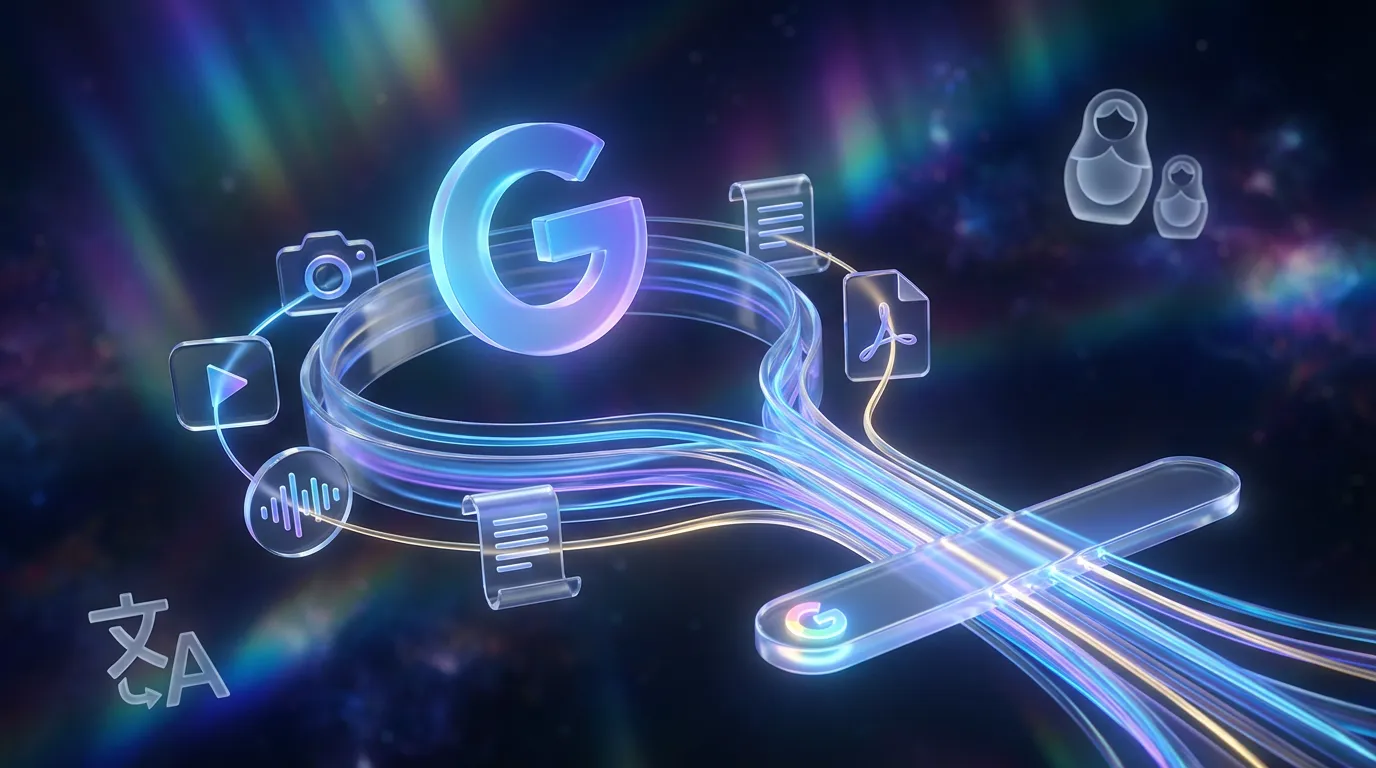
Google just put a major new building block into the creator tech stack: Gemini Embedding 2 is now in public preview via the Gemini API and Vertex AI. It’s Google’s first natively multimodal embedding model, meaning it can turn text, images, video, audio, and PDFs into vectors that live in the same semantic space. If you’ve been duct taping together one embedding model for text, one for images, transcripts for audio, and guesswork for everything else, this is Google saying: stop.
Big picture: this isn’t a new chatbot personality. It’s a new way to index, search, and connect your entire media library without splitting the workflow by file type.

What Google shipped
Gemini Embedding 2 is designed for retrieval and matching, not generation. It encodes multiple content types into a unified vector space so you can compare them directly: image to text, text to video, audio to image, document to anything. Google frames it as a foundation for semantic search, classification, clustering, and multimodal RAG across real world media collections.
Google highlights a few concrete preview limits and behaviors:
- Text: up to 8,192 tokens per request
- Images: up to 6 per request
- Video: up to 120 seconds
- Audio: embedded directly with no transcript required, currently about 80 seconds per request
- PDFs: up to 6 pages
It’s also multilingual (100+ languages), which matters for global catalogs and UGC libraries where language normalization is usually its own separate project.
Why embeddings matter now
Embeddings are the unsexy part of AI that quietly determines whether your tools feel magical or broken. If the retrieval layer is weak, everything downstream gets weird: recommendations drift, search results feel random, and RAG confidently cites the wrong thing.
Most teams doing serious content ops have been living with a structural problem:
- Text search is relatively mature.
- Image and video search is often metadata dependent.
- Audio search usually means transcribe first, then search the text.
- Documents are a mixed bag of text, visuals, and layout.
Gemini Embedding 2 is Google’s attempt to collapse that into one retrieval substrate so you can stop building modality specific ladders and start building actual products.
Multimodal, natively
The word “multimodal” gets thrown around so much it barely has meaning anymore. Here it does: Gemini Embedding 2 can create embeddings from each modality directly. The most notable callout is audio, since Google positions it as not requiring transcription.
That changes what’s practical in day to day creator workflows:
- Audio moments become searchable for what they sound like, not only what the transcript says.
- Video becomes more than frames plus captions, letting you retrieve clips by concept and intent, assuming it holds up on your data.
- Documents stop being second class citizens in retrieval stacks where meaning often spans text and embedded visuals.
Translation: if your library includes podcasts, reels, product photos, and PDFs nobody wants to open, this model is aimed at making them queryable in one system.
Interleaved inputs
One practical detail Google emphasizes is interleaved multimodal inputs. You can combine modalities in the same request, like text plus images, so the embedding represents the paired context, not just each item in isolation.
That matters for contextual matching:
- Find product photos like this and consistent with this positioning line.
- Match clips with this visual style and this tone of voice.
- Retrieve slides that use this chart style and mention this concept.
Older stacks often embed each piece separately, then combine scores downstream. Interleaving tries to push more of that joined meaning into the embedding itself.
Matryoshka sizing
Google also bakes in Matryoshka Representation Learning, which lets you get useful embeddings at multiple sizes. The default output is 3,072 dimensions, and Google recommends using 3,072, 1,536, or 768 as the main sizes for quality tradeoffs.
This matters because embeddings are not free. At scale, vector storage and retrieval cost real money and affect latency. One model that can flex between highest quality and cheap enough to store 200 million assets is the difference between a demo and a durable system.
| Embedding size | What it optimizes | Best fit |
|---|---|---|
| 3072 | Highest semantic fidelity | Premium search, hard matching tasks |
| 1536 | Balance quality plus cost | Large libraries, general retrieval |
| 768 | Storage plus speed | High volume, latency sensitive systems |
Real workflow implications
What changes for creators and the teams building creator tools is simple: the retrieval layer gets better first, and then everything built on top gets easier.
Asset libraries get smarter
Search stops being title contains keyword. You can build libraries where a producer searches warm kitchen lighting, handheld energy, tutorial vibe and gets clips even if nobody tagged them well.
UGC and brand matching improves
For brands sitting on piles of UGC, unified embeddings can help automate:
- similarity grouping
- theme clustering
- cross modal retrieval
This does not replace human taste, but it can remove the worst part of the job: endless scrolling to find the one clip that matches a concept someone described in a message.
Multimodal RAG gets less fake
RAG systems are only as good as what they retrieve. If your assistant can pull the right moment from a video or the right figure from a PDF, not just the nearest paragraph of text, outputs become more grounded. Google explicitly positions Gemini Embedding 2 as a foundation for multimodal RAG.
For broader context on how Google is pushing reliability and production fit across Gemini, our recent coverage of Gemini 3.1 Pro Boosts Reliability for Creator Workflows maps to the same theme: fewer brittle workflows, more automation you can trust.
Access and availability
Gemini Embedding 2 is available in public preview through the Gemini API and Vertex AI, which positions it for both prototype friendly use and production deployment. Google’s announcement also points to integrations across common retrieval tooling, signaling the intent to fit into existing vector database setups rather than forcing a Google only universe.
Third party coverage has emphasized the enterprise angle too. For example, VentureBeat’s overview frames it as a cost and latency play as much as a capability upgrade.
What to watch next
Because this is preview, the smartest stance is excited, not delusional. Three things will determine whether Gemini Embedding 2 becomes a default choice for creator platforms and content ops:
- Retrieval quality on messy data: your chaotic archive is the real test.
- Audio usefulness without transcripts: performance across accents, music beds, noise, and real world production audio.
- Operational ergonomics: batching, throughput, latency, and clean integration with your vector DB, reranker, and caching strategy.
Bottom line: Gemini Embedding 2 is infrastructure for creators who scale, teams building search, recommendation, RAG, and content intelligence across formats. It will not write your script. It will help your systems find the right ingredients fast enough that the script and everything after gets better.