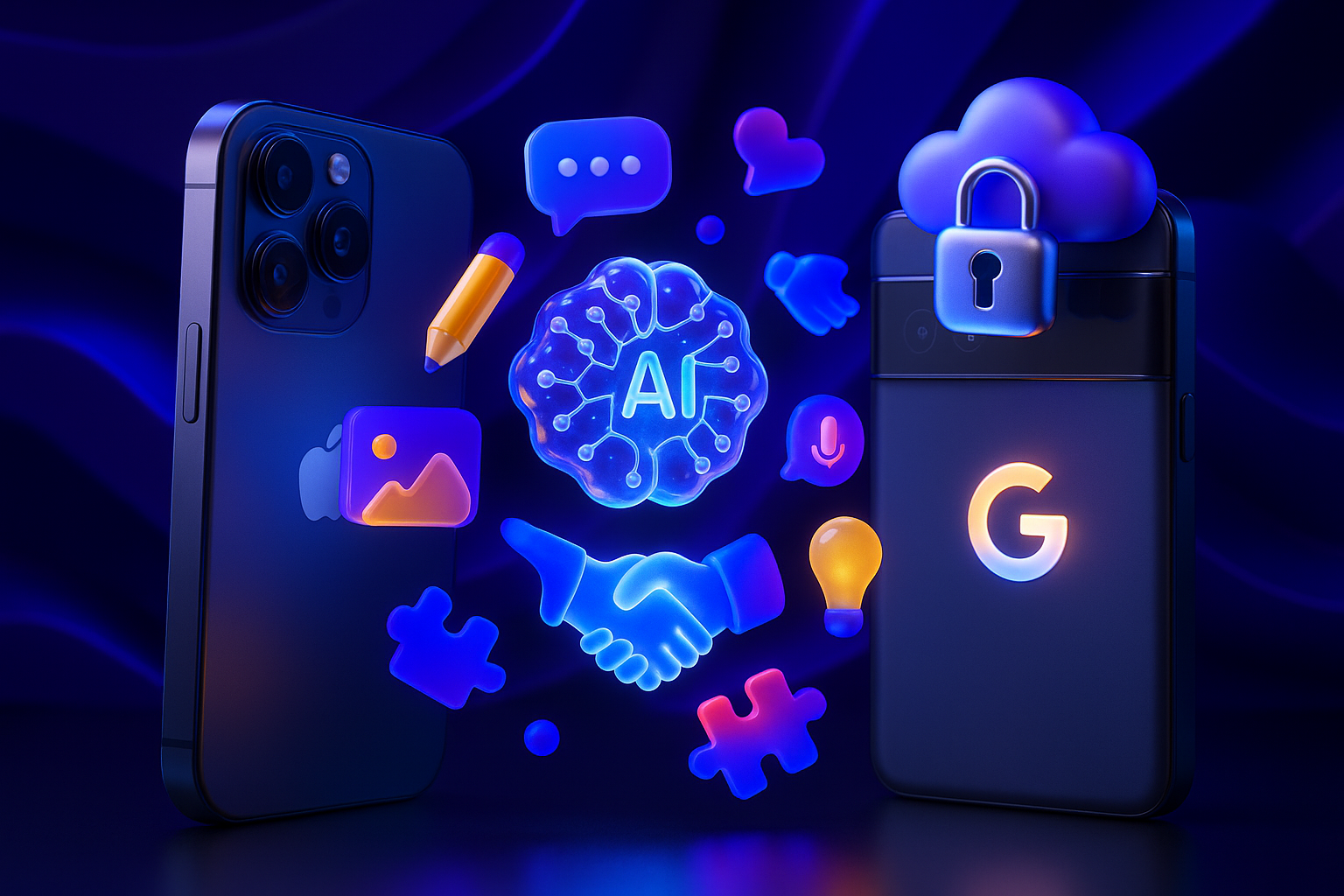
Apple’s latest iPhone launch arrives with an unmistakable message: generative AI is now a native layer of the device, not just an app you open. At today’s showcase, Apple emphasized how Apple Intelligence deepens across its platforms, while Google’s most recent Pixel 9 family continues to scale Gemini across Android and Google services. For creators, the difference shows up in everyday tools like writing aids, camera intelligence, voice, translation, and system hooks, and in the privacy, reliability, and battery life that make those tools usable. You can watch the full Apple presentation on the official Apple Events page.

Strategy: Personal Intelligence vs. Service-Spanning AI
Apple’s framing is clear: personal intelligence anchored on your device. With Apple Intelligence, most tasks run on-device, and only heavier requests are securely escalated to Private Cloud Compute, Apple’s privacy-hardened cloud running on Apple silicon. The effect for creators is practical: writing assistance, image creation, and context-aware Siri actions feel fast, and when the system needs more horsepower, Apple discloses the handoff path and limits what leaves the device.
Google’s approach prioritizes reach. Pixel 9 integrates Gemini on-device via Gemini Nano for speed and privacy, while tapping cloud Gemini for bigger jobs. Because Gemini also powers Search, Photos, Docs, YouTube, and more, creators see benefits beyond the phone. Assets, drafts, and edits travel across Google services with minimal friction. The model is less about a single device and more about an AI fabric that spans Android and the Google ecosystem.
Hardware Enablement: NPUs, Efficiency, and Where the Work Runs
Apple’s silicon and software co-design continues to be the backbone for AI performance. The Neural Engine accelerates on-device models and supports nuanced tasks like rewrites in any app, clean up in Photos, and visual generation via Image Playground, while Private Cloud Compute extends compute using Apple silicon in the data center. Apple’s design target is consistent: lower latency AI with predictable power draw. For creators, that usually means fewer compromises on battery when leaning on system AI throughout the day.
Pixel 9 emphasizes Google’s Tensor platform and a dedicated TPU to run Gemini Nano locally. Offline summaries, voice features, and some image tasks can execute without a connection, with cloud models stepping in for heavier jobs. Google’s cadence of Pixel Drops also matters. Creators often see AI refinements arrive mid-cycle, not just at launch, which steadily broadens and sharpens Gemini’s on-device role.
| Axis | Apple (Latest iPhone + Apple Intelligence) | Google (Pixel 9 + Gemini) |
|---|---|---|
| AI Architecture | On-device by default with escalation to Private Cloud Compute for complex tasks | Hybrid with Gemini Nano on-device and cloud Gemini for advanced workloads |
| Privacy and Data Handling | Task-scoped data with PCC designed so Apple cannot access personal data | On-device Nano for private tasks with cloud services governed by Google account controls |
| Hardware Acceleration | Neural Engine tuned for system-wide features and Apple silicon in PCC | Tensor TPU accelerates Nano with frequent feature updates via Pixel Drops |
| Ecosystem Reach | Tight continuity across iPhone, iPad, and Mac with consistent permissions | AI surfaces across Android, Search, Photos, Docs, and YouTube |
| Developer Access | App Intents and system extensions with Apple privacy guardrails | Hooks into Gemini Assistant and overlays with a broader Android partner path |
| Reliability and Guardrails | Transparent routing with cryptographic attestation for PCC | Safety filters and disclosure of AI involvement with availability that varies by region and device |
Features for Creators: Writing, Imaging, Voice, and Translation
On iPhone, Apple Intelligence brings system-level tools designed to fade into the background of creative work. Writing Tools can rewrite, summarize, and change tone in any text field. Image Playground and Genmoji enable fast visual ideation without spinning up a separate workflow. Photos continues Apple’s natural-first approach to cleanup and enhancements. Siri leverages personal context to chain tasks across apps. These features aim to reduce friction and help you move from draft to polish, or from a sketch of an idea to a shareable visual, with minimal exposure of personal data.
Pixel 9 pushes a broad set of AI tools, many of which tie back to Google services. Google highlights 14 new AI features across the lineup, including Recorder summaries, Call Notes, Pixel Studio for creative image generation, and expanded system-level Gemini access that speeds research and ideation across apps and web content. Google’s official rundown is here: Pixel 9: new AI features. For creators, the headline is reach. Gemini supports quick drafts, visual edits, and context pulls that follow you from phone to desktop to cloud drives.
Apple on PCC: Private Cloud Compute is engineered so that even Apple cannot access your personal data, extending device-grade protections to the cloud layer.
Apple’s PCC architecture, detailed by the company’s security team, includes secure boot, attestation, and code transparency, measures designed to make cloud assistance feel as private as local execution. Apple’s technical overview is here: Private Cloud Compute.
Google on Gemini Nano: Gemini Nano runs on-device, enabling helpful features without a network connection, which can improve privacy and responsiveness for everyday tasks.
Google describes how Nano’s offline capabilities augment core experiences like summaries and accessibility features on supported Pixel devices. An overview is available here: Gemini Nano on-device.
Ecosystem Integration: Continuity vs. Cloud Mesh
Apple’s strength remains continuity. Apple Intelligence respects the same permissioning and privacy rules across iPhone, iPad, and Mac, with features operating consistently as you move between devices. For creators, that uniformity matters. Edits in Photos feel the same on mobile and desktop. Writing Tools behave identically in Mail and third-party apps integrated via App Intents. Context-aware Siri stays bounded by transparent controls. The result is predictable AI that preserves the integrity of professional workflows.
Google’s advantage is a service-spanning mesh. Pixel 9 is the tip of a larger spear. Gemini enhancements show up across Android surfaces and Google’s productivity apps, and updates flow regularly via the cloud. A voice memos summary captured on phone can become a draft outline in Docs. A reference image saved to Photos can become a searchable anchor across devices. For teams collaborating in Google’s ecosystem, that flexibility can accelerate creative throughput.
Reliability, Guardrails, and Regional Availability
Apple positions on-device processing as the default, with escalation to PCC when necessary and with clear disclosure. The company’s security documentation emphasizes code transparency and cryptographic attestation, reinforcing the claim that PCC cannot retain or expose personal data. Rollouts typically begin with U.S. English and expand in stages, reflecting Apple’s cautious approach to language, safety, and regional compliance.
Google balances speed with safeguards. On-device features like transcription and summaries can run fully offline where supported, while cloud-driven tools carry Google’s standard safety filters and account-level controls. Availability can vary by region, device, and account eligibility. However, the cadence of updates generally means creators gain new capabilities steadily over the lifetime of the phone rather than at annual intervals only.
Limitations and Trade-offs: Real-World Usefulness Over Demos
Apple’s privacy-forward, device-led model yields consistent, low-friction tools that are predictable in performance and behavior. The trade-off is pace. Language and regional support expand gradually, and third-party integrations materialize within Apple’s frameworks and review policies. For creative pros, the benefit is trustworthy output in sensitive contexts like client work, unreleased product shoots, and protected IP where privacy and reliability are non-negotiable.
Google’s expansive approach turns Pixel into a rapidly evolving AI testbed connected to the broader Google ecosystem. The upside is breadth. You get new editing tools, faster idea capture, smarter search, and cross-app assistance. The compromise is variability. Some features depend on cloud availability, account type, or geography, and battery impact can change with workload when cloud handoffs are frequent. Still, for creators who live in Google’s services, the cross-surface gains are substantial.
Bottom Line for Creators: Two Clear Philosophies, Both Getting More Useful
Apple is betting on private-by-design intelligence that feels native and consistent wherever you work in its ecosystem. Google is optimizing for a wide, fast-moving layer of AI that spans Android and its cloud services. If your priority is predictable behavior, strong guardrails, and continuity across Apple devices, Apple Intelligence fits that brief. If you want the broadest mix of AI tools tied into Search, Photos, Docs, and YouTube, Pixel 9 with Gemini delivers reach and iteration speed.
In practical terms, both new flagships now treat generative and assistive AI as standard equipment, not a novelty. For creators, that means less time context-switching, more time shipping ideas, and a clearer choice between platform consistency and service-scale flexibility.