ChatGPT Gets Ads and a New “Go” Plan
In a shift that will change how creators experience (and monetize around) the world’s most-used AI chat app, OpenAI is rolling out sponsored messages in ChatGPT and launching an $8/month ChatGPT Go subscription tier. The official announcement is here: Our approach to advertising and expanding access.
These updates aren’t about flashy new models or cinematic video demos. They’re about distribution and business model gravity, two things creators feel immediately, whether you’re running a newsletter, selling a course, building a micro-SaaS, or just trying to keep your workflow costs sane.
OpenAI is positioning the change with a simple promise: ads will be clearly labeled, kept separate from answers, and won’t affect model outputs. But even if the model stays “neutral,” the surface area around it is now officially commercial. That’s the real story.
What’s actually shipping
Two separate moves, one shared theme: making ChatGPT cheaper to run for users and more profitable for OpenAI.
Sponsored messages in ChatGPT
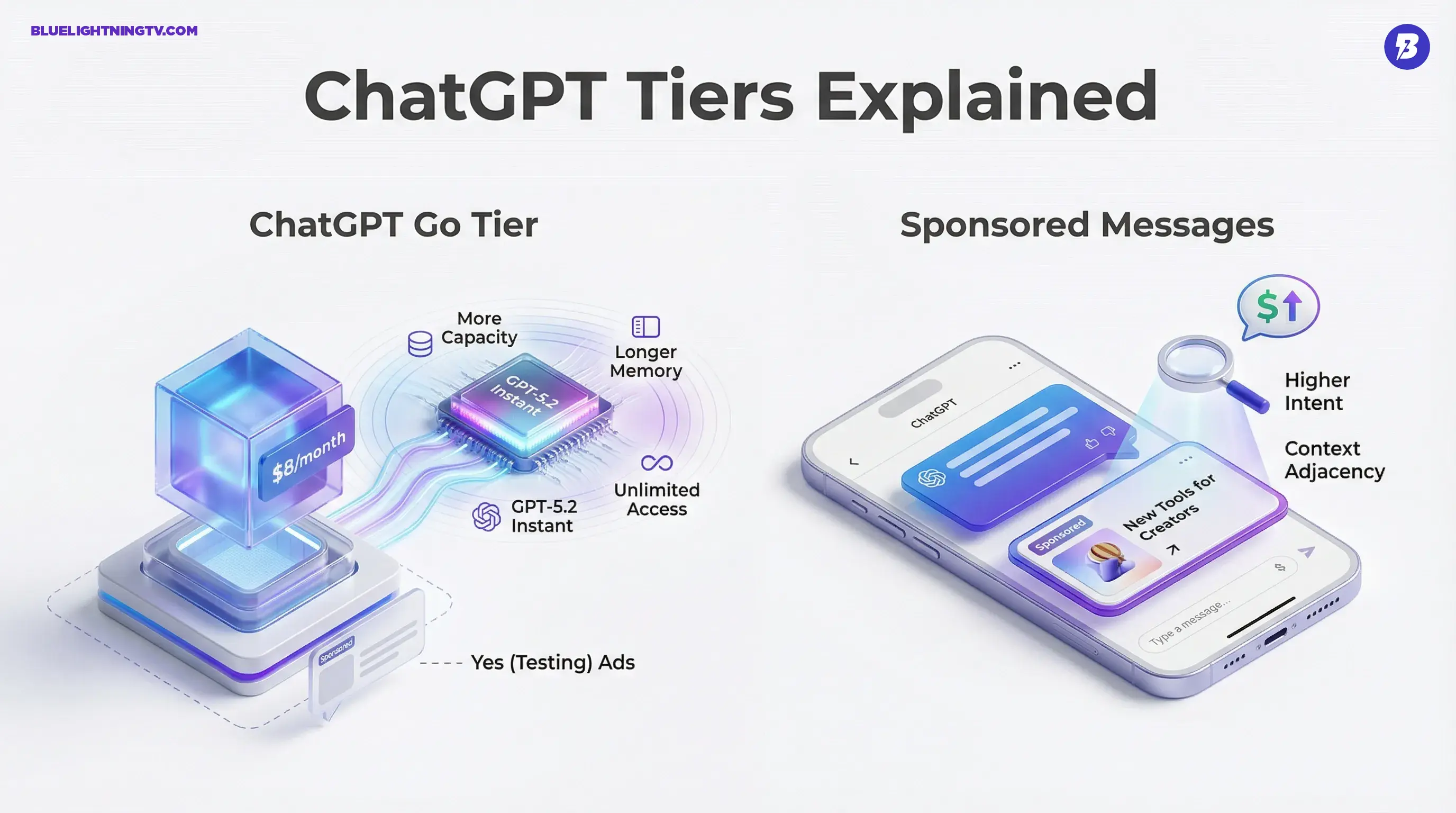
OpenAI says it will test ads (called sponsored messages) in the Free and Go tiers, initially in the U.S., with ads appearing at the bottom of responses when relevant.
If you want the “what will I see?” version, OpenAI’s help center has the clearest guidance: Ads in ChatGPT.
A few important boundaries are already on the record:
- Ads are labeled and visually separated from the assistant’s response
- Paid tiers stay ad-free (Plus, Pro, Business, Enterprise)
- Ads are excluded from sensitive topics (OpenAI highlights categories like health, mental health, and politics)
- Users under 18 won’t see ads (per OpenAI’s policy and rollout details)
ChatGPT Go: the new middle tier
ChatGPT Go is a budget subscription priced at $8/month in the U.S. It sits between Free and Plus and is designed for people who use ChatGPT a lot but don’t want $20/month.
OpenAI’s rollout details and positioning for Go are included in its advertising and access announcement: Our approach to advertising and expanding access.
According to OpenAI’s Go materials and help documentation, the plan includes:
- More capacity than Free (OpenAI describes this as up to 10x more messages, uploads, and image generations vs Free)
- Longer memory and access to features like projects, tasks, and custom GPTs
Notably: Go includes ads. So this isn’t “pay a little to remove ads.” It’s “pay a little to get more throughput.”
Plan differences in practice
OpenAI’s tiers are starting to look less like “feature bundles” and more like audience segmentation, different experiences for different price sensitivity levels.
| Tier | Ads? | Best fit |
|---|---|---|
| Free | Yes (testing) | Casual use, low stakes experimenting |
| Go ($8) | Yes (testing) | Daily users who need higher limits |
| Plus ($20) | No | Creators who want ad-free + higher capability |
The obvious implication: OpenAI is building a monetization ladder that can support massive scale. The less obvious implication: ChatGPT is turning into a discovery platform even if it still pretends it’s “just an assistant.”
Why creators should care
This is not a “marketing industry” story. It’s a workflow and distribution story.
Chat becomes a storefront
When ads show up in a chat interface, you’re not fighting for attention in a feed. You’re showing up at the end of an answer, often when the user is already primed to act.
That’s different from traditional social ads in two ways:
- Higher intent: people are asking for solutions, not doomscrolling
- Context adjacency: the ad sits right after the response, not between unrelated posts
OpenAI says sponsored messages won’t influence answers. Still, from a creator’s point of view, the user experience becomes:
Here’s the information you asked for… and here’s a paid option that might help.
That’s a powerful pattern and creators who sell digital products (templates, tools, courses, subscriptions) should assume this surface will mature quickly.
Go tier changes user expectations
Go is a signal that OpenAI believes a large chunk of users want more capacity, not necessarily more “premium intelligence.” That matters for creators because it shapes what “normal” usage looks like.
If Go becomes the default paid tier for everyday users, the behavior you’ll see is:
- more frequent sessions
- longer ongoing projects
- more file-based workflows (uploads)
- more “assistant as operating system” usage
Which means: if you publish content, prompts, or products designed to plug into ChatGPT workflows, the addressable audience for heavier usage expands beyond just Plus and Pro.
What to watch next
OpenAI hasn’t outlined a full ads product roadmap, but the direction is pretty easy to read.
Ad formats will evolve
Bottom-of-response “sponsored messages” are likely the safest first step. If the experiment works, expect the next phase to emphasize:
- better relevance tuning
- clearer measurement and attribution
- more controlled creative formats
In other words: less “banner ad,” more “this is the one tool you should try next.”
Creators will need skepticism
This is the part where we keep it grounded. Ads inside ChatGPT won’t magically become the best channel on day one. Early-stage ad systems tend to come with:
- uneven targeting
- limited reporting
- creative that doesn’t match the context yet
- user pushback if the experience feels spammy
OpenAI’s job is to keep trust intact. If creators and advertisers abuse the format, users bounce and the whole thing collapses. So expect stricter guardrails, not fewer.
The bottom line
OpenAI is turning ChatGPT into a two-sided platform: users on one side, advertisers on the other, with a new “Go” tier acting as the price-sensitive bridge. For creators, the key change is that ChatGPT is no longer just where people make things. It’s increasingly where people find things.
If you’re building in generative AI right now, this is a reminder that the tools are still evolving but the distribution layer is evolving even faster.