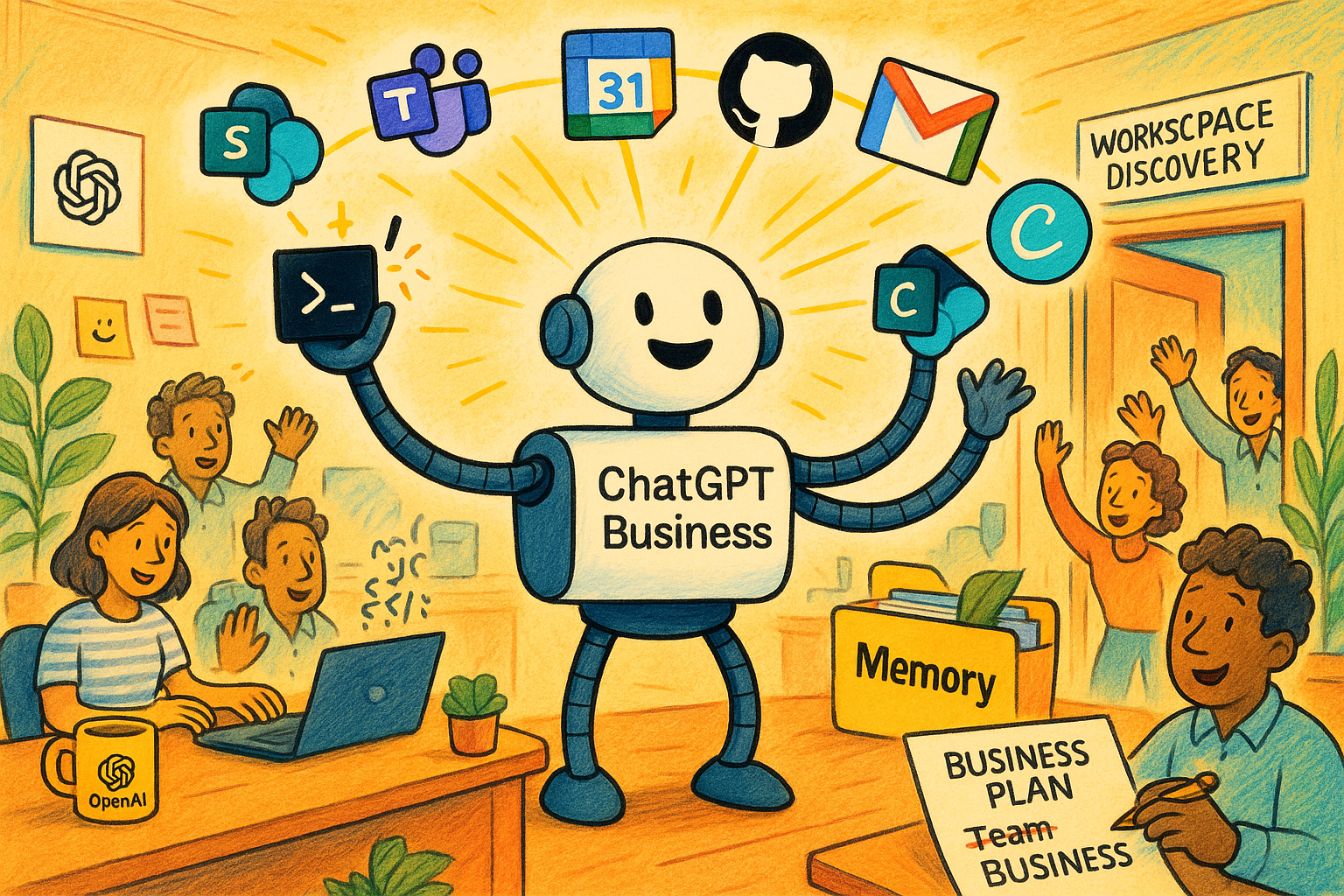
OpenAI announced several updates for ChatGPT Business, including general availability of Connectors, a new project-only memory mode, default-on workspace discovery for verified domains, inclusion of Codex at no extra cost, and a plan rename from “ChatGPT Team” to “ChatGPT Business.” The changes are designed to improve collaboration while strengthening admin control. Full release notes are available here.

Connectors move to GA: Integrations with the tools teams already use
Connectors are now generally available on ChatGPT Business, enabling secure integrations with common productivity and collaboration platforms like GitHub, Google Calendar, Gmail, Google Contacts, Microsoft Teams, Outlook, Microsoft SharePoint, Canva, and Notion. Connectors bring files, messages, and context into ChatGPT so teams can get faster, more complete answers without constant app switching. See the product overview here.
What’s new from a product standpoint: Connectors are part of the standard Business offering, with organizational controls determining which apps employees can connect. OpenAI says ChatGPT only accesses information the authenticated user is permitted to see in the linked tool. For Business plans, business data is excluded from training by default.
At a glance: Connectors become a first-class feature for ChatGPT Business, linking daily tools – email, calendars, chat, files, code repos – so the model can answer with current, organization-aware context.
Project-only memory: Scoped context for sensitive or ongoing work
Project-only memory confines ChatGPT’s memory to a single project. In this mode, the model will not use details from other chats or projects, and it will not carry information out of the current project. This supports teams that need continuity within an engagement – like weekly reporting cycles or stealth initiatives – while avoiding cross-project context bleed.
Operational intent: If memory is enabled at the workspace level, saved memories may be used by default to improve responses; project-only memory narrows that behavior to a designated scope. This helps preserve continuity while respecting compartmentalization requirements for agencies, internal R&D, or regulated workflows.
Workspace discovery: Default-on discoverability for verified domains
Starting next week, workspace discovery will be enabled by default for ChatGPT Business. Employees with email addresses at a verified company domain can find their organization’s workspace and request to join, reducing onboarding friction. Domain verification and identity controls are in the Identity & Provisioning area. Background on identity and provisioning is in the help center here.
Why it matters: Discovery by domain streamlines how employees find the correct workspace as organizations scale, merge, or reorganize. Admins retain controls for reviewing join requests and can enable automatic joining after verification.
Codex included with ChatGPT Business: IDE extension, GitHub reviews, and a revamped CLI
OpenAI is including Codex with ChatGPT Business at no additional license cost, bringing software development assistance into the core subscription. Highlights include a native IDE extension for in-editor collaboration, movement between cloud and local environments, GitHub code reviews, and a reworked command-line interface. Optional credits to increase access to local tasks are slated to become available on September 4. Details for getting started with the CLI and sign-in flow are outlined here.
Positioning for cross-functional teams: Bundling Codex targets hybrid teams where editors, designers, analysts, and engineers collaborate on content automation, web experiences, data visualization, and plug-ins. The addition removes separate licensing as a friction point and centralizes administrative oversight for AI-assisted coding tasks.
Plan rename: “ChatGPT Team” becomes “ChatGPT Business”
OpenAI is renaming its “ChatGPT Team” plan to “ChatGPT Business.” This is a label update only: pricing, features, limits, and terms remain unchanged. Expect the new name in-product, on invoices and receipts, and in OpenAI emails. A dedicated FAQ is available here.
Key takeaway: The plan name shifts to reflect how organizations use ChatGPT today, but entitlements and economics do not change with this update.
Security and admin controls: What OpenAI is emphasizing
The theme across these updates is speed plus governance. Connectors reduce tool switching and bring richer context into chats; project-only memory narrows the blast radius of sensitive details; discovery improves findability at enterprise scale without relinquishing admin sign-off; and Codex consolidates developer tooling under the same administrative umbrella as the chat experience.
OpenAI’s documentation reiterates its enterprise stance: for Business plans, data is not used for training by default, and integrations respect the permissions of connected accounts. Connectors are managed at the workspace level, and identity settings allow domain verification, request reviews, and optional automatic joining.
Update cadence and availability
Connectors are generally available for ChatGPT Business. Project-only memory is available as a mode within ChatGPT projects. Workspace discovery defaults to on beginning next week for verified domains, with administrative controls in Identity & Provisioning. Codex is included with ChatGPT Business immediately, with optional credits for local tasks becoming available on September 4. The plan rename is propagating now across product surfaces and billing artifacts, with no contractual changes reported.