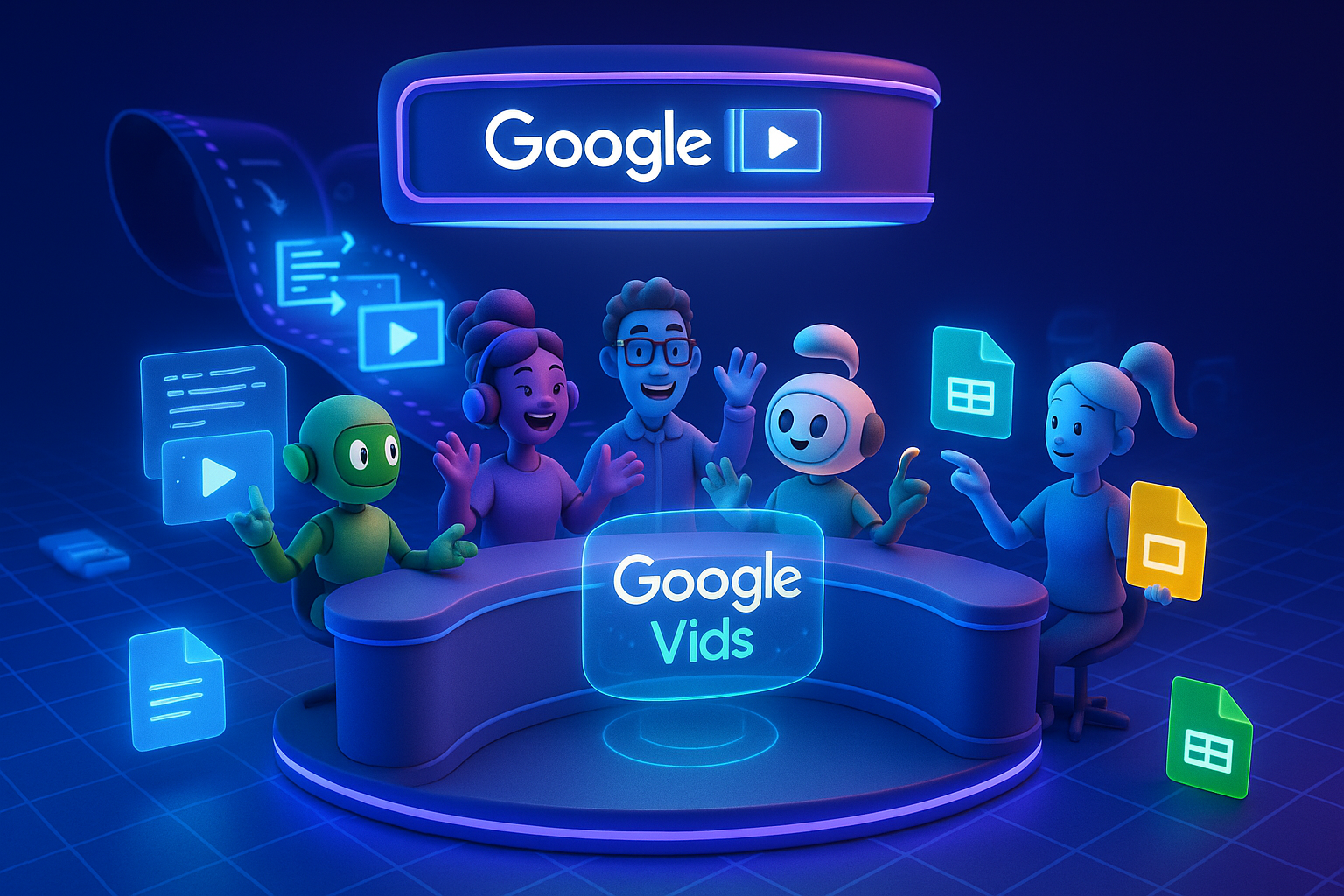
Google is introducing AI-powered avatars directly inside Google Vids, expanding its workplace video creation tool with a script-to-video capability aimed at routine business communications. The update, announced today, brings presenter-style delivery to training, onboarding, product demos, and internal updates without requiring on-camera talent inside the Google Workspace environment. Official announcement.
The update positions Google Vids as a lightweight, script-first video studio for organizations that need fast, consistent, and repeatable presentations at scale.
What Google Announced
With the new release, users draft or paste a script in Google Vids and assign it to a selection of preset AI avatars. Those avatars then deliver the content as a finished clip. Early details emphasize speed and consistency for common business scenarios such as policy explainers, compliance updates, support walk-throughs, and other operational videos that benefit from a uniform, on-brand look and voice.
According to Google’s update, the feature is rolling out to select Workspace customers and subscribers of the company’s paid AI tiers. It is embedded in the Vids interface with no extra installs or external editors, bringing the creation, review, and distribution steps into the same Workspace context as Docs, Slides, and Sheets.
At-a-Glance: Features and Limits
| Capability | Detail |
|---|---|
| Script-to-Avatar Video | Users map written scripts to AI avatars that deliver content in a finished clip. |
| Avatar Options | Preset selection of avatars with distinct looks and voices designed for business-use consistency. |
| Generation Limits | Initial caps include a weekly quota and short clip duration. Limits may evolve as rollout continues. |
| Workspace Integration | Natively available in Google Vids. Collaboration, review, and sharing remain within Workspace. |
| No On-Camera Requirement | Removes the need for presenters, studio setups, and live recording sessions. |
Note: Google indicates usage limits at launch such as per-week generation caps and short maximum clip lengths to maintain reliability and performance during rollout.
Availability, Editions, and Rollout
The AI avatar capability targets organizations on Google Workspace business and enterprise editions, in addition to users subscribed to Google’s AI Pro and Ultra plans. Google is positioning the feature for high-frequency, operational video use where quick turnaround and consistency matter more than bespoke, cinematic production. The company says availability will expand as the rollout progresses.
| Audience | Status | Notes |
|---|---|---|
| Google Workspace Business & Enterprise | Rolling out | Embedded in Vids. Admin and regional availability may affect timing. |
| Google AI Pro & Ultra Subscribers | Supported | Access tied to paid AI tiers for advanced generative features. |
| General Consumers | Evolving | Google is also expanding Vids availability beyond enterprises, with consumer access highlighted alongside the avatars update. Coverage. |
Why This Marks a Shift in Workplace Video
Corporate video has traditionally been constrained by scheduling presenters, booking rooms, and coordinating production. Google’s built-in avatars compress that workflow into a drafting and review cycle, removing hardware, talent, and many post-production variables. For teams already operating in Workspace, it unifies scripts, approvals, and distribution in one environment and reduces handoffs to third-party tools.
The approach aligns with Google’s broader pattern of infusing generative AI into everyday productivity tasks. Earlier this year, Vids expanded its AI voiceover options to increase expressiveness and fit a wider range of business tones, laying groundwork for today’s on-screen avatar expansion. Background.
What Else Is New Around Vids
In parallel with avatars, Google is highlighting adjacent capabilities oriented around tightening the production loop. Reporting points to automatic transcript cleanup that removes filler words and pauses and image-to-video generation options, backed by advances in Google’s video generation models. While the avatar feature targets business-grade standardization, these additions push Vids toward a broader, multimodal editor for script-guided output. More details.
For high-volume, pragmatic video tasks such as policy rollouts, training refreshers, and product updates, the balance in Vids now favors speed-to-message and uniformity over bespoke production.
Signals From the Market
The move lands amid an industry-wide push to automate repetitive video production. Analysts and reporters underscore the upside such as faster content cycles and lower costs while also noting concerns about the overall quality and authenticity of AI-generated output. The addition of avatars in Vids is framed as practical, not cinematic. It is a mechanism to make routine communications clear, consistent, and frequent, rather than a replacement for high-concept brand creative. Context.
Implications for Teams
For operations, enablement, and internal comms, the practical implications are straightforward:
- Repeatability: Standardized avatar delivery supports consistent messaging across regions, teams, and updates.
- Scalability: Script-driven generation scales routine explainer content without presenter bottlenecks.
- Faster revision cycles: Updates to policies or products can be reflected quickly by revising scripts and regenerating clips.
As the feature scales, administrators will likely focus on governance, naming conventions, brand approvals, and review workflows to maintain clarity and compliance across high-volume output. Google positions Vids as an environment where security, collaboration, and content lifecycle remain confined to Workspace boundaries, aligning with existing enterprise controls.
Constraints and Early Boundaries
Google is setting conservative generation constraints during rollout, including short durations and weekly caps, prioritizing reliability and predictable performance. The company notes that these limits are subject to change. This mirrors wider Workspace AI launches, where access and limits expand as infrastructure and usage patterns stabilize.
| Early Boundaries | Rationale |
|---|---|
| Short clip lengths | Optimizes for concise training modules, policy notes, and announcements. |
| Weekly generation caps | Staged rollout for service stability, with headroom to adjust over time. |
| Preset avatar catalog | Consistency for business communications and reduced variability and review overhead. |
The Bottom Line
Google’s AI avatars for Vids move script-led workplace video into a faster, more standardized lane. By integrating presentation delivery within the same surface where teams write, review, and share, the update lowers friction and broadens participation, especially for distributed organizations and privacy-conscious roles. As features across Vids continue to expand, from voiceovers to transcript cleanup and multimodal generation, the tool is consolidating into a focused, operational video desk for Workspace customers.
For organizations prioritizing clear, consistent messaging at scale, the update offers a practical path to increase output while keeping production in-house and within the familiar processes that already govern their documents, decks, and sheets.