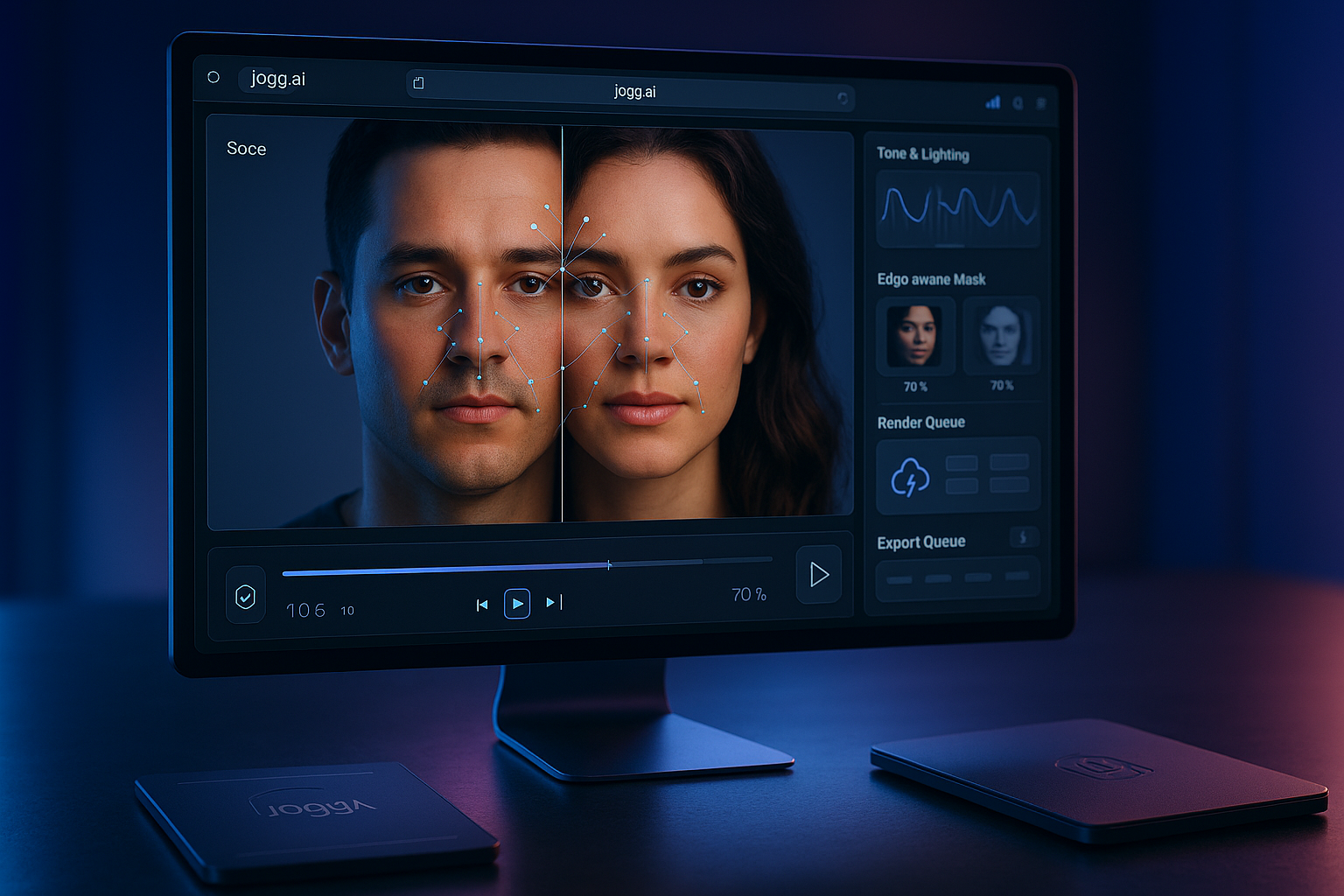
JoggAI has added a new capability to its web-based AI media platform: AI Face Swap. Positioned for fast, realistic compositing, the release extends JoggAI’s focus on avatar-driven content and visual storytelling, bringing automated landmark detection, pose alignment, and lighting-aware blending into a streamlined, browser-first workflow.
What the launch signals
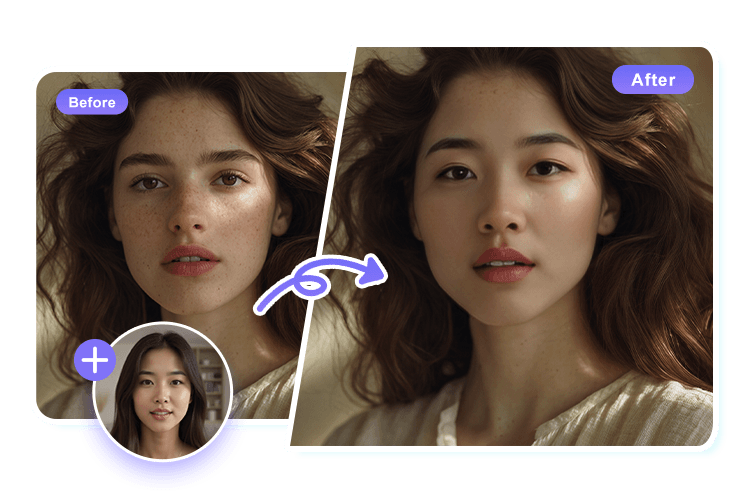
This release underscores a broader trend in creator tools: precision visual edits delivered by accessible, browser-native AI. JoggAI’s new Face Swap module is built to match skin tones, expressions, and head pose while minimizing mismatched edges and color seams. The emphasis is on output that reads as organic, with light-aware blending to reduce telltale artifacts often associated with older-generation face swaps.
Key takeaway: JoggAI is pushing toward end-to-end, studio-style capabilities that are accessible to non-specialists, while placing responsible use and consent at the center of its positioning.
How it fits inside JoggAI’s ecosystem
Face Swap arrives within a platform already oriented around AI avatars, talking photos, and automated video generation. The company’s recent cadence suggests a roadmap designed to tighten the feedback loop between visual realism and speed-to-output. In practical terms, that means creators working inside JoggAI can keep work-in-progress entirely in one environment, moving from asset prep to composited reveals, without relying on external desktop pipelines or plug-ins.
JoggAI frames Face Swap as a creative feature that complements its avatar and photo animation stack. The company’s post introducing the capability uses popular culture scenarios as shorthand for what the model can handle and the fidelity it targets, situating the feature in familiar reference points for short-form and social content producers. More information is available via the company’s announcement post: JoggAI AI Face Swap.
Feature snapshot
| Aspect | What’s notable |
|---|---|
| Modality | Web-based, no local installs; designed for rapid, iterative outputs |
| Core mechanics | Facial landmark detection, pose/expression alignment, tone and lighting matching, edge-aware blending |
| Intended use cases | Creator marketing, character concepts, playful identity remixes, and promotional visuals |
| Output focus | Realistic composites intended to minimize visible artifacts in everyday scenarios |
| Guardrails | Consent-focused guidance; avoidance of deceptive or harmful depictions |
Availability and plans
Face Swap is part of JoggAI’s broader toolset, which is distributed across tiers ranging from a free entry point to paid plans targeting creators, teams, and enterprise deployments. While plan details evolve, the company characterizes access as part of its AI tools library, with differences in output limits, watermarking, processing speeds, and collaboration features across tiers. Plan specifics are outlined on the official pricing page: JoggAI Pricing.
| Plan | Focus | Typical inclusions |
|---|---|---|
| Free | Exploration | Limited generations, watermark, standard processing |
| Starter / Creator | Individual production | Expanded generations, watermark removal on paid tiers, faster processing |
| Team | Collaborative workflows | Multi-user workspaces, roles/permissions, brand coordination |
| Enterprise | Custom integrations | Tailored capacities, account management, extended features |
Responsible use, consent, and policy context
Alongside the creative promise, JoggAI’s documentation points to consent and rights management as baseline expectations for the feature. The company requires an explicit consent process for custom avatars, including a short confirmation video from the individual whose likeness is being modeled. That consent framework complements platform-wide guidance around respectful, lawful use of identity-based AI tools. Details on consent for custom avatars are available here: JoggAI Knowledge Base: Custom Avatar.
JoggAI’s Terms of Use outline ownership and licensing boundaries related to user-provided content and generated media. In broad strokes, users retain rights to their inputs and outputs while granting the service the necessary, limited licenses to operate and improve the platform. The policy also makes clear that users are responsible for ensuring that their content does not infringe on third-party rights or applicable laws. The latest terms can be reviewed at: JoggAI Terms of Use.
Industry context: As face-swapping tools become widespread, consent, attribution where appropriate, and transparent labeling of synthetic content remain central to how creators, platforms, and audiences build and maintain trust.
Performance envelope and fidelity
As with most identity compositing, performance is bounded by input quality. JoggAI indicates that lighting, angle, and visibility of facial features materially influence realism and the likelihood of misalignment. Non-photoreal content, such as stylized illustrations, heavy filters, or extreme occlusions, can introduce variance. These constraints mirror common limitations across the category and reflect the underlying dependency on reliable landmarks and consistent exposure.
The company also notes that extreme angles, low-resolution sources, and high-contrast lighting can increase the risk of artifacts. The direction of travel for tools like Face Swap is toward robustness across a wider array of inputs, but in the near term, the most reliable outputs are associated with well-exposed, clearly framed faces.
Part of a faster-moving avatar stack
The Face Swap release arrives amid other avatar-oriented updates from JoggAI, including improvements to speech synchronization for talking avatars. The platform’s Lip Sync 3.0 update emphasizes sharper articulation and stability, especially in profile and partial-profile views, reinforcing the overall goal of reducing the gap between synthetic and live-action delivery. More on that update can be found here: JoggAI Lip Sync 3.0.
Taken together, Face Swap and recent avatar upgrades suggest a platform strategy that blends identity control (whose face shows up on screen) with speech realism (how it looks and sounds when talking), giving creators a tighter loop between concept and publishable content within a single, integrated set of tools.
Where this leaves creators and teams
For social producers, brand marketers, and independent creators, the headline is straightforward: Face Swap adds a new degree of flexibility to identity-driven content without imposing a heavy technical burden. The point of differentiation is not only the realism of the swap but the speed and cohesion of the surrounding workflow, with asset preparation, compositing, and export housed within one environment and consistent policy guardrails.
For larger teams, the interest will often be operational as much as creative. Workspace features, permissioning controls, and the ability to standardize outputs across campaigns are increasingly important as short-form and language-localized content cycles accelerate. Face Swap slots into that picture as a targeted tool rather than the whole stack, another lever that teams can pull to shape narratives and characters while staying inside a policy-aware platform.
Bottom line
JoggAI’s AI Face Swap is a focused, production-minded addition to an expanding suite of creator tools. It pushes on realism while foregrounding responsible use, and it arrives alongside avatar improvements aimed at reducing friction from prompt to publish. As identity and expression continue to anchor short-form formats, features like this point to a near-term horizon in which high-quality visual transformation becomes a standard part of the everyday creative toolkit, without requiring a specialized post-production background.