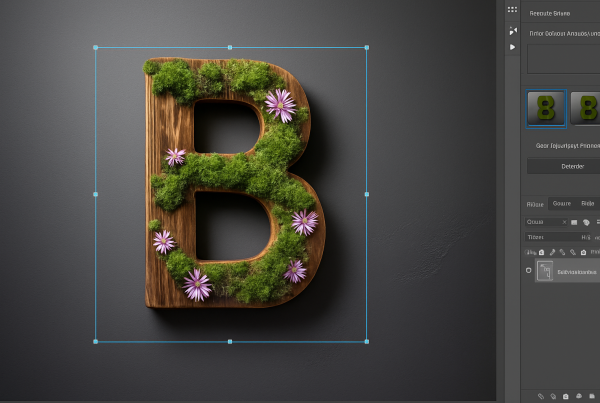
Unleash Your Inner Animator with Photoshop
Have you ever wanted to bring your static designs to life? Well, it’s time to unleash your inner animator with a simple yet effective technique in Photoshop! Today, we’re diving into the exciting world of frame animation in Photoshop. Whether you’re looking to jazz up your social media graphics, add flair to a presentation, or just have a bit of fun, frame animations could be the creative spark you’ve been searching for.
Getting Started: Setting Up Your Canvas
As every artist knows, greatness begins with the perfect canvas. Start by firing up Photoshop and creating a new document by pressing Ctrl + N on Windows or Cmd + N on a Mac. For this project, we recommend a canvas size of 1280 by 720 pixels, with a resolution of 150 pixels per inch. Remember, you are free to choose any size that suits your project—your creativity is your only limitation!
Text and Design: Choose Your Tools of Expression
Next up is selecting your weapon of choice, the Horizontal Type Tool. It’s font time! Opt for something dynamic and visually striking. We suggest a font like “False 3D,” which adds a bold, graphic element to your text. Adjust the size to 116 points and ensure the text is aligned to the center for maximum impact.
Mastering the Character Panel
Fonts looking a bit stiff? It’s time to work some magic with the Character panel. This is where you tweak line spacing and vertical positioning to create a more cohesive look. Slide that “Baseline Shift” to tease the exact look you’re aiming for—precision is key.
Rasterize and Revamp
To unleash the full potential of your text, you’ll need to rasterize it. By converting your text into pixels, you can paint outside the lines and personalize your design. Go to Layer > Rasterize > Type, and from there, let your Paint Bucket Tool go wild with color! Remember, creativity is messy, but that’s why the undo button exists.
Layering the Dimensions: Bringing Characters Into Focus
Here’s where things really start to take shape. We’re going to cut and copy each character into its own layer—essentially giving each letter its own spotlight. Use the Lasso Tool to nimbly outline each character and duplicate it onto a new layer using Ctrl + J (or Cmd + J if you’re sporting a Mac). Who knew Photoshop also taught delegation?
Creating the Frames: The Birth of Animation
Now that each character is independently free to boogie, it’s time to capture those moments. Hide your original text layer and create composite snapshots—aka frames. Using Ctrl + Shift + Alt + E (or Cmd + Shift + Opt + E), you’ll get a composite of your active layers. Name each frame sequentially: 1, 2, 3—you get the idea.
Motion on the Horizon: Making Characters Dance
Make sure Auto-Select is activated so each character can independently waltz across your canvas. Nudge them slightly for each frame, using your Move Tool to create the illusion of movement. It’s like choreography, only with less sweat involved.
Assembling the Animation: Photoshop’s Hidden Talent
With frames in hand, it’s time to construct the sequence that takes your static design into a world of motion. Depending on your version of Photoshop, you’ll either venture into “Animation” or “Timeline,” but the essence remains the same: transforming layers into moving images.
Creating Frame Animation
This is where the real alchemy happens. Click “Create Frame Animation” in your timeline and choose “Make Frames from Layers.” Like assembling images in a flip-book, you’re composing a narrative from separate snapshots.
Final Touches: Fine-Tuning Frame Durations
Select all frames and set a consistent duration, such as 0.1 seconds per frame, to ensure your animation flows smoothly. This uniformity helps keep your animation rhythm steady, though individual frame timing can be adjusted for varied effects.
To Infinity and Beyond: Looping the Animation
Once you’ve nailed the timings, choose “Forever” for the loop setting. Press play and watch your creation in action. You’re practically Disney at this point.
Transforming Your Animation into a GIF
Finally, transform this masterpiece into a shareable format. Opt for File > Save for Web, selecting GIF as your file format to maintain animation integrity. Choose a location to save it—desktop, obscure folder, the world’s your oyster! Name it something fittingly epic.
Now you’re equipped to venture into the world of frame animations, letting your designs transcend their static origins and enter the dynamic realm. As always, happy Photoshopping!